Rome 1st June 1878

ROME. ( FROM OUR OWN CORRESPONDENT )

Rome, May 25, 1878

The Vatican:  The Marquis de Gabriac, the new French  Ambassador, and the secretaries and officials of the French Embassy, were driven in three state carriages to the Vatican on the 20th of May. The Marquis was met at the entrance to the Pontifical apartments by two of the Camerieri di Spada e Cappa and conducted to the Sala degli Arazzi. The Pope, attended by his Court in full uniform, and preceded by his cross-bearer, entered the Throne-room about 11 a.m. The Swiss Guards and Pontifical Gendarmes, the Palatine Guard, and a detachment of the Noble Guards were present in the antechambers. Monsignor Martinucci, Prefect of Pontifical Ceremonies, conducted the Ambassador to the Throne-room, and the Acting Master of the Chamber, Mgr. Van der Branden, introduced him to his Holiness. The Ambassador presented his credentials and was cordially received by his Holiness. The Pope then signified his pleasure to make the audience private, and, all other persons withdrawing, he was left alone with the Ambassador. At the termination of this private interview, the secretary and gentle-men of the Embassy were presented to Leo XIII. The Ambassador subsequently paid a visit of ceremony to Cardinal Franchi, the Secretary of State.

On the same day, the 20th, about 300 persons, lay and ecclesiastical, were admitted to audience in the Consistorial Hall and in other apartments of the Vatican. Mgr. Kirby was honoured by a special audience on the 20th to present to his Holiness a richly bound copy of a dissertation, entitled De Rom. Pontificis jure Appellationes excipiendi,&c. This dissertation was written in the year 1835, when the Pious Society of the Priests of St. Paul offered a prize for the best essay on the subject of the right of the Supreme Pontiff to hear appeals from all the faithful without exception. Mgr. Kirby at that time was in holy orders and an alumnus of the Roman Seminary, the Apollinare, and Leo XIII. was then the Rev. Gioacchino Pecci. Both, as well as many other young priests, competed for the prize offered by the St. Paul’s Society. And the prize was won by Father Pecci. But the essay of Father Kirby was next in merit, and was honoured with a second prize, the censors describing it as powerfully written and replete with erudition. Leo XIII. a little time ago reminded Mgr. Kirby of their early days as fellow students, and of the concursus for the prize offered by the Society of St. Paul. The Pope suggested that Mgr. Kirby should print his essay, and gave permission that it should be dedicated to himself. The essay was accordingly searched for, and was printed at the Propaganda Press, and was then presented, as already related, to his Holiness.

On Thursday, the 23rd, the German pilgrims, over 150 in number, were received in audience in the hall of Consistory. The deputation included Count Felix Löe, President ; Counts Louis Arco, Preysing, Maximilian Löe, Korff-Schmising, Hahn, Hoensbroech ; Barons Ketteler, Beckendorff, Vequel, and Reichlin-Meldegg ; and Messrs. Eheberg, formerly Councillor of State, of Munich ; Dr. Lingens, Deputy to the Reichstag; Haas, Director of the Postzeitung of Augsburg ; Dr. Kalt, Mgr. Zehrt, and Mgr. Orsbach. The address, which was in Latin, was read by Count Felix Löe. The Pope replied in Latin, and said he was encouraged by these numerous and influential pilgrimages to hope for better times for the Church, against which and against its head a bitter war was now waged. He was convinced that the same proofs of devotion and loyalty which were so constantly rendered to Pius IX. would be also manifested towards himself. He, for his part, would never cease to return his most cordial love and affection to those who thus boldly laboured in behalf of the Catholic religion. He recommended them to persevere in their works of charity and faith, and especially to promote good education among Catholic children, to fit them for contending against the evils of the age. He prayed for the conversion and reformation of the foes of the Church. He then pronounced the solemn benediction.

At 6 p.m. on the 23rd, his Excellency Bedros Effendi Kujumgian had farewell audience of his Holiness, and left Rome the same evening.

The Earl of Denbigh and Mr. Kenyon had a private audience on Thursday, the 23rd, and in this interview, which lasted for forty minutes, Lord Denbigh presented his Holiness with a beautifully bound copy of the late Mr. Urquhart’s essay on the restoration of public law among nations. The late Mr. Urquhart was a Protestant, but considered the Pope to be the arbiter of all international disputes. Leo XIII. was much interested in this dissertation. Lord Denbigh, on this occasion, obtained a special blessing from the Pope for the members of the Catholic Union and of the Poor School Committee of England. Mr. Kenyon obtained a similar favour for the members of the League of St. Sebastian.

His Eminence Cardinal Cullen, who had spent a few days at Albano, returned to Rome on the 22nd of May, and on the 24th had a private audience with his Holiness, to whom he presented a richly-bound and beautifully illuminated address from the Convent of Loreto, near Dublin. This address was signed by Lady Power of Edermine and by Father Barron, S.J., the Spiritual Director of the Convent.

The German pilgrims:  Mass was celebrated on Sunday, May 19th, for  the German pilgrims in the church of Sta Maria dell’ Anima, by Archbishop de Neckere, and a sermon was preached by Canon Zehrt, of Paderborn. Cardinals Hohenlohe, De Luca, and Franzelin were present.

The Consecration of Cardinal Borromeo:  The archpriest of St. Peter’s, his Eminence Cardinal Borromeo, was consecrated to the archbishopric of Adana in partibus infidelium on Sunday, the 19th of May, in the Sistine chapel, by his Holiness Leo XIII., assisted by Archbishop Sanminiatelli, his private almoner, and Bishop Marinelli, the sacristan of the Vatican. The function began at 8:30a.m., and terminated a little before 11 a.m. Admission to the Sistine was by ticket of invitation. The Princess of Thurn and Taxis, with her children, were in the royal tribune, and the Ottoman Envoy, Bedros Effendi Kujumjian, and his son, Ohannes Bey, were in the seats set apart for diplomatists. Cardinals Sacconi, Randi, Chigi, and Franchi were present. The Earls of Denbigh and Gainsborough, Lady Edith Noel, Mr. Kenyon, Mr. Hartwell Grissell, and many of the English deputation were invited to the ceremony. After the functions were concluded the Holy Father proceeded to the private library, where tables were laid for refreshments for the distinguished visitors. At one of these tables his Holiness sat, having on one side Cardinal Borromeo, and on the other the Princess of Thurn and Taxis. At this table the other Cardinals who had attended the consecration were seated. Cardinal Borromeo wore on his breast a splendid pectoral cross of gold, adorned with rubies, diamonds, and emeralds, the gift of the Holy Father.

Sant’Agnese in Agone, Piazza Navona, Rome

Marriage of Prince Colonna:  On Monday, the Prince of Avella, Don Fabrizio Colonna, and Donna Olympia, sister of Prince Doria, were married in the church of St. Agnes in Piazza Navona, by his Eminence Cardinal di Pietro, Dean of the Sacred College and Camerlengo. Monsignor Cataldi officiated as Master of Ceremonies. Prince Alessandro Torlonia and the Duke of Marino acted as witnesses for the bridegroom, and Prince Marcantonio Borghese and Prince Don Alphonso Doria were the bride’s witnesses.

Among those present were Prince Giovanni Andrea Colonna, Prince Assistant at the Pontifical Throne, the father of the bridegroom ; Prince Orsini, Prince Assistant at the Throne ; Princess Orsini, Princess Borghese, Prince and Princess di Fondi, Princess Pallavicini, the Duchess of Marino, Duke and Duchess Sforza-Cesarini, Duke and Duchess of Ceri, the Marchesa Sacchetti, Duchess of Rignano, Count and Countess Somaglia, &c., &c. The bride and bridegroom drove to the church in the state carriages of their respective families, and after the solemnisation of the marriage went, according to custom, to the Basilica of St. Peter’s to venerate the tomb of the Prince of the Apostles. The newly-married pair went to the Villa Doria at Albano, and after a few days spent there, left for the Colonna Villa at Capodimonte.

San Clemente, Rome

San.Clemente: The following persons lately paid visits to the Church of S. Clemente and were conducted through the subterranean churches by the Very Rev. Father Joseph Mulloolly, the Prior :—Her Royal Highness the Duchess of Genoa, her Royal Highness the Princess of Thurn and Taxis, with her son Prince Max Albert and her daughter Princess Louise. The Earl of Portarlington, Sir Augustus Paget, and Count Corte, the Italian Foreign Minister, were among the recent visitors to this interesting church.

Spanish Pilgrims: A number of Catholic pilgrims from Spain arrived in Rome on the 22nd of May, and will be received in audience on Monday, the 27th.

The Late Count Oreste Macchi:  On the evening of the 20th of May the mortal remains of the late Count Oreste Macchi were deposited at Campo Verano, in the vault of the Venerable the Archconfraternity of the Most Precious Blood. The brethren of the Archconfraternity attended the funeral and carried the coffin on their shoulders, reciting psalms and prayers for the repose of the soul of the defunct. Mgr. Luigi Macchi, Maestro di Camera to Leo XIII., the son of the deceased Count, attended the funeral.

The New Bishop of Dunkeld: Dr. George Rigg, Bishop of Dunkeld, in Scotland, was consecrated on the 26th of May by his Eminence Cardinal Howard, in the Church of the Scotch College. The assisting prelates were Mgr. Walter Steins, S.J., Archbishop of Busra, in partibus infidelium, and Vicar-Apostolic of Western Bengal, and Mgr. Giovanni Jacovacci, Bishop of Eritrea,in partibus infidelium, and Secretary of the Sacred Congregation of Esame dei Vescovi. Mgr. Cataldi, Master of Pontifical Ceremonies, acted as Principal Master of Ceremonies, while Mgr. Luigi Sinistri, also a Master of Pontifical Ceremonies, acted as Master of Ceremonies for the Bishop-Elect. Among the persons present at the consecration were Mgr. Van der Branden, Private Chamberlain to his Holiness; Mgrs. Weld, Stonor, Milella, Kirby, domestic prelates to Leo XIII. ; the Father-General of the Redemptorists, with Fathers Douglas and Morgan ; the General of the Dominicans and Father Mullooly, Prior of S. Clemente ; Very Rev. Dr. James Maher ; Very Rev. John Egan, Vice-Rector of the Irish College; the Rev. Dr. O’Callaghan, Rector of the English College • Very Rev. Dr. O’Bryen ; Canon Walsh.; U.S. ; the Very Rev. Dr. Hostlot, Rector of the North American College ; Father Costello ; Mrs. Savile Foljambe, Mrs. Kinloch Grant, the Misses Sperling, Miss Isabel Fane, Miss Senior, Mrs. Vansittart, the Misses Gorman, Mr. and Mrs. Handley, Mrs. Hall, the Misses Steele, Mrs.Martin, Miss Whelan, Mr. William Palmer, Messrs.English and Youngman, Commendatore Winchester, Mr.Douglas Hope, Mr. Hartwell Grissell, Mr. Bliss, Mr. Justice O’Byrne, the Very Rev. Father Keogh, Prior of Sta. Maria in Posterula ; Mrs. Posi, Miss Lewis, &c. After the ceremony the Cardinal and the invited guests were conducted to an apartment in the College, where refreshments were served. Cardinal Howard entertained subsequently to dinner, at his palace, the new Bishop, the assisting prelates, and Cardinals Franchi and Bartolini.

Feast of S. Giro in Portici:  The Italian Government has not yet forbidden processions through the streets (at least in Southern Italy) as the Government has done in France, where in Marseilles the Archbishop has been unable to procure permission for the time-honoured processions, though he made a journey to Paris with that intent. In Southern Italy all the rejoicings of the lower classes are so interwoven with religion that a procession of the effigy of the patron saint, accompanied by his relics, forms, as a matter of course, the opening of the Festa ; and even in Naples itself the procession of S. Gennaro retains all its ancient splendour. At Portici, which lies at the very foot of Vesuvius, S. Giro is the patron. He was a native of Alexandria, a doctor by profession, who became a hermit, and was martyred in A.D. 288, in a city called Canopo. After the conversion of the Emperor Constantine his relics were brought to his native city, and were placed in the church of St. Mark. In the time of Pope Celestine I., by order of the Emperor Theodosius, they were brought to Rome, and were venerated in the Church of Santa Prassede. Many centuries elapsed, and the relics, which had attracted but little attention, became an object of special devotion to a great saint, S. Francesco Girolamo, who was inspired by Divine Providence with an extraordinary devotion to S. Giro. At the death of this saint, which occurred in 1716, this devotion bore fruit, and the relics he had procured for Portici were held in high esteem. In 1763, a famine occurred, when Ferdinand IV. was Regent. In the following year food was so dear that the state of suffering became very great, and a plague followed the famine. Then the inhabitants invoked the intercession of S. Giro, doctor of the body as well as of the soul, and innumerable cures were wrought. In 1770, mindful of these favours, a famous artist, Ferdinando Sperandeo, was charged with the task of making a noble statue of S. Giro, and there is a beautiful legend that, while he was thinking how he could best fashion the countenance, the Saint himself appeared to him, and that celestial vision enabled him to produce the statue which was carried in procession last Sunday. It is of beaten silver, and exceeds life-size. The hands, feet, and face, are enamelled in natural colours. The face is truly noble, ascetic, and benign, and the attitude is dignified. In his left hand he holds a crucifix, to which he points with his right. The cranium of the Saint is in an antique reliquary fixed to the pedestal. Here and there along the line of the procession a carpet of flowers had been made with much taste and skill. The procession opened with the band of the town in bright unforms. Then followed the Confraternity called by the Saint’s name, in habits of white merino, with red silk capes, and here and there were carried handsome gold embroidered banners. Next came the Guild of the Immaculate Conception, similarly costumed, only that the capes were blue silk, and all wore large silver badges. The music of the township of St. George (the men dressed in very handsome uniforms and plumes) and that of S. Giovanni Teduccio enlivened the scene. Four thuribles, with incense, were waved before the statue, which was carried under a white and gold satin canopy. As this went past, immense quantities of rose leaves were thrown from the windows of the houses. Crowds of poor people followed, who were reciting a Litany in the Saint’s honour in thanksgiving for favours received through his intercession. In the church of S. Giro is a votive altar of very costly marble, erected in 1778, with an inscription formally declaring him the patron of the town. The devout crowd, the music, flowers, and gay procession, all bathed in a southern sunshine, made a very striking and edifying scene.

The above text was found on p.15, 1st June 1878, in “The Tablet: The International Catholic News Weekly.” Reproduced with kind permission of the Publisher. The Tablet can be found at http://www.thetablet.co.uk .

The Founding of Westminster Cathedral, 1883.

Westminster cathedral

This is included for a few reasons, but two of them are family related. Herman Lescher, the auditor of the Westminster Land Company is a 1st cousin, four times removed, as is his brother Frank. Frank Harwood Lescher’s wife Mary is also a 1st cousin, in her case three times removed. It’s also here because Alfred Purssell was a founder-donor to the cathedral with his name in the loggia, if I remember rightly.


The Westminster Land Company and The New Cathedral 1883.

We have already given our readers full information on the formation of the new company, as far as it concerned the site for the new cathedral of this diocese. Some incomplete particulars, however, having found their way into a bi-weekly paper, we feel it necessary to give the facts in greater detail :— It will be remembered that we stated that the law binds the Home Office to re-convey the site of Tothill-fields Prison to the Middlesex magistrates. This formal re-conveyance, we understand, has to be made some time within six months, and will therefore in all probability be effected shortly after Christmas. In the meantime the land was purchased from the magistrates by the Earl of Denbigh, Lord Beaumont, Sir Charles Clifford, and the Count de Torre Diaz. These four gentlemen have entered into contract with the Westminster Land Company, which is now duly formed, registered, and in working order.

The Memorandum of Association, which had to be filed at Somerset House on registration, bears the following signatures :—The Earl of Denbigh, Hon. Henry Wm. Petre, Francis Charles New, Sir Charles Clifford, Count de Torre Diaz, Herman Lescher, Alfred Blount.

The new company has now, by a draft Agreement between them and the four purchasers, taken over from the latter the prison site and the land in possession of the Cardinal Archbishop of Westminster. In this draft Agreement, to the signatures of the four purchasers are added the names of eight of the original founders or guarantors of the deposit, the remaining two being among the purchasers. These signatories are :—

  • The Earl of Denbigh.
  • Lord Beaumont.
  • Sir Charles Clifford.
  • Count de Torre Diaz.
  • Edward Devenish Walshe, Esq.
  • The Cardinal Archbishop of Westminster.
  • Lord Clifford of Chudleigh.
  • Lord Arundell of Wardour.
  • Thomas Weld Blundell, Esq., of Ince Blundell.
  • Walter Hussey Walsh, Esq.
  • Herman Lescher, Esq.
  • Alfred Blount, Esq.

The Westminster Land Company are, therefore, in equitable possession of the land of which the Middlesex magistrates have the power to dispose, and by their agreement with the purchasers and founders take over all the liabilities. The Company’s agreement with the Cardinal Archbishop of Westminster, whereby they take over the adjoining portion of land in his possession in exchange for a part of the prison site on the payment of the difference in money value, is in course of preparation for signature. The Company’s registered capital is £130,000, in 15,000 shares of £ 10 each. The Board of Directors and the officers of the Company have been constituted as follows :—

  • Earl of Denbigh.
  • Lord Beaumont.
  • Lord Clifford of Chudleigh.
  • Sir Charles Clifford
  • Directors
  • Hon. Henry William Petre.
  • Edward Frederick Devenish Walshe, Esq.
  • Walter Hussey Walsh, Esq.

Solicitors—Messrs. Blount, Lynch, and Petre, 4, King-street, Cheapside, E.C.

Auditor—Herman Lescher, Esq., T, Princes-street, Bank, E.C.

Surveyors—Messrs. Vigers and Co., 4, Frederick’s-place, Old Jewry, E.C.

Secretary—Francis Charles New, Esq.

Offices—T. Princes-street, Bank, E.C.

The above text was found on p.8, 6th October 1883 in “The Tablet: The International Catholic News Weekly.” Reproduced with kind permission of the Publisher” The Tablet can be found at http://www.thetablet.co.uk .

Sarah Bernhardt. Requiem at Westminster Cathedral April 1923


I like this one, it’s got a great, great grandfather , and a first cousin four times removed (by marriage) in it, and an A-list cast of luvvies.

Sarah Bernhardt c.1878

A Requiem Mass for Madame Sarah Bernhardt, the famous French tragedienne, was celebrated on Tuesday, at Westminster Cathedral, in the presence of a congregation that filled the building to the doors. The occasion was organized as a London tribute to the memory of the dead actress, and brought to the Cathedral a very representative gathering. Although the Mass did not begin until half-past eleven, many who wished to be present were in their seats as early as nine o’clock, whilst a large number of those who came later to assist at the ordinary half-past ten Mass remained for the Requiem an hour later. In the absence of the Cardinal Archbishop, who was presiding at the Bishop’s Low Week meeting, the Bishop of Cambysopolis presided. The King was represented by the Hon. Henry Stonor and Queen Alexandra by Major Edward Seymour, whilst Colonel Waterhouse was present as representing the Prime Minister.

Westminster Cathedral

The Royal representatives and the Lord Mayor and Sheriffs, who attended in state, were received at the entrance to the Cathedral by the Administrator, Mgr. Howlett, and conducted to specially reserved places.. The French Ambassador was not able to attend personally, but was represented by his wife, the Comtesse de St. Aulaire, who was accompanied by a number of members of the staff of the Embassy. The Belgian Ambassador ; the Polish Minister ; the French Military Attaché ; Sir Edward Elgar ; Mr. T. P. O’Connor, M.P.; the Hon. Maurice Baring; Madame Verneuil and Madame Gross (grand-daughter of Sarah Bernhardt) ; Sir Charles Russell ; Col. Sir Roper Parkington, and Sir Aston Webb (representing the Royal Academy) were also present. Sir Gerald Du Maurier and Sir George Arthur officiated as stewards.

Ellen Terry as Lady Macbeth by John Singer Sargent -1889

Among the many notable members of the theatrical and musical professions who attended the Requiem were Madame Albani, Lady Tree, Miss Ellen Terry, Mrs. Kendal, Sir Charles and Lady Hawtrey, Miss Viola Tree, Dame Clara Butt, Dame Nellie Melba, Miss Marie Lahr, Sir Charles and Lady Hawtrey, Mr. Allan Aynesworth, and Mr. George Grossmith.

The Mass was sung unaccompanied to a setting by Palestrina, and the ” Dead March “ was played as the congregation left the building.

The above text was found on p.28,14th April 1923 in “The Tablet: The International Catholic News Weekly.” Reproduced with kind permission of the Publisher. The Tablet can be found at http://www.thetablet.co.uk .

Obituaries of two grandsons: Leonard J. Bidwell ,1916, and Wilfrid Cary-Elwes, 1917

Two Roper-Parkington grandsons died during the First War. Leonard’s  was an accident caused by a soldier’s rucksack leant against a train door, which managed to turn the door-handle so when he leant against it, the door opened and he fell from the moving train. Wilfrid died at the Battle of Bourlon Wood in France on the 27th of November 1917, thirty-four days after arriving in France. He has no known grave.

MIDSHIPMAN LEONARD JOHN BIDWELL, R.N.

Midshipman Leonard Bidwell, whose death is announced, was accidentally killed on the 17th instant. He was the eldest son of Mrs. Bidwell, of 15, Upper Wimpole Street, and the late Leonard A. Bidwell, F.R.C.S., and grandson of Sir J. Roper Parkington. Mr. Bidwell was born in August, 1897, joined the Royal Naval College, Osborne, at the Easter term, 1910, and at the outbreak of war was in H.M.S. ” Cumberland ” and saw service in the Cameroons where he was severely wounded. At the time of his death he had not completely recovered, but was employed on special service by the Admiralty. A Requiem Mass was said at St. James’s, Spanish Place, and the burial took place at St. Mary’s Cemetery, Kensal Green. Amongst those present at the funeral service were :—Mrs. Bidwell (mother), the Misses Bidwell (sisters), Master T Bidwell (brother), Fleet Surgeon L. Bidwell, R.N , Miss Edith and Miss Agnes Bidwell, Mr. E. W. Farnall, C.B., Mrs. Farnall, Sir J. Roper Parkington, Mr. and Mrs. Charles Cary-Elwes, Mr. Wilfrid & Miss Lilian Cary-Elwes, Mrs. Sherston Baker, Monsignor Bidwell, Mr. Harry Lawrence. Amongst the naval officers present was Captain Fuller, C.M.G., who was in command of H.M.S. “Cumberland ” during operations in the Cameroons. The Admiralty provided a firing party at the grave, the coffin being carried by men of the R.N.V.R.—R.I.P.

The above text was found on p.24, 29th July 1916  in “The Tablet: The International Catholic News Weekly.” Reproduced with kind permission of the Publisher. The Tablet can be found at http://www.thetablet.co.uk .

Wilfrid Gervase Cary-Elwes,

Second-Lieut. Wilfrid Gervase Cary-Elwes, Irish Guards, officially reported ” missing, believed killed,” but of whose survival no hopes are entertained, was the eldest son of Mr. Charles Cary-Elwes, of Courtlands, Eltham, Kent, and grandson of Sir J. Roper Parkington. Born nineteen years ago, he was educated at Downside, where he was distinguished as an athlete. On receiving a nomination in the Irish Guards, he went to Sandhurst in 1916, and was gazetted in the August of that year. He was anxious to go to the front, and made repeated efforts to be sent there, but only received marching orders on the eve of his nineteenth birthday. He left for the front on October 25, and fell on November 27.

The above text was found on p.28,15th December 1917,  in “The Tablet: The International Catholic News Weekly.” Reproduced with kind permission of the Publisher. The Tablet can be found at http://www.thetablet.co.uk .

150 years ago today, a Papal army marched into Rome

The Battle of Mentana was fought on November 3, 1867 near the village of Mentana, just outside Rome, [about three miles]   between French-Papal troops and the Italian volunteers led by Giuseppe Garibaldi, who were attempting to capture Rome, which was not unified to Kingdom of Italy until three years later. It was the last battle the Popes won.

The entry of the Pontifical troops into Rome, after their victory at Mentana 1867.

— We have received the following from our Roman Correspondent, under date of Rome, November 15.—

The entry of the Pontifical troops after their victory at Mentana took place last Wednesday. [13th November] Nothing could be more imposing than the spectacle, and it offered the most convincing proof possible that the Roman population considered the triumph of the army as their own, and was resolved to show their feeling on the matter. The Porta Pia was the gate by which the troops were to arrive, and long before the hour fixed every window was filled, every balcony draped, and stores of autumn flowers laid up, to shower on the victorious troops.

Porta Pia, Rome.

They entered with banners displayed, trumpets sounding and the Commander-in-Chief, General Kanzler, who had gone outside the gate to meet them, at their head. His Excellency was accompanied by the French General de Failly, and on reaching the Piazza Pia they drew up, surrounded by their respective staffs, and the long line of troops defiled before them. The Zouaves came first and were cheered again and again by the crowd. The great Roman families joined heartily in the demonstration, and the French General appeared as much excited as any one, and repeatedly turned to General Kanzler and pressed his hand, as company after company of the flower of the French Catholic youth passed, victorious, before them. The Legion, too, were admirably received, and so were the gallant Swiss Chasseurs, whose conduct at Mentana under Colonel Jeannerot and Major Castella was beyond praise.

Madame Kanzler’s carriage driving up at the same moment, her Excellency was received with a very warm demonstration, and no wonder, for, from the first arrival of the wounded of Bagnorea and Monte Libretti, she has consecrated herself with unwearied energy to the care of the hospitals, and has devoted her entire time to the consolation and nursing of our brave soldiers. A Roman by birth, her danger, in case of a reverse, would, from the courageous and active part she has taken in the cause, and from her husband’s position, have been greater than that of any other person, but this consideration, fully weighed and met, has never deterred her from her noble task.

It is one of the most curious signs of the present time the military enthusiasm which has seized on the Roman people and the pride it feels in its army. The lists of subscriptions for the wounded, for the soldiers and their families, are rapidly filling, each offering being in the Italian fashion generally accompanied by a sentence in praise of the Pontifical troops.

It is only now we are beginning to realise what we have escaped from. The recent perquisitions made have brought to light some terrible revelations of the intentions of the sect. Five hours’ pillage was to have been allowed by the Garibaldian army. The churches and convents were to have been sacked, the priests massacred, the nuns insulted. Hundreds of barrels loaded with shot were found ; and ” pour comble ” [to cap it all]  a well made guillotine, with axe, rollers, pulley, and all, “en regle”, [ready for use]  was among the moral forces discovered in the search for arms.

Five cases of guns addressed to Mr. Odo Russell [ From 1858 until August 1870,  the real, though unofficial, representative of Britain at the Vatican. He was the nephew of Lord John Russell, Prime Minister between 1846 – 1852, and again 1865 -1866 ] were recently seized by the police, a circumstance at least awkward for a diplomatic agent, and of which it is to be hoped some satisfactory explanation will be afforded.

It was arranged that on a certain day, the 30th of October or 1st of November, the column of Garibaldi, numbering 15,000, the column of Acerti, 15,000, the column of Pincigiacci, 15,000, were to concentrate their collective force of nearly 60,000 men on Rome from ten different points of Monte Rotondo, Viterbo, Velletri, and Froeinone. The Finanziere or custom-house officers of the Porta San Paolo had been bought over, and all was prepared for the supreme attack. Had not the French landed in time, it is difficult to realise what would have been the end. It was-resolved, in case of the worst, that all who wished to share the fate of the Holy Father and his defenders should cross the Tiber, and St.Spirito and the bridge of St. Angelo being blown up, the Leonine city was to have been defended to the very last, all being ready to have died on the very staircases of the Vatican, if need were,, round the throne of Pius IX. The fort could have held out eight days at least, and in that interval help might arrive from France. The army numbered 10,000, and was ready to fight à l’outrence under the conduct of its heroic and devoted general. Surrender under any circumstances was not spoken of. It was a word erased from the vocabulary while a single Garibaldian remained on the Pontifical territory, and had the French delayed their arrival, Europe would have heard of a wholesale martyrdom, but not of a capitulation.

His Holiness celebrated Mass in the Sixtine Chapel on Friday, the 8th, for the repose of the souls of those who fell in battle since the beginning of the campaign. He was so deeply moved that he could scarcely continue the concluding prayers.

On Saturday, the 9th, we celebrated the obsequies of Julian Watts Russell at the English College. I can add nothing to the beautiful notice by Padre Cardella, his confessor, which I enclose, and which I feel sure you will give a place to in your columns. It was to all present a source of hope and trust for England, that she has given two glorious martyrs to the Temporal Power since the beginning of the present campaign, and the names of Alfred Collingridge and Julian Russell will never be forgotten by English Catholics, when they recall the memory of Monte Libretti and Mentana.

At the same hour as the requiem in the English College another on a far larger scale was performed at San Lorenzo, for the souls of MM. De Veaux and Deodat Dufournel. As your readers will remember, his younger brother, Emmanuel Dufournel, was killed in battle at Farnese. Deodat, who was attached to the staff of the Zouaves, was shot down at Villa Cecchina, while conducting a perquisition in one of the houses filled with Garibaldians, and died, after linger-ing a week, in the hospital of St. Spirito. He was universally beloved and deplored, and the entire corps of officers followed his remains and those of the gallant De Veaux to the grave.

The Zouaves, I am happy to say,are daily increasing, and the certainty which exists in the minds of all classes here that the meeting of the Chambers in Florence will hurry on the catastrophe in which the Pontifical army must again be called into action, is acting as a spur to the recruitment in every country and to the movement in favour of the increase and armament of the Pontifical forces. The third battalion of’ Zouaves will be formed to-day under the conduct of Captain D’Albions, one of the oldest and most experienced officers in the regiment, and who previously served in the French army. The recruits at the depot were 1,100 yesterday, and among them are the Baron De Farelle, the Comte De Montmorin, Mr. Vavasour, of Hazelwood, Mr. Hansom, M. Henri de Riancey (son of the Catholic journalist), and an immense number of young men belonging to the first French and Belgian families. It is considered impossible that the status quo can be maintained in Italy. It is most uncertain whether the French will remain – if they do it will only be to make an end of the Italian kingdom, whose state is a perpetual menace to the cause of order in Europe; and it is more than probable that in such a case the Pope’s troops would be called on to reoccupy Umbria and the Marches. At all events, the Papal army must be rendered sufficiently strong to occupy the territory of the Pope as it stands at present, and this cannot be done save by the united action of Catholics in every country.

The points most important are the enrolment of volunteers and the purchase of the very beat arms of precision. The Meyer rifle, with an improvement firing eighteen shots per minute, has been accepted, and the funds are now being raised as fast as possible in France and Belgium. “Bis dat qui cito dat “  [he gives twice, who gives promptly,] was never so completely exemplified as in the present case. We cannot wait for arms, for the attack will be renewed in the spring, and breechloaders are essential. Had the Pontifical army been armed with them at Mentana, not a Garibaldian could have escaped. The Chassepot, too, far from the best rifle invented, did wonders in the hands of the French reserve ; but the Zouaves had only the Minie of 1856 and the bayonet to rely on, and what they did with them proves what they would have done had they been properly armed.

I enclose General Kanzler’s official report of the battle, from which you will see what a decisive action Mentana was.

The police of Florence are, it appears, in jubilation since Mentana. There are neither thefts nor murders in the city, which has been emptied of its dangerous elements since the battle. The Pope, who received the French officers in audience on Wednesday, told them that Italy, of all countries, ought to be grateful to them for having rid her of a revolution more dangerous to her than to any other.

It is uncertain what dispositions will be taken in regard of the Garibaldian prisoners, and the opinion that the French Government will charge itself with their deportation to Cayenne is that most in favour. It would be the most prudent, as, in spite of the kindness with, which they have been treated, the antecedents and characters of the greatest proportion are such as to forbid any hope of honour or gratitude, and they would return to their life of pillage and rapine at the first opportunity.

The above text was found on p.1, 23rd November 1867 in “The Tablet: The International Catholic News Weekly.” Reproduced with kind permission of the Publisher. The Tablet can be found at http://www.thetablet.co.uk .

Rome, May, 1879

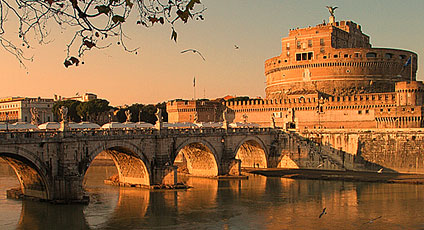
Castel Sant’ Angelo

(FROM OUR OWN CORRESPONDENT.)

Rome, May 10, 1879.

The Vatican:  On Monday, May 5, a large number of visitors, Roman and foreign, were received at the Vatican. On the evening of the 6th, private audience was given to Monsignor David, Bishop of Saint-Brieuc, who presented to the Holy Father a large sum of money as Peter’s Pence from his diocese. The Bishop of Saint-Brieuc had the honour of introducing to the Holy Father his Vicar-General, Father Juventon, and four other priests who accompanied him. On the 7th (Wednesday) the Pope gave permission to twenty-three young workmen from Paris to attend his private Mass, at 7 a.m., and to receive Holy Communion from the hands of his Holiness. After the Mass, Leo XIII. received in private audience these young men, who were introduced by Comte de Boursetty, and conversed with each of them for some time, inquiring the particulars concerning their mode of life, their respective .trades, their wages and hours of labour. He accompanied them through part of the Pontifical galleries, gave them permission to visit the Vatican gardens, and presented each of them with a valuable memorial of their visit. On the 11th there was another large reception of strangers. On the same day Cavaliere Enrico Angelini had private audience of his Holiness and presented to him a large offering of Peter’s Pence, in name of Monsignor Tommaso Baron, Bishop of Chilasca, in Mexico.

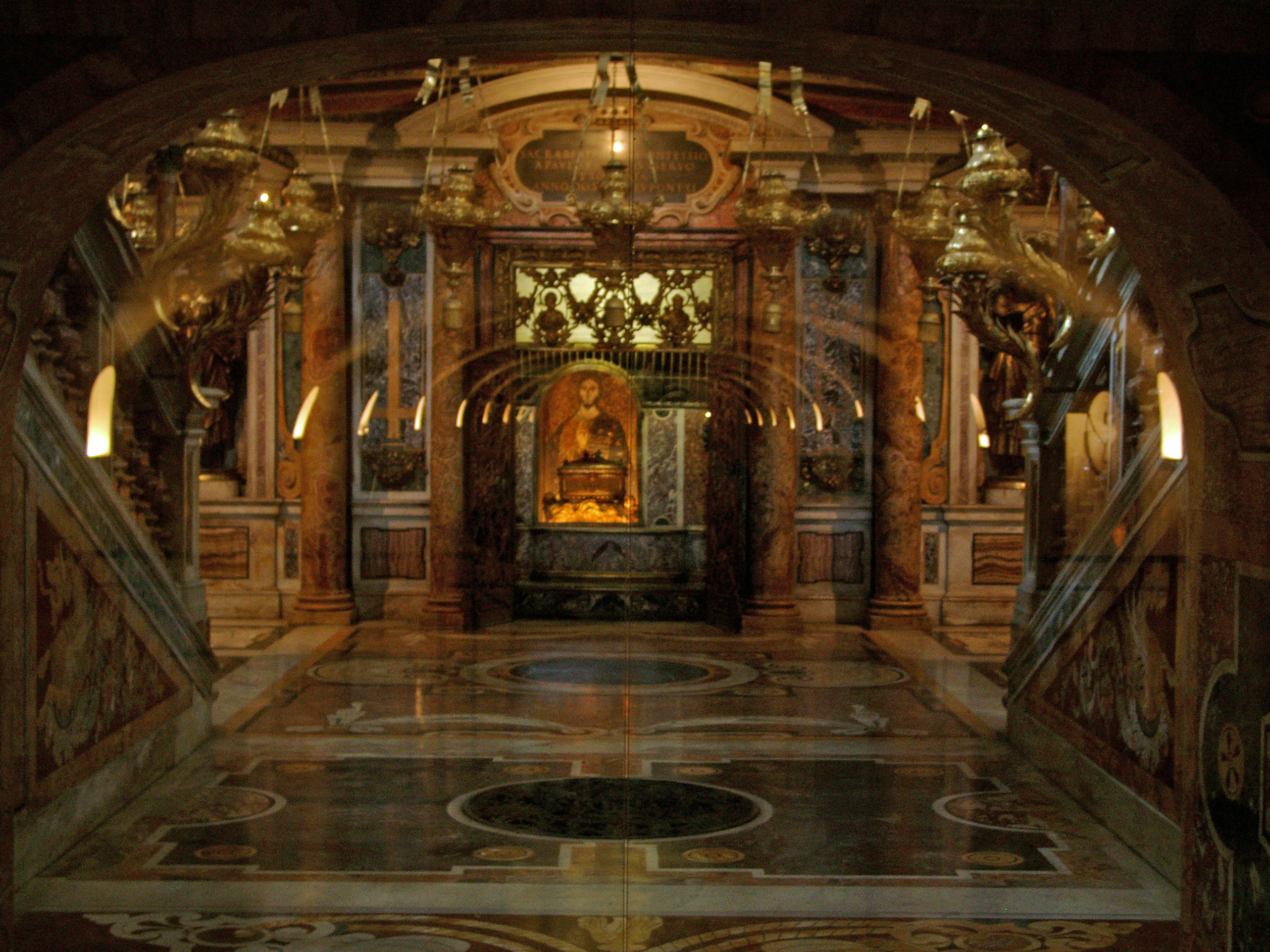
In the evening, at half-past seven, the Pope entered the Basilica of St. Peter’s by the private passage, and remained in prayer before the tombs of the Apostles and the Altar of the Sacrament, for a considerable time. He was accompanied by the private Chamberlains on duty and by a few officials of the Vatican. The gates of the Basilica were of course closed.

Mass at the Quirinal:  It is stated that the Pope has granted permission for Mass to be said in the Quirinal. This is not quite correct. The interdict has not been removed from the palace of the Quirinal. But there is a building near the palace proper, called the Palazzina, which was restored and enlarged by Victor Emmanuel. Canon Anzino, chaplain to the Royal Family, presented a petition stating that Queen Margarita was greatly inconvenienced by crowds of supplicants when attending Mass at the Sudario, and pointing out that after the attempt at Naples and the more recent Garibaldian agitations there might be some peril to the Queen and her son in attending mass in the Sudario or in the passage to and from the Quirinal. Licence was consequently given to Canon Anzino to celebrate Mass in a chapel erected in the Palazzina for the benefit of Queen Margarita and the persons whom she might invite to attend.

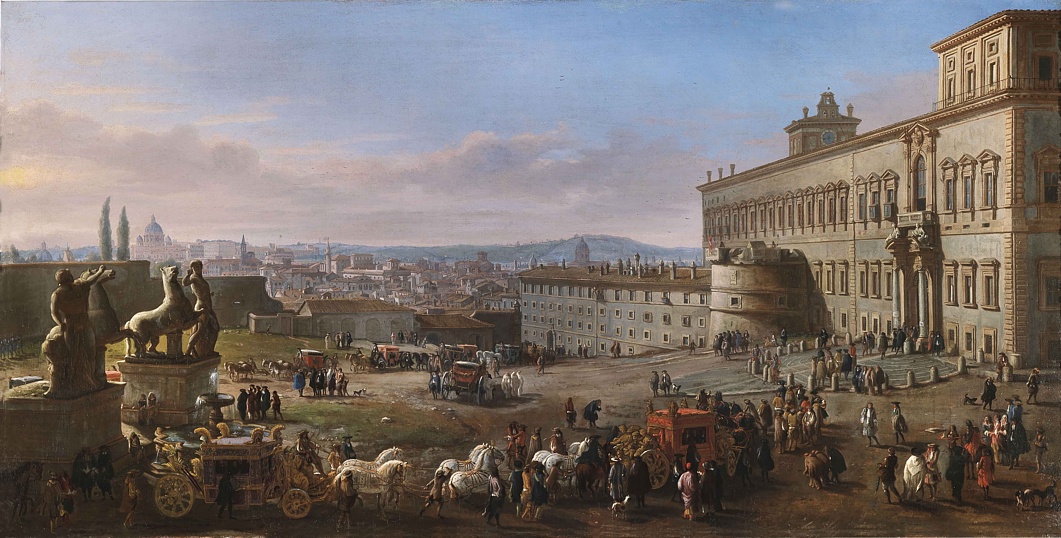
Palazzo Quirinale, Rome

The Pensions to the Suppressed Orders: The pittances paid to the members of the suppressed Religious Orders by way of pensions in compensation for the loss of their homes and revenues are very small, and are moreover very irregularly paid. The Minor Conventuals in Mussomeli, Sicily, were paid on the 4th of May, the arrears which ought to have been paid to them in March. The local paymaster was in vain applied to by the Friars for payment of their pensions, and the Friars telegraphed to the Minister of Finance in Rome and to King Humbert, before they could obtain redress.

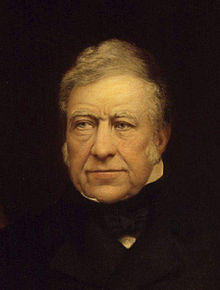
Cardinal Newman

Cardinal Newman:  After his audience with the Pope on Sunday the 27th of April, Dr. Newman scarcely left his apartments, being troubled with a severe cold and cough. Dr. Aitken was called in to see him, and at one time some anxiety was felt as to the condition of the illustrious Oratorian. However, no apprehension is now entertained, and it is believed certain that Cardinal Newman will be able to attend the consistory on the 15th to receive the hat.

The Advocates of St. Peter:  His Holiness Leo XIII. has been pleased to signify that he will receive the members of the Society of Advocates of St. Peter in audience on the 29th of June, the Feast of SS. Peter and Paul. This Society counts many members in England, and includes the Duke of Norfolk, the Marquises of Ripon and Bute, besides all the English bishops. The President, Count Agnelli dei Malherbi, has issued notice of the audience on the 29th of June, and it is expected several foreign members of rank will come to Rome for the occasion.

Dr. Woodlock: The Right Rev. Dr. Woodlock, bishop-elect of Ardagh, will be consecrated by the Pope himself to that see on Whitsunday next.

May 12.

Conversions:  On Sunday, May 11, Mr. and Mrs. Cassell, who had been a few days previously received into the Church by Monsignor Capel, were admitted to the Pope’s private Mass in the Vatican, and received their first communion from the hands of his Holiness. At this celebration were Mrs. Handley, who acted as godmother to Mrs. Cassell, Mrs. Pereira, and a few other persons. After the Mass Leo XIII. admitted Mr. and Mrs. Cassell, with Mrs. Handley, to private audience, and conversed with them for some time. Monsignor Macchi, the Maestro di Camera, presented the new converts with beautiful rosaries.

Peter’s Pence From Ireland:  At a recent audience Monsignor Kirby presented to the Holy Father the sum of £163 from the Bishop, clergy, and faithful of the diocese of Achonry in Ireland. Leo XIII. sent his special blessing to the donors.

Consecrations By The Pope:  On Whitsunday next the Pope will consecrate Cardinal Pitra for the bishopric of Frascati ; Monsignor Latoni, Auditor of his Holiness, for the bishopric of Senigaglia ; and Dr. Woodlock, for the bishopric of Ardagh in Ireland.

The above text was found on p.17,17th May 1879 in “The Tablet: The International Catholic News Weekly.” Reproduced with kind permission of the Publisher. The Tablet can be found at http://www.thetablet.co.uk .
John Henry Newman becomes a Cardinal. May 1879

Palazzo della Pigna

Cardinal Newman:   On Monday morning [May 12]  Dr. Newman went to the residence of Cardinal Howard in the Palazzo della Pigna to receive there the messenger from the Vatican bearing the biglietto from the Cardinal-Secretary of State, informing him that in a secret Consistory held that morning his Holiness had deigned to raise him to the rank of Cardinal. By eleven o’clock the rooms were crowded with English and American Catholics, ecclesiastics and laymen, as well as many members of the Roman nobility and dignitaries of the Church, assembled to witness the ceremony. Soon after midday the consistorial messenger was announced. He handed the biglietto to Dr. Newman, who, having broken the seal, gave it to Dr. Clifford, Bishop of Clifton, who read the contents. The messenger having then informed the newly-created Cardinal that his Holiness would receive him at the Vatican the next morning at ten o’clock to confer the berretta upon him, and having paid the customary compliments, his Eminence spoke as follows:

“ Vi ringrazio, Monsignore, per la participazione che mi avete fatto dell’ alto onore che it Santo Padre si è degnato conferire sulla mia persona ; and if I ask your permission to continue my address to you, not in your musical language, but in my own dear mother tongue, it is because in the latter I can better express my feelings on this most gracious announcement which you have brought to me than if I attempted what is above me. First of all, then, I am led to speak of the wonder and profound gratitude which came upon me, and which is upon me still, at the condescension and love towards me of the Holy Father in singling me out for so immense an honour. It was a great surprise. Such an elevation had never come into my thoughts, and seemed to be out of keeping with all my antecedents. I had passed through many trials, but they were over, and now the end of all things had almost come to me and I was at peace. And was it possible that, after all, I had lived through so many years for this? Nor is it easy to see how I could have borne so great a shock had not the Holy Father resolved on a second condescension towards me, which tempered it, and was to all who heard of it a touching evidence of his kindly and generous nature. He felt for me, and he told me the reasons why he raised me to this high position. His act, said he, was a recognition of my zeal and good services for so many years in the Catholic cause.

Moreover, he judged it would give pleasure to English Catholics, and even to Protestant England, if I received some mark of his favour. After such gracious words from his Holiness I should have been insensible and heartless if I had had scruples any longer. This is what he had the kindness to say to me, and what could I want more? In a long course of years I have made many mistakes. I have nothing of that high perfection which belongs to the writings of saints—namely, that error cannot be found in them ; but what I trust I may claim throughout all that I have written is this—an honest intention, an absence of private ends, a temper of obedience, a willingness to be corrected, a dread of error, a desire to serve the Holy Church, and through the Divine mercy, a fair measure of success. And, I rejoice to say, to one great mischief I have from the first opposed myself. For 30, 40, 50 years I have resisted to the best of my powers the spirit of liberalism in religion. Never did the Holy Church need champions against it more sorely than now, when, alas ! it is an error overspreading as a snare the whole earth ; and on this great occasion, when it is natural for one who is in my place to look out upon the world and upon the Holy Church as it is and upon her future, it will not, I hope, be considered out of place if I renew the protest against it which I have so often made.

Liberalism in religion is the doctrine that there is no positive truth in religion, but that one creed is as good as another, and this is the teaching which is gaining substance and force daily. It is inconsistent with the recognition of any religion as true. It teaches that all are to be tolerated, as all are matters of opinion. Revealed religion is not a truth, but a sentiment and a taste—not an objective fact, not miraculous ; and it is the right of each individual to make it say just what strikes his fancy. Devotion is not necessarily founded on faith. Men may go to Protestant churches and to Catholic, may get good from both, and belong to neither. They may fraternise together in spiritual thoughts and feelings without having any views at all of doctrine in common or seeing the need of them. Since, then, religion is so personal a peculiarity and so private a possession, we must of necessity ignore it in the intercourse of man with man. If a man puts on a new religion every morning, what is that to you ? It is as impertinent to think about a man’s religion as about the management of his family. Religion is in no sense the bond of society. Hitherto the civil power has been Christian. Even in countries separated from the Church, as in my own, the dictum was in force when I was young that Christianity was the law of the land. Now everywhere that goodly framework of society, which is the creation of Christianity, is throwing off Christianity.

The dictum to which I have referred, with a hundred others which followed upon it, is gone or is going everywhere, and by the end of the century, unless the Almighty interferes, it will be forgotten. Hitherto it has been considered that religion alone, with its supernatural sanctions, was strong enough to secure the submission of the mass of the population to law and order. Now, philosophers and politicians are bent on satisfying this problem without the aid of Christianity. Instead of the Church’s authority and teaching they would substitute, first of all, a universal and a thoroughly secular education, calculated to bring home to every individual that to be orderly, industrious, and sober is his personal interest. Then, for great working principles to take the place of religion for the use of the masses thus carefully educated, they provide the broad, fundamental, ethical truths of justice, benevolence, veracity, and the like, proved experience, arid those natural laws which exist and act spontaneously in society and in social matters, whether physical or psychological—for instance, in government, trade, finance, sanitary experiments, the intercourse of nations. As to religion, it is a private luxury which a man may have if he will, but which, of course, he must pay for, and which he must not obtrude upon others or indulge to their annoyance. The general character of this great apostasy is one and the same everywhere, but in detail and in character it varies in different countries.

For myself, I would rather speak of it in my own country, which I know. There, I think, it threatens to have a formidable success, though it is not easy to see what will be its ultimate issue. At first sight it might be thought that Englishmen are too religious for a movement which on the Continent seems to be founded on infidelity ; but the misfortune with us is that, though it ends in infidelity, as in other places, it does not necessarily arise out of infidelity. It must be recollected that the religious sects which sprang up in England three centuries ago, and which are so powerful now, have ever been fiercely opposed to the union of Church and State, and would advocate the un-christianising the monarchy and all that belongs to it, under the notion that such a catastrophe would make Christianity much more pure and much more powerful.

Next, the liberal principle is forced on us through the necessity of the case. Consider what follows from the very fact of these many sects. They constitute the religion, it is supposed, of half the population ; and recollect, our mode of government is popular. Every dozen men taken at random whom you meet in the streets have a share in political power. When you inquire into their forms of belief, perhaps they represent one or other of as many as seven religions. How can they possibly act together in municipal or in national matters if each insists on the recognition of his own religious denomination? All action would be at a deadlock unless the subject of religion were ignored. We cannot help ourselves. And, thirdly, it must be borne in mind that there is much in the liberalistic theory which is good and true ; for example, not to say more, the precepts of justice, truthfulness, sobriety, self-command, benevolence, which, as I have already noted, are among its avowed principles. It is not till we find that this array of principles is intended to supersede, to block out, religion, that we pronounce it to be evil. There never was a device of the enemy so cleverly framed and with such promise of success. And already it has answered to the expectations which have been formed of it. It is sweeping into its own ranks great numbers of able, earnest, virtuous men—elderly men of approved antecedents, young men with a career before them. Such is the state of things in England, and it is well that it should be realised by all of us ; but it must not be supposed for a moment that I am afraid of it. I lament it deeply, because I foresee that it may be the ruin of many souls ! but I have no fear at all that it really can do aught of serious harm to the work of truth, to the Holy Church, to our Almighty King, the Lion of the tribe of Judah, faithful and true, or to His Vicar on earth. Christianity has been too often in what seemed deadly peril that we should fear for it any new trial now. So far is certain.

On the other hand, what is uncertain, and in these great contests commonly is uncertain, and what is commonly a great surprise when it is witnessed, is the particular mode in the event by which Providence rescues and saves his elect inheritance. Sometimes our enemy is turned into a friend ; sometimes he is despoiled of that special virulence of evil which was so threatening ; sometimes he falls to pieces of himself ; sometimes he does just so much as is beneficial and then is removed. Commonly the Church has nothing more to do than to go on in her own proper duties in confidence and peace, to stand still, and to see the salvation of God. ‘ Mansueti hereditabunt terram et delectabuntur in multitudine pacis’  [But the meek shall inherit the earth; and shall delight themselves in the abundance of peace.] .”

Cardinal Newman by John Everett Millais 1885.

His Eminence spoke in a strong, clear voice, and although he stood the whole time, he showed no signs of fatigue. After taking his seat, those present went up in turn to compliment him, Monsignor Stonor, at the request of Monsignor Cataldi, master of the ceremonies to his Holiness, presenting those with whom his Eminence was unacquainted. Among the many present were Dr. Moran, Bishop of Ossory ; Monsignor Lenti, Vice-gerent of Rome ; Dr. O’Callaghan, Rector of the English College ; Dr. Giles, Vice-rector of the English College ; Monsignor Kirby, Rector of the Irish College ; Dr. Campbell, Rector of the Scotch College; Dr. Smith, of the Propaganda ; Dr. O’Bryen ; Dr. Hostlot, Rector of the American College ; F. Mullooly, Prior of St. Clement’s ; Dr. Maziere Brady, Lady Herbert of Lea, Marchioness Ricci, Baroness Keating, Prince and Princess Giustiniani Bandini, Commendatore de Rossi, Count de Redmond, General Kanzler, Professor Blackie, Sir Hungerford Pollen, Monsignors Folicaldi, Rinaldi, de Stacpoole, and others, and nearly all the English residents now in Rome, both Catholic and Protestant.

The Times correspondent telegraphs the following account of the presentation to his Eminence, on Wednesday, of the gifts and the address of the English, Irish, Scotch, and American residents in Rome :— Wednesday May 14.

At 11 o’clock this morning his Eminence Cardinal Newman, attended by his train-bearer and gentleman of honour in full Pontifical Court dress and sword, and accompanied by the Fathers of the Birmingham Oratory who are with him and Mgr. Cataldi, master of the ceremonies to his Holiness, was received at the door of the English College by the rector, Dr. O’Callaghan, the vice-rector, Dr. Giles, and Mgr. Stonor, and conducted into a large upper chamber, already crowded by ladies and gentlemen, Protestant as well as Catholic. At the further end were exposed the complete set of vestments, rich as becoming the intention, but plain in accordance with the Cardinal’s desire, the cloth of silver cope and jewelled mitre for State occasions, the pectoral cross and chain, and a silver-gilt altar candlestick, for which the English-speaking Catholics at Rome have sub-scribed as a present to his Eminence, together with a richly illuminated address. On each vestment was embroidered his Eminence’s coat-of-arms in proper heraldic colours, with the motto ” Cor ad cor loquitur.” The jewelled mitre is a facsimile of that presented to Leo XIII. Cardinal Newman having taken his seat on the throne, with Mgr. Moran, Bishop of Ossory, Mgr. Woodlock, Bishop elect of Ardagh ; Mgr. Siciliano di Rende, Archbishop of Benevento; and Mgrs. Stonor, Cataldi, and de Stacpoole standing on the steps of the dais on either side, Lady Herbert of Lea read the following address

” My Lord Cardinal,—We, your devoted English, Scotch,. Irish, and American children at present residing in Rome,. earnestly wishing to testify our deep and affectionate veneration for your Eminence’s person and character, together with our hearty joy at your elevation to the Sacred Purple, venture to lay this humble offering at your feet. We feel that in making you a Cardinal the Holy Father has not only given public testimony of his appreciation of your great merits and of the value of your admirable writings in defence of God and His Church, but has also conferred the greatest possible honour on all English-speaking Catholics, who have long looked up to you as their spiritual father and their guide in the paths of holiness. We hope your Eminence will excuse the shortness and simplicity of this address, which is but the expression of the feeling contained in your Eminence’s motto, ‘ Heart speaking to Heart,’ for your Eminence has long won the first place in the hearts of all. That God may greatly prolong the years which have been so devoted to His service in the cause of truth is the earnest prayer of your Eminence’s faithful and loving children.”

His Eminence, having first descended to examine the presents, then replied as follows

“My dear friends,—Your affectionate address, introductory to so beautiful a present, I accept as one of those strange favours, of Divine Providence which are granted to few. Most men if they do any good die without knowing it ; but I call it strange that I should be kept to my present age—an age beyond the age of most men—as if in order that, in this great city, where I am personally almost unknown, I might find kind friends to meet me with an affectionate welcome and to claim me as their spiritual benefactor. The tender condescension to me of the Holy Father has elicited in my behalf, in sympathy with him, a loving acclamation from his faithful children. My dear friends, your present, which while God gives me strength I shall avail myself of in my daily Mass, will be a continual memento in His sight both of your persons and your several intentions. When my strength fails me for that great action, then in turn I know well that I may rely on your taking up the duty and privilege of intercession, and praying for me that, with the aid of the Blessed Virgin and all saints, I may persevere in faith, hope, and charity, and in all that grace which is the life of the soul till the end comes.”

A great improvement was manifested in the Cardinal’s appearance since the day before yesterday, and he may now be considered perfectly re-established in health.

Thursday.

Cardinal Newman attended the Consistory to-day, and received the Cardinal’s hat and his title of S. Giorgio in Velabro a church situated in the lower town of Rome, on the left bank-of the Tiber, near the foot of the Palatine. There was a large attendance of Cardinals.

The above text was found on p.18 – p.19, 17th May 1879 in “The Tablet: The International Catholic News Weekly.” Reproduced with kind permission of the Publisher. The Tablet can be found at http://www.thetablet.co.uk .
The Purssells 1870 – 1890

“It is indisputable that while you cannot possibly be genteel and bake, you may be as genteel as never was and brew.” Charles Dickens, Great Expectations, 1861.

As we’ve already seen the decade between 1861 and 1871 seemed to have been  pivotal for the family. Some have definitely succeeded,  others don’t seem to do well; and by the start of the 1870’s there appears to be almost a gulf between the two remaining branches of the family, possibly exacerbated by a split in religions, but more likely by a combination of class, status, and money.

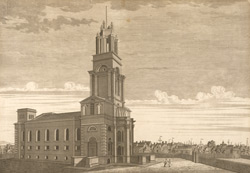
St Anne Limehouse
St Anne Limehouse

As far as we can tell, the whole family were born and christened as members of the Church of England.  Roger and Charlotte were christened, and married at St Anne, Limehouse, in the late C18th, and all the children were christened there.  All seem to have had C of E christenings.  But at some point, there were some conversions to Rome, at least on the part of Charlotte, Frances Jane [Mother St. George], and Alfred. It’s not entirely clear why, or when.

Mother St. George is the easiest to pin down, she was professed a nun, at the age of twenty one, in 1848, the year of revolutions, and, coincidentally, the year the Communist Manifesto was published in London. So, we at least have a date as to when Mother St George was a recognized Catholic.

At the moment, this has to be speculation, but it is logical to assume that Charlotte was the first to convert, probably after the Roman Catholic Relief Act 1829, and almost certainly as an adult convert. Charlotte was the eldest of the brothers and sisters; sixteen years older than Mother St. George, and twenty years older than Alfred.  Charlotte and Frances were the only two girls, and it’s reasonable to assume that given the amount of instruction, and the sacraments Mother St. George (Frances) would have had to received prior to her profession that she followed her sister, and they were both Catholic by, perhaps, 1844.

Alfred was the youngest of his brothers and sisters; much closer in age to Mother St. George than anyone else. He was at least eight years younger than his nearest brother John Roger, and sixteen years younger than Joe, the eldest. Quite when he converted is rather more difficult.  Alfred married Laura Rose Coles in the spring of 1857 at St George the Martyr, in Southwark, in an apparently  C of E marriage. He was twenty six, and she was two years younger. Laura Rose was born in Blackheath on 19th March 1833, and apparently christened into the Church of England. Alfred then married Ellen Ware in 1865 in Exeter. That marriage also seems to have been Anglican. But by 1871, his eldest daughter,Laura Mary, is being educated by the nuns in Norwood at her aunt’s convent. So it’s a reasonable bet that Alfred had become a Catholic by then.

By 1871,  Alfred had re-married, and had five more children. Mother St George is in the convent in Norwood. Charlotte Purssell Jnr had been dead almost two years,William is dead, and  James, and his family, had been in New York for almost fourteen years, and well established on Broadway.  John Roger Purssell is presumed to be in Australia, and Joe has been in Australia for at least ten years, and possibly as many as nineteen years; and finally, their mother Charlotte Purssell Senior is living in Mile End, at 350 Mile End Road, aged eighty-one, with Mary Isaacs, a sixteen year old servant girl; and her daughter-in-law, Eliza (nee Newman), William’s widow, is living at 2 Satin Road, Lambeth, also with a servant.

So the split is almost complete, possibly it is more of a drift than a split, but there are now only two of Roger and Charlotte’s families remaining in London. Alfred’s living in Finsbury Square, on the northern edge of the City, and John Roger’s in Mile End Old Town in the East End. The remaining households are Eliza Purssell, William’s widow, who is living at 2 Satin Road, in Lambeth with a nineteen year old servant Louisa Cox, and eighty-one year old Charlotte herself, who is living in Mile End Road with her servant Mary Issacs.

John Roger has emigrated to Australia sometime in the 1860’s, most probably after 1866 when his daughter Eliza was born. His wife Eliza (nee Davies) calls herself a widow, in the 1871 census, when she was living at 19 Lincoln Street, Mile End with their five youngest children. She describes herself as a house-owner, though doesn’t give herself a profession, or occupation. The usual descriptions of the well off are “living on own means” or “fundholder”, or possibly “annuitant” so while she may have had some money, but that’s by no means certain. Given JR’s rather checkered history with money, he may have left her with some, he may not. He’d gone bankrupt in 1854, and his restaurant business had failed in 1861 when he had re-invented himself as a photographer. He later re-imagines himself as a builder.

 It’s not quite clear whether John Roger re-marries in Australia, but he wouldn’t be unusual in doing so. His older brother Joe had emigrated in the 1850’s and remarried, quite possibly bigamously. It seems to be quite common, so much so that Australian law seems to have permitted a second marriage if husband and wife had lived apart for seven years. Certainly, there were bigamous Australian marriages in the O’Bryen, and Elworthy families as well.

In terms of status, in 1871, Eliza is to all intents abandoned, so it’s not surprising she calls herself a “widow”, and slightly defensively as a “house owner”. At least the eldest three of her children have already died; John Junior aged two and a half in 1852, Alfred aged nine in 1860, and thirteen year old Edward in 1865. There is no trace of Albert after 1861, so it seems reasonable to assume he is dead by 1871, though he would be seventeen by then, so he could feasibly have left home. But she is living with five children, aged between five and thirteen, and no servants in the East End, quite a step down from ten years earlier when she had two. In 1871,Francis, and Charles are living with their mother, along with Arthur,Augustus, and Eliza.  

All of John Roger and Eliza’s adult sons appear to have gone to Australia. Francis emigrated on the Illawarra, arriving in New South Wales on the 6th Aug 1883.  Charles George seems to have emigrated some time after 1881, and died in Australia. Arthur, also, appears to have emigrated; and Augustus appears to have emigrated, married, and died in Australia as well.

John Roger Purssell returns to London by the end of the century. Crucially, JR’s youngest, and only, daughter remained in London; and it’s with her, and her family, that he lives with on his return. So at least one of the children knew their father was still alive.

By contrast, a couple of miles away on the other side of the City, Alfred is living at 49 Finsbury Square, with Ellen, who he has been married to for almost six years. They’ve had five children in the six years they’ve been married, in addition to Alfred’s daughter Laura; starting with Lucy who was born in the autumn of 1865, the year they got married, followed by Alfred Junior, Frank, Charlotte, and Agnes, none of them more than twenty one months apart, and in the case of the youngest two girls nor more than fifteen months apart. Gertrude, following the same pattern as her youngest sisters, was born fifteen months later in the summer of 1872.

Alfred is now describing himself as a “wine merchant etc employing 65 heads”, rather than a “confectioner”, which is what he called himself ten years earlier. The business is still expanding, he has increased the workforce by 30% in ten years, on top of a 25% increase in the 1850’s. But he is now clearly wanting to cement his place further as a Victorian gent. He was a subscriber to the International Exhibition of 1862 – held ten years later than the Great Exhibition- He subscribed £ 100 [ the modern day equivalent of £ 130,000].  But to quote from “Great Expectations” published ten years earlier, in a remark about Miss Havisham’s father ” Her father…. was a brewer. I don’t know why it should be a crack thing to be a brewer; but it is indisputable that while you cannot possibly be genteel and bake, you may be as genteel as never was and brew. You see it every day.”  I think we can safely assume that gentility, and the wine trade are fine, but baking definitely not. So Alfred is re-inventing himself.

By this point in the century, 1871, the family has transformed itself. In two lifespans- from Roger [1783 – 1861] to the death of Alfred [1831 – 1897] his youngest son,in 1897, and over the course of the nineteenth century, at least one part of the family has done very well for itself. At least in terms of social status, I think it is fair to imagine that Alfred has come to think of himself as “genteel” in the Dickensian sense.

Roger can first be traced in the 1851 census, living in a shared house in Mile End. His neighbours can only really be described as working class, though to use a Booth definition, probably  “Higher class labour”. Roger himself is, in that acutely British way of looking at class, not genteel, but he does seem to be wealthy. Roger dies in 1861, and Charlotte, then living at 1 Saville Place, in Mile End, buys a grave in Bow Cemetery [City of London, and Tower Hamlets Cemetery] where he is buried in 1861, and William Purssell is buried with his father nine years later in September 1870, aged 54.

So back to Alfred, thirty nine years old, the father of six, soon to be seven, children, and living in some splendour in Finsbury Square. In addition to his wife and children, the household contains five servants, a ratio of family to servants that he maintains for the next thirty years. I think it is safe to say this is a prosperous upper middle class Victorian household, and would regard itself as such. There is no attempt to emulate the upper classes with a butler, or footmen, just a mixture of housemaids, nurses, and a cook.

Alfred Purssell has moved a long way in ten years. In 1861 he was a twenty-nine year old widower staying with his eldest brother in Brighton with a two year old daughter. He and Laura, then lived in Blackheath, and continued to do so after Alfred’s second marriage to Ellen Ware in 1865, up to at least 1868 because Lucy, Alfred Joseph, and Frank were born there. Charlotte, Agnes, and Gertrude were all born in Finsbury Square.  

In 1871 Laura Mary Purssell (aged 12) was at school  at the Virgo Fidelis convent in Norwood where Mother St George was, she is shown as Frances Jane Purssell aged 42 on the census return, and listed with the rest of the nuns as “attending on the children”.  Gertrude Purssell, the youngest daughter was born a year later in the summer of 1872. Her mother Ellen was 37, and within a year Ellen was dead. Alfred was forty one years old, a widower twice over, and a father of seven.

In the next snap shot in 1881, Alfred has moved house again. The family are now in Clapham, at 371 Clapham Road; though on the 3rd of April, most of the children are away at school. Lucy, Charlotte, and Agnes are boarding in Folkestone at the Convent of the Faithful Virgin. It’s a daughter house of the convent in Norwood with ” a Community of Nuns, Boarding school, and Orphanage with 17 orphans, and 13 boarders.”  Mother St George is the Lady Superior, and as well as her nieces boarding there, they are being visited by Laura Purssell on the night of the census.

Both the boys are also away at school. Frank is definitely at Downside, and it’s not entirely clear where Alfred Joseph is. Given that there is only a year’s difference between the boys, it would be logical to assume he was there too, but he doesn’t appear on the census return.

At home in Clapham, are Alfred and Gertrude who is eight years old.  He’s employing Annabella Norris as a housekeeper, along with a cook, two housemaids, and a children’s maid. Annabella’s position is a slightly hybrid one, similar in status to a governess. She is firmly not categorised as a servant, and was previously, and subsequently a schoolmistress.  In 1851, the Norris family were living in Stroat House, in Tidenham, Gloucestershire on the edge of the Forest of Dean, where Thomas Norris described himself as a farmer of 46 acres employing two labourers. Annabella’s mother called herself a “landed proprietor”  in 1861 when she and her daughters were living in a cottage in the village, and Annabella was teaching in the house with four boarding pupils. By 1871, she was running a school at 1 Powis Square, in Brighton with her sister Ellen and thirteen boarding pupils. After her stint with the Purssells, she moved to Bristol and resumed life as a schoolmistress, living at 10 Belmont Road in Montpellier, with her sister Margaret. She died in 1909 leaving the modern day equivalent of £ 264,700.

Of the remaining family,  William’s widow Eliza is living in Romford; John Roger’s abandoned wife, another Eliza is nowhere to be found but seems to have died in Dartford five years later. James and his family have been established in New York for nearly twenty years, and his five youngest children were all born in New York City, and Charlotte Purssell still seems to be alive, dying five years later in the winter of 1886 in Romford at the age of ninety-six.

The Battle of Mentana, November 3rd 1867.

The Battle of Mentana was fought on November 3, 1867 near the village of Mentana, just outside Rome, [about three miles]   between French-Papal troops and the Italian volunteers led by Giuseppe Garibaldi, who were attempting to capture Rome, which was not unified to Kingdom of Italy until three years later.. The battle ended in a victory by the French-Papal troops. This is the report from “The Tablet” published on 23rd November 1867. As would be expected, it does take sides. It is still staggering that a Papal army was fighting just under one hundred and fifty years ago.


THE BATTLE OF MENTANA.

(FROM OUR OWN CORRESPONDENT.)

ROME, Nov. 8th.

The events of the past week have been so stirring that I preferred waiting till a correct appreciation could be formed of their weight and extent, to sending you a hurried and unsatisfactory account of the great triumph of the Pontifical army. An hour or two after posting my last letter on Saturday afternoon received notice from the ambulance that the muster of the columns which was going to attack Monte Rotondo would take place at three in the morning of Sunday, at the Piazza delle Termine, and that those intending to form part of it must be there a few minutes earlier.

The Sisters of St. Vincent de Paul, newly arrived on special duty from Marseilles, the Vicomte de Lupe, M. Keller (fils), De Ozanam and Mgri. Vergneaud, and Benoit D’Azy, under the direction of M. de St. Priest, formed the members of the French volunteer ambulance, and its place was in the centre of the attacking columns, immediately behind the artillery and cavalry. The night was rainy, but in spite of the weather the scene was picturesque beyond description. The troops were formed in line from the Baths of Diocletian to the Piazza Pia, and the red glare of the torches which lighted the march fell on the gigantic ruins of the Thermae, on the facade of the Maria degli Angeli, on the brazen helmets of the dragoons, and the Pontifical standard, which

“Wet with the mists, and smitten by the lights,

Blazed, making all the night a stream of fire,”

and guarded by the entire regiment of Zouaves, went on before us into the darkness, followed by the prayers and blessing of the Vicar of Christ, and the countless holy souls who were watching round the altars and in the cloisters of the Eternal City.

The long line, measuring more than three-quarters of a mile from van to rear, began to wind slowly through the Porta Pia, and the quick rattle of officers on horseback passing our carriage told us that the general and his staff were taking their place at the head of the column. General Kanzler was accompanied by his Royal Highness the Comte de Caserta, MM. de Bourbon, Charles de Maistre, Ungarelli, and a brilliant staff of officers. Colonel Allett, with M. de Charette, and the commandants De Troussures, and De Lambilly, headed the Zouaves. The Swiss under the commandant De Castella, the artillery commanded by M. de Nadin, the dragoons by the Count Von Loiningen, and the Legion by the Comte D’Azy, formed the effective force of the Pontifical column, numbering about six thousand men. The reserve was given to the French, under General Polhes, General Kanzler claiming the honour of the first attack. In spite of the bad weather, the troops were in the highest spirits. Most of the Zouaves had not slept save for an hour or two for twelve nights, from the constant alarm and fatigue duty, but there was no sign of wavering when the bugle sounded, and as the Porta Pia was passed and the column was fairly in the open country, the pace was quickened, and by the time the first dawn broke cold and grey over the Sabine Mountains, the troops had accomplished nearly half their march.

The sun rose at last, and though the weather was chill, damp, and threatening, the rain ceased, to the great satisfaction of every one. At the Ponte Nomentana three companies of Zouaves were detached from the column, and under the conduct of the commandant De Troussures, executed a movement to support the French reserve, and attack the Garibaldians at their flank outposts at Mentana, a village about two miles in advance of Monte Rotondo on the Roman side by the Ponte Manola road.

The Ponta Nomentano was secured and a strong guard of French chasseurs was left in charge of it to guard the retreat.

About five miles beyond Ponte Nomentana a halt was sounded, the hour being nearly ten o’clock, and the troops breakfasted. The pious Dominican chaplain, Pere Lignir, who, with Mgri. de Waelmont, Bastide, and three Jesuit Fathers, accompanied the ambulance, celebrated the Holy Sacrifice in presence of the army in a little wayside chapel attached to the Osteria. For many present it was their last Mass, and the devotion and fervour with which it was assisted at by the Zouaves especially, it is impossible to describe. By eleven we were again on the march, our route lying over the Campagna in a north-easterly direction, the villages of Monticelli, San Francesco, and Palombara lying to our right, and Tivoli in the same direction, bet further down the flank of the Sabine. The march became slower, for the heavy clay clung to the wheels of the carriages, and the artillery was constantly requiring to be lifted out of the mire. This continued across the Campagna for about two miles, and then the soil became lighter, and as we neared the village of Mentana the country became more wooded, and showed signs of enclosure and cultivation, and the road more practicable. Mentana was still invisible, being concealed from us by a circle of woody eminences, all of which we had reason to believe were occupied by the Garibaldians, and we knew that at Mentana itself they maintained a force of 700 men as the advanced post of Monte Rotondo, and General Kanzler had, even from the beginning, prepared for a stout resistance there, and took his measures accordingly.

The road by which Mentana was to be reached runs up a ravine lying between hills covered with light brushwood, and when we reached the first eminence above the champaign country, flanking companies were detached ” en tirailleur,” on either side of our march to prevent a surprise, and the artillery passing to the front, took up a position on a round hill commanding the ravine and the opposite heights, two ranges of hills, about 800 feet high, separating us from the enemy, who, as yet, gave no sign of life.

The bugle sounded from the Zouave ranks far on ahead ; General Kanzler and his staff, with the Count of Caserta, cantered up the line, and we finding that our drivers were not particularly anxious to pro-ceed further, with the prospect of immediate action, got down and proceeded on foot a little in the rear of the troops, to a point where we could observe the attack and where we resolved to establish our first ambulance.

We had not long to wait before the first sharp crack of the rifles broke the silence. From the bill we occupied we could plainly distinguish the scarlet shirts of the Garibaldian skirmishers, through the hazel and alder copsewood, and, in a few seconds, the whole edge of the heights was alive with their troops. Volley after volley rung through the thickets, and our cannon responded gallantly, doing terrible execution on the enemy, and protecting the advance of our column.

The Zouaves had, of course, the post of honour and of danger, the guerdon of their undying chivalry and devotion. Company after company swept by our post, the officers and men saluting the Sisters of St. Vincent of Paul, who, for the first time since their foundation, accompanied an army to the open battle-field ; and the cry of ” Vive la France ! Vive Pie IX. !” went up like a clarion note from the hearts of 2,000 Christian gentlemen, ready, as were even their crusading fathers, to die for God’s cause and the triumph of the Church. Up the ravine they swept, Charette at their head, on his superb chestnut horse, his clear bright eye . gleaming with the light of battle, and his noble features looking prouder and nobler even than their wont in the excitement of the hour. Gallant old Alett, sitting calm and square on his stout charger as he sat at Castelfidardo, when his fugitive regiment of Swiss left him alone on the field to fight side by side with the Zouaves he now commands. De Lambilly, De Saizy, and Le Gouidec, D’Albions, De Fumel and Thormelet, Breton, and Provencal, and Swiss, each at the head of their company, passed on. There were some of English birth too, who shared the honour of the day, George Collingridge, Roland Cary, Wilfrid and Julian Watts Russell, Charles Woodward, were all in the ranks, brave and devoted as any Frenchman there, and longing to rival their comrades for the honour of Catholic England and the expiation of her past coldness in the cause. Past, let us trust and believe, forever!

The five first companies formed ” en tirailleur” and charged rapidly up the pass. The ” 6me du ler,” the compagnie d’elite, of which almost every man is a noble, was the first up the hill, and the shot from each side of the ravine made terrible havoc in its ranks. De Cathelineau was among the first who fell, and as the columns neared the top of the hill; which is crowned by a farm and gateway, called the Villa Santucci, the combat became more dreadful. The Garibaldians had fortified the buildings, and defended by its walls, their sharpshooters kept up a deadly fire on the Zouaves. The Sixieme was mounting to the assault two or three hundred yards below the villa, when its brave captain, the Comte de Vaux, waving his sword and cheering on his men, fell, shot through the heart, and never spoke again. He only lived a few moments, but long enough to receive the last absolution on the field of battle. He had confessed and communicated, as had every man and officer present, the day before he died as a soldier might dream of dying. I saw him a few minutes later, when, the heights being carried, we established a second ambulance in the Villa Santucci. He was lying with his sword still in his hand, his eyes raised to heaven, a smile on his lips, and the cross of Castelfidardo, which had been struck by the fatal bullet, carried into his heart, where it was found imbedded after his autopsy.

The fire now slackened, and the rear companies, which guarded the Papal Standard and were ranged, not ” en tirailleur” but in battle order, suffered severely but never broke their ranks. The sound of the fusillade mingled with the word of command, ” appuyez à droite,” ” appuyez à gauche,” as men fell and their vacant place was filled up. There was a moment of hesitation—and only a moment—and Charette pressing to the front cried “A moi! Zouaves atia bayonette. Chassez moi cette canaille. Vive Pie IX !” and waving the kepi of a Garibaldian chief he had taken in the early part of the charge, he spurred into the hottest of the fire. The balls literally rained, rattling and hissing through the yellowing oak leaves; one struck the sheath of his sabre, and another wounded his horse, which became unmanageable. The Comte Joseph de Pavillon, who had just taken Major Fabrizi’s horse in a single combat, in which the Garibaldian chief was mortally wounded, came up at the moment, and M. de Charette mounting it continued to expose himself with bravery so unthinking that it is a miracle that he escaped with his life.

A moment’s lull in the fire, and a new cry of ” Vive la France” sounded from the heights to the left, and the quick rattle of the Chassepots [a new type of French breech-loading rifle] told us that Polhes’ brigade had engaged the Garibaldian left. Castella and his Swiss regiment of Chasseurs came in sight, the Zouaves gave another and louder cheer, and the enemy falling back pell melt, retreated on the village, leaving the height of Villa Santucci in the hands of the Pontifical troops.

On reaching it, far down the flank of the opposite hills we could see the village of Mentana itself; its every house, its feudal castle, its church and walls, bristling with Garibaldian rifles. The heights above it were still in their possession, but the French were pressing hotly on their outposts, and on the road below the farm up to the gate of the village, which was strongly barricaded with earthworks, the 1st, 4th, 5th, and 7th companies of Zouaves were advancing. The Swiss were moving up in reserve, and we found their brave commandant, whose horse had just been killed under him, severely wounded in the knees and unable to move, but propped up against the wall and still directing the movements by voice and arm, till his regiment had advanced out of sight and earshot. Then alone was M. De Castella persuaded to accept the services of the surgeons, and retire to the farm to have his wounds dressed.

The battle swept down the valley and raged hot and furious round Mentana. The wounded soon became too numerous for the second ambulance, and we were obliged to establish a third nearer the field of battle, in a chapel between Montana and the Villa, where General Kanzler and the staff now took up their head-quarters, as well as a part of the ambulance service. From where I was, at the bottom of the second bill, I could distinguish the attack on the gate of the village and the movement of the troops. The Garibaldians were at least 14,000. The extent of ground they occupied and the arms found at Monte Rotondo, prove that their number was greatly under-stated by the official accounts at first published.

The 1st company was among the foremost in the attack on the gate, and it was here, about four in the afternoon, that our gallant young countryman Julian Russell fell, shot through the head, the second martyr England has given to Rome, and a fitting rival of Louis Guerin in youth, bravery, innocence, and devotion to the Church. Here, too, fell the Sergeant Lairon, a Breton, known and reputed in the entire regiment for his piety and courage. M. De Montbel was close to him when he was struck, and ran up to help him. ” Leave me,” he said, ” I am dying, and I die for Pius the IXth. You are wanted in the front, but tell my mother I did my duty, and give her my watch for the poor.”

Here, too, fell Walerond, Baron D’Erps, chief of a great house of North Brabant ; M. De Boischevalier, and Alfred Laroyse, whose family, one of the most considerable in Lower Canada, sent him to represent that faithful colony in the army of the Church. The two latter gentlemen were only dangerously wounded, but there is little hope of their recovery.

Another act of devotion deserves mention here. M. Jean Moeller, one of the celebrated Catholic Belgian writers of that name, served as Lieutenant of Zouaves at Castelfidardo with great credit, but his extreme youth in proportion to his grade and his want of experience were not in his favour in the regiment. A few childish acts were misinterpreted and very harshly judged, and he was obliged to give up his commission. He returned to Brussels to maintain his family in an honourable financial employment, but at the first outbreak of war he returned, entered as a simple soldier, and, serving under the orders of the very men he had once commanded, was among the first to enter Mentana, and flinging his kepi within the Garibaldian lines, followed rifle in hand, and was shot down severely wounded, but the position was carried by his comrades, and he was removed to the rear. There are many among the older students of the English College who know him and who will be glad to hear of their old Zouave acquaintance distinguishing himself so gallantly.

The twilight was coming on before the battle gave any signs of relenting. The Garibaldians fought every inch of the ground with desperate bravery, and their magnificent position, chosen with care and strategical knowledge, which proved the direction of high military knowledge, gave them every advantage, but the light was waning and a suspension of arms inevitable for the night. Menotti Garibaldi and his father had been seen twice in the early part of the fighting, the former on a white horse and the latter in a carriage, on the Monte Rotondo road, but they did not expose their person much according to the testimony of their followers, who are much dissatisfied at their leaders.They all, however agree that Ricciotti Garibaldi behaved most gallantly and shared every dangerous part with his soldiers, by whom he appears much beloved for his kindness of disposition and superior education. Two Garibaldian officers in the grey uniform of the Guides were all through the day remarkable for their courage and sangfroid, and the Zouaves are unanimous in their testimony to it. The Garibaldian marksmen were remarkably good, and two of them picked off the artillerymen one after the other,, ten loading for them as fast as they discharged the shots.

The superiority of the Chassepot was, however, clearly proved, and the terrible havoc in the enemy’s ranks was only realised when the battle was over and the wounded brought in. The patrols went up and down the ground with torches, and under every hedge, behind the walls, in the outhouses, and under the bracken were lying the unfortunate men ; many dead more dying and desperately wounded, and some able to walk, and too glad to surrender themselves prisoners and receive the best care that could be afforded them, and which was given by Dr. Ozanam and the Sisters to Garibaldians and Zouaves alike.

At five in the evening the firing ceased, and General Kanzler ordered a recall to be sounded and a camp formed round the Casa Santucci, whose elevated position rendered it the strongest post in our possession. The Zouaves soon returned with the Swiss, the chasseurs à pied, and the dragoons, and preparations were made for the bivouac. The French line was picketted in the ravine and the Legion on the open space below the ravine, round the little chapel where the first ambulance had remained under charge of Dr. Ceccarelli and Mgr. De Waelmont. The:night was a dreadful one—a cutting tramontana wind had set in, and four-fifths of the wounded at the lower ambulance could not be got under shelter, the chapel being too small, and they were obliged to be left on the ground, covered, as best we could contrive, with the scanty blankets of the train. Our water, too, ran short, and the wells being in the hands of the enemy, the sufferings of the poor soldiers were dreadful.

With the Sister Superioress and the surgeon and chaplain I spent the greatest part of the night on that terrible battle ground—the faces of the dead lighted up by the red glare of the camp fires, and now and then by a cold watery moon breaking through the storm clouds and rendering the scene ghastly beyond description. The cries of our unfortunate wounded were ringing in our ears, and we had not one pint of water left to give them. One poor Breton Zouave, to whom I was giving the last orange left in the ambulance, whose sufferings were dreadful to witness, from thirst, insisted on dividing it between two of his fellow wounded, both of them Garibaldians. It was his last act of heroic charity, for he went to receive his reward before daybreak.

We returned to the ambulance of Casa Santucci about three in the morning ; all along the road the dead were lying, the immense majority being Garibaldians. The body of one, an officer evidently, was guarded by his dog: the poor faithful creature sat there through the night and all next day, crying piteously, and would not be induced to leave it. When its master was buried the French office of the 59th took it home to their regiment, but for days it refused to eat or to notice any one.

About five in the morning the Comte de Christen arrived from Rome bringing important despatches from General Dumont, requesting the commander-in-chief, General Kanzler, to postpone his attack on Monte Rotondo till nine o’clock, as by that time a reinforcement of two French regiments and a heavy siege train would reach Mentana.

Preparations were, however, made for hostilities, and General Kanzler expected the Garibaldians to attack the Pontifical headquarters, and,by seven all was ready to recommence the battle. Still the Garibaldians remained perfectly inactive, and it would be difficult to imagine the astonishment of all present when, about eight o’clock, a flag of truce was hoisted from Mentana and a ” parlementaire,” on horseback, evidently an officer of some standing, appeared at the end of the avenue leading up to our lines.

Having been conducted to our head-quarters, he offered, on the part of the Mentana garrison, to surrender at discretion, Garibaldi having previously evacuated Monte Rotondo during the night.

The terms were of course accepted, and a few minutes after twelve hundred Garibaldians were marched into the Pontifical lines and sent under escort to Rome. The banner of Pius IX. was hoisted on the bastions, the Battle of Mentana was won, and Castelfidardo avenged !

The General and his staff started about eleven with the greater part of the troops to occupy Monte Rotondo, and the combatants busied themselves in the transport of the wounded. Prince Lancillotti, of whose courage and devotion it is impossible to speak too highly, rode off to Rome with General Kanzler’s despatches, and returned in the afternoon with fifty carriages, the Borghese, Patrizi, and all the great families sending their breaks and open carriages for the use of the ambulance. MM. les Ducs de Luynes and de Lorges, two of the oldest members of the French Peerage, were among the most active assistants, as well as MM. de Luppe, De Vergneaud, Keller, De Benoit d’Azy, under the direction of Dr. Ozanam. Of the services of M. de St. Priest and the Sisters of Charity I need not speak— they were indeed worthy of true children of St. Vincent of Paul.


A Pen Portrait of the House of Commons, 1854

The main text in this post is Chapter XXX. from ” The American Fugitive in Europe. Sketches of Places and People Abroad. By Wm. Wells Brown.”  published in Boston, Cleveland Ohio, and New York in 1855 which reprinted all of his earlier book “Three Years in Europe” with additional material up to, and including, his return to the United States. It’s an astonishing piece of writing, and all the more extraordinary for the fact that William Wells Brown was born into slavery in Kentucky in 1814, escaping to Ohio aged 20. At the time of writing, he was still potentially at risk of being returned to slavery as a result of the Fugitive Slave Act  of 1850, which ”  required that all escaped slaves were, upon capture, to be returned to their masters. Brown had legally become a free man in 1854  when it had been bought by Ellen Richardson of Newcastle, England. 

The choice of M.P.’s he describes is an interesting mixture. The majority he chooses could all be described as radical, pro-free trade, and in favour of greater Parliamentary reform; though there are sketches of Disraeli, Palmerston, and Gladstone, the great majority represent the newly industrialized cities of the north-west. 


The House of Commons  –  1854

The Abbey clock was striking nine, as we entered the House of Commons, and, giving up our ticket, were conducted to the strangers’ gallery. We immediately recognized many of the members, whom we had met in private circles or public meetings. Just imagine, reader, that we are now seated in the strangers’ gallery, looking down upon the representatives of the people of the British empire.

There, in the centre of the room, shines the fine, open, glossy brow and speaking face of Alexander Hastie, a Glasgow merchant, a mild and amiable man, of modest deportment, liberal principles, and religious profession. He has been twice elected for the city of Glasgow, in which he resides. He once presided at a meeting for us in his own city.

On the right of the hall, from where we sit, you see that small man, with fair complexion, brown hair, gray eyes, and a most intellectual countenance. It is Layard with whom we spent a pleasant day at Hartwell Park, the princely residence of John Lee, Esq., LL.D. He was employed as consul at Bagdad, in Turkey. While there he explored the ruins of ancient Nineveh, and sent to England the Assyrian relics now in the British Museum. He is member for Aylesbury. He takes a deep interest in the Eastern question, and censures the government for their want of energy in the present war. [ The Crimean War ]

Joseph Hume

Not far from Layard you see the large frame and dusky visage of Joseph Hume. He was the son of a poor woman who sold apples in the streets of London. Mr. Hume spent his younger days in India, where he made a fortune; and then returned to England, and was elected a member of the House of Commons, where he has been ever since, with the exception of five or six years. He began political life as a tory, but soon went over to radicalism. He is a great financial reformer, and has originated many of the best measures of a practical character that have been passed in Parliament during the last thirty years. He is seventy-five years old, but still full of life and activity–capable of great endurance and incessant labor. No man enjoys to an equal extent the respect and confidence of the legislature. Though his opinions are called extreme, he contents himself with realizing, for the present, the good that is attainable. He is emphatically a progressive reformer; and the father of the House of Commons.

Edward Miall M.P.

To the left of Mr. Hume you see a slim, thin-faced man, with spectacles, an anxious countenance, his hat on another seat before him, and in it a large paper rolled up. That is Edward Miall. He was educated for the Baptist ministry, and was called when very young to be a pastor. He relinquished his charge to become the conductor of a paper devoted to the abolition of the state church, and the complete political enfranchisement of the people. He made several unsuccessful attempts to go into Parliament, and at last succeeded Thomas Crawford in the representation of Rochdale, where in 1852 he was elected free of expense. He is one of the most democratic members of the legislature. Miall is an able writer and speaker–a very close and correct reasoner. He stands at the very head of the Nonconformist party in Great Britain; and The Nonconformist, of which he is editor, is the most radical journal in the United Kingdom.


William Johnston Fox M.P.

Look at that short, thick-set man, with his hair parted on the crown of his head, a high and expansive forehead, and an uncommon bright eye. That is William Johnson Fox. He was a working weaver at Norwich; then went to Holton College, London, to be educated for the Orthodox Congregational ministry; afterwards embraced Unitarian views. He was invited to Finsbury Chapel, where for many years he lectured weekly upon a wide range of subjects, embracing literature, political science, theology, government and social economy. He is the writer of the articles signed “Publicola,” in the Weekly Dispatch, a democratic newspaper. He has retired from his pulpit occupations, and supports himself exclusively by his pen, in connection with the liberal journals of the metropolis. Mr. Fox is a witty and vigorous writer, an animated and brilliant orator.

Richard Cobden M.P.

Yonder, on the right of us, sits Richard Cobden. Look at his thin, pale face, and spare-made frame. He started as a commercial traveller; was afterwards a calico-printer and merchant in Manchester. He was the expounder, in the Manchester Chamber of Commerce and in the town council, of the principles of free trade. In the council of the Anti-Corn-Law League, he was the leader, and principal agitator of the question in public meetings throughout the kingdom. He was first elected for Stockport. When Sir Robert Peel’s administration abolished the corn-laws, the prime minister avowed in the House of Commons that the great measure was in most part achieved by the unadorned eloquence of Richard Cobden. He is the representative of the non-intervention or political peace party; holding the right and duty of national defence, but opposing all alliances which are calculated to embroil the country in the affairs of other nations. His age is about fifty. He represents the largest constituency in the kingdom–the western division of Yorkshire, which contains thirty-seven thousand voters. Mr. Cobden has a reflective cast of mind; and is severely logical in his style, and very lucid in the treatment of his subjects. He may be termed the leader of the radical party in the House.

Thomas Macaulay M.P.

Three seats from Cobden you see that short, stout person, with his high head, large, round face, good-sized eyes. It is Macaulay, the poet, critic, historian and statesman.  If you have not read his Essay on Milton, you should do so immediately; it is the finest thing of the kind in the language. Then there is his criticism on the Rev. R. Montgomery. Macaulay will never be forgiven by the divine for that onslaught upon his poetical reputation. That review did more to keep the reverend poet’s works on the publisher’s shelves than all other criticisms combined. Macaulay represents the city of Edinburgh.

Joseph Brotherton, M.P.

Look at that tall man, apparently near seventy, with front teeth gone. That is Joseph Brotherton, the member for Salford. He has represented that constituency ever since 1832. He has always been a consistent liberal, and is a man of business. He is no orator, and seldom speaks, unless in favour of the adjournment of the House when the hour of midnight has arrived. At the commencement of every new session of Parliament he prepares a resolution that no business shall be entered upon after the hour of twelve at night, but has never been able to carry it. He is a teetotaller and a vegetarian, a member of the Peace Society, and a preacher in the small religious society to which he belongs.

Morton Peto M.P.

In a seat behind Brotherton you see a young-looking man, with neat figure, white vest, frilled shirt, with gold studs, gold breast-pin, a gold chain round the neck, white kid glove on the right hand, the left bare with the exception of two gold rings. It is Samuel Morton Peto. He is of humble origin–has made a vast fortune as a builder and contractor for docks and railways. He is a Baptist, and contributes very largely to his own and other dissenting denominations. He has built several Baptist chapels in London and elsewhere. His appearance is that of a gentleman; and his style of speaking, though not elegant, yet pleasing.


John Bright, M.P

Over on the same side with the liberals sits John Bright, the Quaker statesman, and leader of the Manchester school. He is the son of a Rochdale manufacturer, and first distinguished himself as an agitator in favour of the repeal of the corn-laws. He represents the city of Manchester, and has risen very rapidly. Mr. Cobden and he invariably act together, and will, doubtless, sooner or later, come into power together. Look at his robust and powerful frame, round and pleasing face. He is but little more than forty; an earnest and eloquent speaker, and commands the fixed attention of his audience.


W.E. Gladstone M.P. by G.F. Watts,1859

See that exceedingly good-looking man just taking his seat. It is William Ewart Gladstone. He is the son of a Liverpool merchant, and represents the University of Oxford. He came into Parliament in 1832, under the auspices of the tory Duke of Newcastle. He was a disciple of the first Sir R. Peel, and was by that statesman introduced into official life. He has been Vice-president and President of the Board of Trade, and is now Chancellor of the Exchequer. Mr. Gladstone is only forty-four. When not engaged in speaking he is of rather unprepossessing appearance. His forehead appears low, but his eye is bright and penetrating. He is one of the ablest debaters in the House, and is master of a style of eloquence in which he is quite un-approached. As a reasoner he is subtle, and occasionally jesuitical; but, with a good cause and a conviction of the right, he rises to a lofty pitch of oratory, and may be termed the Wendell Phillips of the House of Commons.

Disraeli

There sits Disraeli, amongst the Tories. Look at that Jewish face, those dark ringlets hanging round that marble brow. When on his feet he has a cat-like, stealthy step; always looks on the ground when walking. He is the son of the well-known author of the “Curiosities of Literature.” His ancestors were Venetian Jews. He was himself born a Jew, and was initiated into the Hebrew faith. Subsequently he embraced Christianity. His literary works are numerous, consisting entirely of novels, with the exception of a biography of the late Lord George Bentinck, the leader of the protectionist party, to whose post Mr. Disraeli succeeded on the death of his friend and political chief. Mr. Disraeli has been all round the compass in politics. He is now professedly a conservative, but is believed to be willing to support any measures, however sweeping and democratical, if by so doing he could gratify his ambition–which is for office and power. He was the great thorn in the side of the late Sir R. Peel, and was never so much at home as when he could find a flaw in that distinguished statesman’s political acts. He is an able debater and a finished orator, and in his speeches wrings applause even from his political opponents.

Lord Palmerston, M.P. c.1855

Cast your eyes to the opposite side of the House, and take a good view of that venerable man, full of years, just rising from his seat. See how erect he stands; he is above seventy years of age, and yet he does not seem to be forty. That is Lord Palmerston. Next to Joseph Hume, he is the oldest member in the House. He has been longer in office than any other living man. All parties have, by turns, claimed him, and he has belonged to all kinds of administrations; tory, conservative, whig, and coalition. He is a ready debater, and is a general favorite, as a speaker, for his wit and adroitness, but little trusted by any party as a statesman. His talents have secured him office, as he is useful as a minister, and dangerous as an opponent.

Lord Dudley Coutts Stuart (1803-1854), MP

That is Lord Dudley Coutts Stuart speaking to Mr. Ewart. His lordship represents the populous and wealthy division of the district of Marylebone. He is a radical, the warm friend of the cause of Poland, Hungary and Turkey. He speaks often, but always with a degree of hesitation which makes it painful to listen to him. His solid frame, strongly-marked features, and unmercifully long eye-brows are in strange contrast to the delicate face of Mr. Ewart.The latter is the representative for Dumfries, a Scotch borough. He belongs to a wealthy family, that has made its fortune by commerce. Mr. Ewart is a radical, a staunch advocate of the abolition of capital punishment, and a strenuous supporter of all measures for the intellectual improvement of the people.


Lord John Russell, M.P.

Ah! we shall now have a speech. See that little man  rising from his seat; look at his thin black hair, how it seems to stand up; hear that weak, but distinct voice. O, how he repeats the ends of his sentences! It is Lord John Russell, the leader of the present administration. He is now asking for three million pounds sterling to carry on the war. He is a terse and perspicuous speaker, but avoids prolixity. He is much respected on both sides of the House. Though favourable to reform measures generally, he is nevertheless an upholder of aristocracy, and stands at the head and firmly by his order. He is brother to the present Duke of Bedford, and has twice been Premier; and, though on the sunny side of sixty, he has been in office, at different times, more than thirty years. He is a constitutional whig and conservative reformer. See how earnestly he speaks, and keeps his eyes on Disraeli! He is afraid of the Jew. Now he scratches the bald place on his head, and then opens that huge roll of paper, and looks over towards Lord Palmerston.

Sir Joshua Walmsley, M.P. 1794 -1871


That full-faced, well-built man, with handsome countenance, just behind him, is Sir Joshua Walmsley. He is about the same age of Lord John; and is the representative for Leicester. He is a native of Liverpool, where for some years he was a poor teacher, but afterwards became wealthy in the corn trade. When mayor of his native town, he was knighted. He is a radical reformer, and always votes on the right side.


Joseph Hume, M.P.

Lord John Russell has finished and taken his seat. Joseph Hume is up. He goes into figures; he is the arithmetician of the House of Commons. Mr. Hume is in the Commons what James N. Buffum is in our Anti-Slavery meetings, the man of facts. Watch the old man’s eye as he looks over his papers. He is of no religious faith, and said, a short time since, that the world would be better off if all creeds were swept into the Thames. His motto is that of Pope:


“For modes of faith let graceless zealots fight:
His can’t be wrong whose life is in the right.”

Mr. Hume has not been tedious; he is done. Now for Disraeli. He is going to pick Lord John’s speech to pieces, and he can do it better than any other man in the House. See how his ringlets shake as he gesticulates! and that sarcastic smile! He thinks the government has not been vigorous enough in its prosecution of the war. He finds fault with the inactivity of the Baltic fleet; the allied army has made no movement to suit him. The Jew looks over towards Lord John, and then makes a good hit. Lord John shakes his head; Disraeli has touched a tender point, and he smiles as the minister turns on his seat. The Jew is delighted beyond measure. “The Noble Lord shakes his head; am I to understand that he did not say what I have just repeated?” Lord John: “The Right Hon. Gentleman is mistaken; I did not say what he has attributed to me.” Disraeli: “I am glad that the Noble Lord has denied what I thought he had said.” An attack is made on another part of the minister’s speech. Lord John shakes his head again. “Does the Noble Lord deny that, too?” Lord John: “No, I don’t, but your criticism is unjust.”  Disraeli smiles again: he has the minister in his hands, and he shakes him well before he lots him go. What cares he for justice? Criticism is his forte; it was that that made him what he is in the House. The Jew concludes his speech amid considerable applause.

William Ewart Gladstone

All eyes are turned towards the seat of the Chancellor of the Exchequer: a pause of a moment’s duration, and the orator of the House rises to his feet. Those who have been reading The Times lay it down; all whispering stops, and the attention of the members is directed to Gladstone, as he begins. Disraeli rests his chin upon his hat, which lies upon his knee: he too is chained to his seat by the fascinating eloquence of the man of letters. Thunders of applause follow, in which all join but the Jew. Disraeli changes his position on his seat, first one leg crossed, and then the other, but he never smiles while his opponent is speaking. He sits like one of those marble figures in the British Museum. Disraeli has furnished more fun for Punch than any other man in the empire. When it was resolved to have a portrait of the late Sir R. Peel painted for the government, Mr. Gladstone ordered it to be taken from one that appeared in Punch during the lifetime of that great statesman. This was indeed a compliment to the sheet of fun. But now look at the Chancellor of the Exchequer. He is in the midst of his masterly speech, and silence reigns throughout the House.


“His words of learned length and thundering sound
Amazed the gazing rustics ranged around;

And still they gazed, and still the wonder grew
That one small head could carry all he knew.”

 Let us turn for a moment to the gallery in which we are seated. It is now near the hour of twelve at night. The question before the House is an interesting one, and has called together many distinguished persons as visitors. There sits the Hon. and Rev. Baptist W. Noel. He is one of the first of the Nonconformist ministers in the kingdom. He is about fifty years of age; very tall, and stands erect; has a fine figure, complexion fair, face long and rather pale, eyes blue and deeply set. He looks every inch the gentleman. Near by Mr. Noel you see the Rev. John Cumming, D.D. We stood more than an hour last Sunday in his chapel in Crown-court to hear him preach; and such a sermon we have seldom ever heard. Dr. Cumming does not look old. He has rather a bronzed complexion, with dark hair, eyes covered with spectacles. He is an eloquent man, and seems to be on good terms with himself. He is the most ultra Protestant we have ever heard, and hates Rome with a perfect vengeance. Few men are more popular in an Exeter Hall meeting than Dr. Cumming. He is a most prolific writer; scarce a month passes by without something from his pen. But they are mostly works of a sectarian character, and cannot be of long or of lasting reputation.

Further along sits a man still more eloquent than Dr. Cumming. He is of dark complexion, black hair, light blue eyes, an intellectual countenance, and when standing looks tall. It is the Rev. Henry Melville. He is considered the finest preacher in the Church of England. There, too, is Washington Wilks, Esq., author of “The Half-century.” His face is so covered with beard that I will not attempt a description; it may, however, be said that he has literally entered into the Beard Movement.

Edward Bulwer Lytton

Come, it is time for us to leave the House of Commons. Stop a moment! Ah! there is one that I have not pointed out to you. Yonder he sits amongst the tories. It is Sir Edward Bulwer Lytton, the renowned novelist. Look at his trim, neat figure; his hair done up in the most approved manner; his clothes cut in the latest fashion. He has been in Parliament twenty-five years. Until the abolition of the corn-laws, he was a liberal; but as a land-owner he was opposed to free trade, and joined the protectionists. He has two country-seats, and lives in a style of oriental magnificence that is not equalled by any other man in the kingdom; and often gathers around him the brightest spirits of the age, and presses them into the service of his private theatre, of which he is very fond. In the House of Commons he is seldom heard, but is always listened to with profound attention when he rises to speak. He labors under the disadvantage of partial deafness. He is undoubtedly a man of refined taste, and pays a greater attention to the art of dress than any other public character I have ever seen. He has a splendid fortune, and his income from the labors of his pen is very great. His title was given to him by the queen, and his rank as a baronet he owes to his high literary attainments. Now take a farewell view of this assembly of senators. You may go to other climes, and look upon the representatives of other nations, but you will never see the like again.