All Posts page

Easter Sunday at the Providence (Row) Night Refuge 1897

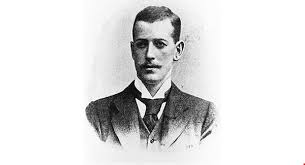
This is seventeen days before Alfred’s death on the 5th May 1897, and about six weeks before Frank’s wedding a month later on the 6th June.

ProvidenceRowPROVIDENCE (Row) NIGHT REFUGE AND HOME.—On Easter Sunday at the Providence (Row) Night Refuge and Home, Crispin Street, Spitalfields, E., in accordance with the custom of the late Mgr. Gilbert, a special dinner, consisting of hot soup, meat, potatoes, and bread, was provided for the inmates, who numbered over 300. In the absence of the Hon. Manager, Mr. Alfred Purssell, through illness, his son, Mr. F. W. Purssell, presided, and was supported by the Rev. M. Fitzpatrick, the Misses Purssell, Miss B. G. Munk, Mr. and Mrs. Secrett, Mr. J. W. Gilbert (Secretary) &c.

In the men’s refectory, Mr. F. W. Purssell gave a short address. He said that they came there on behalf of the Hon. Manager and the committee to bid the inmates welcome to the refuge. Whilst deeply regretting the misfortune which had forced them to accept its hospitality, he trusted that it might be the means of reinstating them in life. Although it was very hard to be poor, poverty was not necessarily a disgrace. The refuge had been established by the late Mgr. Gilbert to help the deserving poor, and his work was still being continued. There was every prospect this year of a revival in trade owing to the many public celebrations which were to take place, and he (Mr. Purssell) hoped that when Easter came round next year, all the inmates present would have homes of their own. In conclusion, he announced that the Rev. Mother would give each inmate sixpence as an Easter gift on leaving the refuge next morning. Three ringing cheers for the Rev. Mother and the Sisters of Mercy, and for Mr. Purssell were followed by dinner, which was served by the Sisters. The visitors then proceeded to the women’s room and to the servants’ homes, in each of which Mr. Purssell addressed a few kindly words to those present. During the course of the afternoon oranges were distributed, and additional fare was given at the tea in the evening. Altogether the poor people had a very enjoyable day, and the Sisters and visitors must have been gratified at the joy and happiness to which they by their help contributed.

The above text was found on p.36, 24th April 1897 in “The Tablet: The International Catholic News Weekly.” Reproduced with kind permission of the Publisher. The Tablet can be found at http://www.thetablet.co.uk .

Princess Mary at Crispin Street 1931

The Providence (Row) Night Refuge was founded in 1860, and heavily supported by Alfred Purssell, and his children, and sons-in-law almost from its foundation. Wilfrid Parker, Alfred Purssell’s  son in law, was chairman of the committee in 1931, Wilfrid’s nephew George Bellord was also on the committee. George’s father, Edmund Bellord (Agnes Purssell’s husband) had also chaired the committee. Frank Purssell had also been on the committee, and deputised for his father at times.

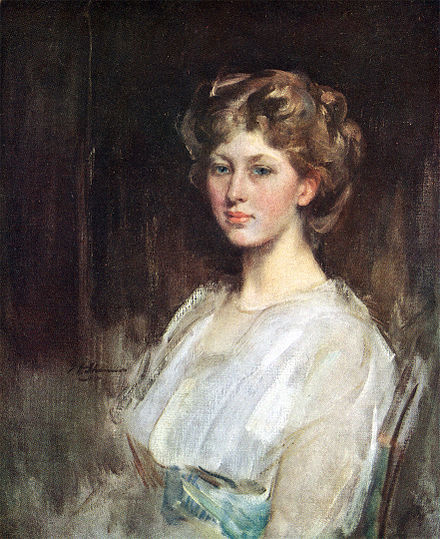
Princess Mary c 1930

In the course of its seventy years’ history the Providence (Row) Night Refuge has several times had the honour of welcoming members of the Royal House within its walls. The Prince of Wales visited the Refuge about four years ago; and on Friday last week Princess Mary presided at the annual Founder’s Day celebration, the third princess to accept the performance of that function; her Royal Highness’s predecessors were Princess Alice of Athlone, who presided in 1913; and Princess Marie Louise, in 1924. Founder’s Day at Crispin Street is always an occasion for enlisting the sympathy, by presence, of a distinguished chairman; no fewer than eleven Lord Mayors of London, it may be noted, and five Chairmen of the London County Council, have been among those presiding in past years. This year, the visit of Princess Mary gave added distinction to the occasion, and the present Lord Mayor, Alderman Sir William Phene Neal, attended among those who welcomed Her Royal Highness and expressed their welcome in words. With the Lord Mayor were the Bishop of Cambysopolis, representing His Eminence the Cardinal Archbishop; Viscount FitzAlan, the senior trustee of the charity; Alderman Sir Harold Downer, K.C.S.G.; Sheriff Collins ; the Mayor of Stepney (Mr. M. H. Davis, L.C.C.); Captain W. W. Parker, M.B.E., Chairman of the Committee; Sir John Gilbert, K.C.S.G., K.S.S., Secretary; Adele Countess Cadogan, and others.

Her Royal Highness, attended by Miss Dorothy Yorke as Lady-in-Waiting, took the chair. A bouquet was presented by Bona Leather, of St. Aloysius’ Secondary School, Clarendon Square, N.W. The speeches followed. First of all the Lord Mayor, expressing gratitude to the Princess for the honour of her presence, extolled the work of the Night Refuge and commended as an example the action of market workers in the City who had subscribed fifty pounds to its funds. Lord FitzAlan associated himself with the words of welcome ; and the Bishop, who followed, remarked, as representing the Cardinal, that His Eminence, in whose name he thanked Her Royal Highness for honouring the institution, took a deep interest in that as in all other good works in the Archdiocese. His lordship referred also to the beneficent labours of the Sisters of Mercy at Crispin Street, labours, he said, which included work that in its result often meant more than the value of food and shelter to the poor and needy who sought the Refuge. Monsignor Butt was followed by Sir John Gilbert, who briefly related some salient facts and figures in connection with the work, as, for instance, that since 1860 the Refuge has provided nearly 2,600,000 free nights’ lodgings, and 5,200,000 free meals, upon an organization plan aimed at securing the benefits of the deserving.

Princess Mary and the other guests afterwards paid a visit to the various parts of the Refuge. They found everything in its customary’ order ; the inmates for the night had been admitted as usual at five o’clock, and the only circumstance marking the rejoicing for the visit of Her Royal Highness was a special meal, provided by an anonymous benefactor and more satisfying in its character than any banquet of cakes and ale.

The valuable link between the Home and the Corporation of the City of London may be noted from an examination of the charity’s list of officers in the annual report. Sir John Knill, treasurer and a trustee, was Lord Mayor of London, 1909-10; Sir Henry T. McAuliffe, a trustee, has served for many years upon the Common Council and is Deputy-Alderman for Bishopsgate; Sir Harold Downer, a member of Committee, was Sheriff in 1924 before his election last year as Alderman for Coleman Street Ward. Similarly, an extensive “second generation” of workers for Monsignor Gilbert’s institution will be recognized. Sir John Knill’s offices were formerly held by his father, the late Sir Stuart Knill, London’s first post-Reformation Catholic Lord Mayor; as mentioned above, Captain W. W. Parker, son of the late Sir Henry Watson Parker, a well-known City lawyer, fills the chair of the Committee, as did his father-in-law, the late Mr. Alfred Purssell, a former member of the Corporation and the great personal friend of the Founder ; Mr. George Bellord has succeeded his father, the late Mr. Edmund Bellord, thirty four years a member of Committee and twenty-six years its chairman ; Mr. Joseph Towsey joined the Committee upon the death of his father, the late Mr. William Towsey, an original member with a record service extending from 1860 to 1926; Mr. J. Arthur Walton is the son of the late Hon. Mr. Justice Walton, a trustee for many years. Finally, Sir John Gilbert, a nephew of the Founder, will this year complete thirty-five years’ work as Secretary.

Princess Mary has had a letter sent to Sir John Gilbert expressing her deep interest in all she saw at the Refuge. Her Royal Highness wishes to show that interest by a grant from Queen Mary’s London Needlework Guild.

The above text was found on p.22, 2nd May 1931 in “The Tablet: The International Catholic News Weekly.” Reproduced with kind permission of the Publisher. The Tablet can be found at http://www.thetablet.co.uk .

Manchester – so much to answer for…….

The_Massacre_of_Peterloo
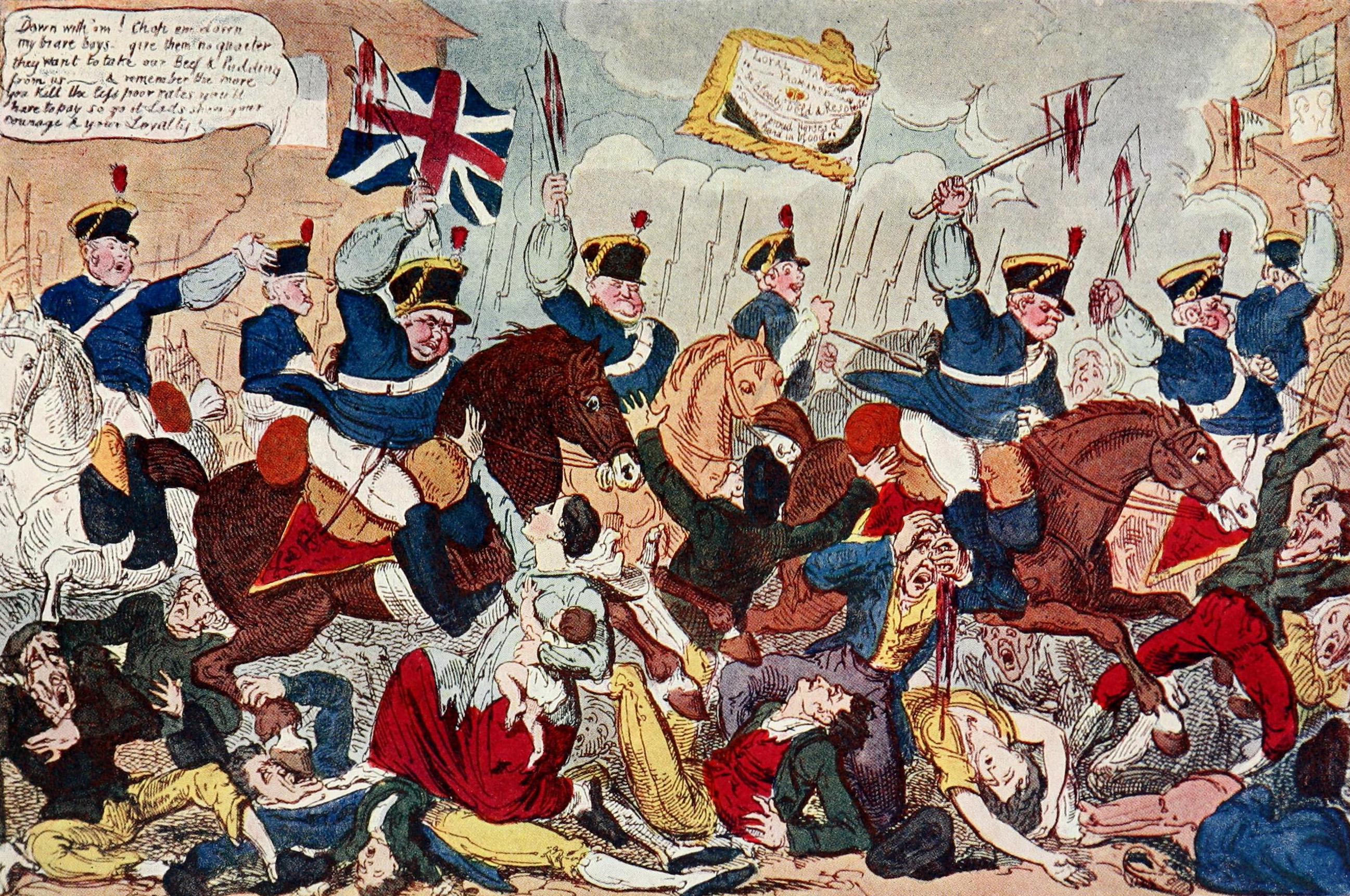
The Massacre of Peterloo, 16th August 1819

One hundred and ninety seven years ago yesterday, between 60 – 80,000 people gathered on St Peter’s Field in Manchester at a meeting for parliamentary reform. The crowd was charged by the Manchester and Salford Yeomanry, and the 15th Hussars; between 10 and 20 people were killed and hundreds more injured in what quickly became known as the Peterloo Massacre.

The Manchester & Salford Yeomanry were a relatively inexperienced militia recruited from among local shopkeepers and tradesmen, a large number ran or owned pubs.  For some reason, this came to mind .. “They smelt of pubs and Wormwood Scrubs, and too many right wing meetings.”

The Manchester Observer had recently described them as “generally speaking, the fawning dependents of the great, with a few fools and a greater proportion of coxcombs, who imagine they acquire considerable importance by wearing regimentals”  they were subsequently described as “younger members of the Tory party in arms”, and as “hot-headed young men, who had volunteered into that service from their intense hatred of Radicalism”.

They were also drunk.

Just after 1:00pm the Yeomanry received an order that the Chief Constable had an arrest warrant which he needed assistance to execute, and sixty cavalrymen of the Manchester and Salford Yeomanry, led by Captain Hugh Hornby Birley, moved into the crowd. As they became stuck, they began to panic, and began to attack the crowd with their sabres.

At about 1:50 pm, Lieutenant Colonel Guy L’Estrange commanding the 15th Hussars arrived; he ordered them into the field to disperse the crowd with the words: “Good God, Sir, don’t you see they are attacking the Yeomanry; disperse the meeting!”

The 15th Hussars formed themselves into a line stretching across the eastern end of St Peter’s Field, and charged into the crowd. At about the same time the Cheshire Yeomanry charged from the southern edge of the field.

At first the crowd had some difficulty in dispersing, as the main exit route into Peter Street was blocked by the 88th Regiment of Foot, standing with bayonets fixed. One officer of the 15th Hussars was heard trying to restrain the, by now out of control, Manchester and Salford Yeomanry, who were “cutting at every one they could reach”: “For shame! For shame! Gentlemen: forbear, forbear! The people cannot get away!”

By 2:00pm the crowd had been dispersed, leaving eleven dead and more than six hundred injured.

Peterloo was hugely influential in ordinary people winning the right the vote; it led to the rise of the Chartist Movement, which in turn led to the formation of Trade Unions; and it resulted in the foundation of the Manchester Guardian newspaper.

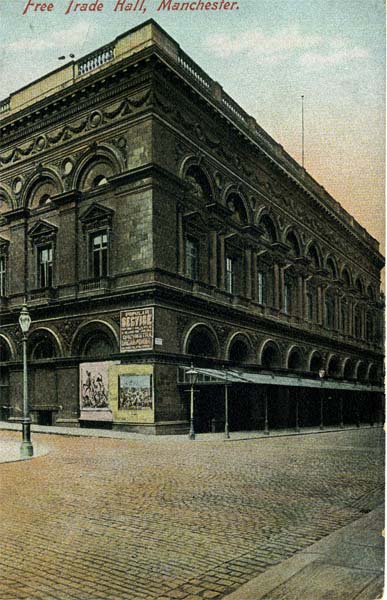
freetradehallcard
Free Trade Hall, Manchester

Percy Bysshe Shelley was in Italy, and did not hear of the massacre until 5 September. His poem, The Masque of Anarchy”, subtitled “Written on the Occasion of the Massacre at Manchester” was sent for publication but not published until 1832, thirteen years after the massacre, and ten years after Shelley’s death.

The Free Trade Hall in Manchester, built to commemorate the repeal of the Corn Laws in 1846, was also partly built as a “cenotaph raised on the shades of the victims” of Peterloo. The land it was built on was given by Richard Cobden.

This isn’t really a shameless attempt to bring in the UK’s second greatest city (you can pretty much guess the gold medal winner), well it probably is. Ok, so, Manchester, one of the world’s great cities, along with London (obviously), Venice, Florence, New York, probably Glasgow………

Anyway,  Sir Joseph Thackwell, GCB, KH, (1781 – 1858) commanded the 15th Hussars from 1820 to 1832. So he may well have been at Peterloo. It’s probably too much to hope he was the officer “trying to restrain the out of control Manchester and Salford Yeomanry”, but it is at least possible. But, a year after the massacre, he was in command of the regiment.

He was, later, a lieutenant general in the British Army. He had served with the 15th Hussars in the Peninsular War at Sahagún (1808) and Vitoria (1813), and lost his left arm at the Battle of Waterloo in 1815. He was promoted to a major at Waterloo, and made a brevet (honorary) lieutenant-colonel in 1817. So he was almost as senior as Lieutenant Colonel Guy L’Estrange, but didn’t out-rank him on the day. Guy L’Estrange does sound like one of Becky Sharpe’s conquests………..

But on the day, with a joint operation combining the Manchester and Salford Yeomanry, the Cheshire Yeomanry, and the 15th Hussars, he would have had equivalent rank to L’Estrange.

Joseph Thackwell commanded the 15th Hussars from 1820 to 1832. He then served in India, commanding the cavalry in the First Anglo-Afghan War (1838–39), the First  and Second Anglo-Sikh Wars (1845–49). The reason for bringing this in to our story is that he had married Maria Audriah Roche, [eldest daughter of Francis Roche of Rochemount, County Cork (an uncle of Edmond Roche, 1st Baron Fermoy).] in 1825,  and, more importantly, he bought Aghada Hall n 1853, and died there in April 1859.

So, Joseph Thackwell was the first person to own Aghada since John Roche had built it in 1808. The house had been in the Roche family for forty five years, but JR’s dream of creating a Roche dynasty, with a landed inheritance, had failed. Both male Roche heirs, his nephews’ James Joseph, and William, had died without male heirs. So the estate was sold with the beneficiaries being JJ, and William’s daughters.

Lady Thackwell [Maria A. Roche] shares a surname with John Roche, and his heirs, but is at best a tangential relation, and more likely no close relation at all. Her branch of the Roche family were neighbours of “our” Roches, substantial landowners in county Cork, important and influential, – Maria was a first cousin of the 1st Baron Fermoy; which coincidentally makes her the first cousin five times removed from Diana, Princess of Wales. But when it comes down to it, probably not much more than someone deciding – “you know that nice house down on Cork harbour, quite close to a lot of my family……… can we buy it?”

Peterloo also resonates in other parts of the story…… It’s a shocking, shameless, massacre. It is not defendable in any way. The crowd attendance was approximately half the population of the immediate area around Manchester. But it led to the  Great Reform Bill of 1832, it led to the repeal of the Corn Laws in 1846 in part through the efforts of Richard Cobden, and, amongst others, his next door neighbour Sir Joshua Walmsley, – another character in our story.

But most of all, one hundred and ninety seven years on, we should doff our caps to the people of Manchester.

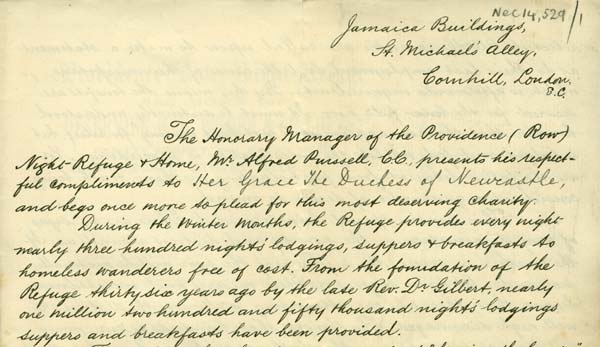
Alfred Purssell writes a begging letter in 1896

The Providence (Row) Night Refuge was founded in 1860, and heavily supported by Alfred Purssell, and his children, and sons-in-law almost from its foundation. Wilfrid Parker, Alfred Purssell’s  son in law, was chairman of the committee in 1931, Wilfrid’s nephew George Bellord was also on the committee. George’s father, Edmund Bellord (Agnes Purssell’s husband) had also chaired the committee. Frank Purssell had also been on the committee, and deputised for his father at times.

AP begging letter
Alfred Purssell’s letter, probably from 1896,


Jamaica Buildings,
St Michael’s Alley,
Cornhill, London
EC


The Honorary Manager of the Providence (Row) Night-Refuge & Home, Mr Alfred Purssell, C.C., presents his respectful compliments to Her Grace The Duchess of Newcastle, and begs once more to plead for this most deserving charity.

During the Winter Months, the Refuge provides every night nearly three hundred night’s lodgings, suppers & breakfasts to homeless wanderers free of cost. From the foundation of the Refuge thirty six years ago by the late Rev. Dr. Gilbert, nearly one million two hundred and fifty thousand night’s lodgings suppers and breakfasts have been provided.

The work of the charity does not end at “feeding the hungry” and “harbouring the harbourless”. It is also the means of enabling many of those, who find shelter within the walls of the Refuge, to begin life afresh, and to obtain again a position for themselves in the world. Those, for example, who through dire necessity, to save their families from starvation or worse, have parted with their tools, are enabled to recover them: sellers of fusees (large matches), flowers, newspapers, bootlaces, and the like, without hope or money, are supplied with a little stock: rent is paid and a small allowance granted to mothers and children, when the breadwinner through sickness is unable to work: the ragged are also clothed and situations obtained for them.

It is specially desired to call the attention of the charitable to some distinguishing marks of the Charity. In the first place it is absolutely non-sectarian. There are no questions as to nationality or creed. Whilst there is accommodation in the Refuge, no bona-fide applicant is refused, the sole passport necessary being genuine poverty and want. Secondly no effort is spared to secure the benefits of the Charity for the really deserving. The imposter, the professional beggar is soon detected. All the inmates are called upon to make a statement as to their last employment, and the cause of their misfortune, which is afterwards inquired into. By this means the benefits are secured for the bona-fide poor. It must be distinctly understood however that the poor applicant is not kept waiting for relief, but is lodged and fed, whilst the investigation is proceeding. Nor are the fallen debarred from participating in them, truth being considered a guarantee of desire to amend.

This winter special help is needed. There are no signs of any diminution in the poverty and distress around us. If the weather is severe, the sufferings of the poor will be materially increased. At times so great do their misery and wretchedness become, that those who are attempting to alleviate the distress are well nigh discouraged. The thought that hundreds of men, women and even children have in the depths of winter no home but the streets is simply appalling. There is a worse aspect to the question than this. How many of our poorer brothers and sisters in this vast metropolis are driven to crime. As degradation, by the want of food and shelter. Men and children become thieves; women and girls, alas! Barter their most valuable possession, their priceless innocence for food and shelter. These unfortunate ones find in the Refuge the means of reforming their lives, and of turning their backs for ever on the sinful past.

Will you kindly help the Committee of the Providence (Row) Night Refuge and Home in their great work amongst the poor? If you could pay a visit to it, one night during the winter months, and see for yourself the good that is being done by it, you would willingly do so.

Hear the opinions of some who have visited it:- Mr James Greenwood, the “Amateur Casual”, writing in the “Ludgate Monthly” has said “Outcasts of all kinds and from all parts find shelter there, and all are sure of something for supper and a bed, and a big roll, and a mug of cocoa ‘as a comforter’, “before they start on their way next morning…. The Managers of the Home have been thus unostentatiously engaged for many years, and the good they have effected is incalculable.”

The late Mr Montague Williams Q.C., in “Later Leaves” says of this Refuge: “There is no more Excellent institution…. The place is beautifully clean…. This institution, which is not nearly so well known as it deserves to be, is in the heart of Spitalfields.”

The “Daily Chronicle” has said: “Christianity is certainly not played out at the corner of Crispin St., and Raven Row, although it may be doubled, whether it ever found more depressing material to work upon.”

As an example of the distress, which exists in our midst may be mentioned that in the Refuge last year, amongst those assisted were an Architect, an Optician, clerks, waiters, valets, woodcarvers, ivory-turners, weavers, painters, a professor of music, a linguist, certificated teachers, dressmakers, domestic servants, etc., etc.

In addition to the Refuge, there are two homes, one for Servants, who partially support themselves by work, the other where women out of engagements can board and lodge at a small cost per week, whilst searching for situations.

An especial appeal for help is made this year, in order that funds may be raised to extend the work, which has now been carried on so effectively for thirty-six years. The Refuge was founded by the late Rev. Dr. Gilbert in 1860 with fourteen beds. It has now accommodation for nearly three hundred. Will you assist in extending the good work?

The smallest donation will be gratefully acknowledged, and the heartfelt prayers of the hungry you help to feed, of the houseless you help to lodge, the naked you help to clothe, the fallen you help to brighter and happier lives will be bound to

http://spotlight.nottingham.ac.uk/story001/viewImage.asp?page=4&image=2

Captain William Hayes, D.S.O

He is Pauline Roche‘s eldest grandson.

Captain William Hayes, D.S.O., Queen’s (R. West Surrey) Regt. and Staff Captain, died on October 20, at a stationary hospital abroad (Genoa) , of pneumonia following influenza.. He was the eldest of the three sons of the late Major Patrick Aloysius Hayes, R.A.M.C., and of Lady Babtie, and step-son of Lieut.-General Sir William Babtie, V.C. Born in 1891, he was educated at Beaumont and Sandhurst, and was gazetted to the Queen’s in 1911. With the 1st Battalion he accompanied the original Expeditionary Force to France, taking part in the Mons retreat and the battles of the Marne and the Aisne, in the latter of which he was very severely wounded. He returned to the Front in 1915, joining the 2nd Battalion of his regiment, but was soon afterwards invalided as a result of shell concussion. In 1916 he rejoined the 2nd Battalion in time to take part in the battle of the Somme. He was appointed second in command, with the temporary rank of major, and for his services in that capacity while in temporary command of his battalion was mentioned in dispatches, and awarded the D.S.O. in 1917. Later in that year he proceeded to another front, and in 1918 he was appointed Staff Captain on the lines of communication. He had just returned from leave in England when attacked by influenza. One who knew him writes :—” A keen soldier, whose heart and soul was in the honour and credit of the Queen’s, he was a man of character and of great personal charm, and his memory will live long in the hearts and minds of his regiment and of his multitude of friends in and out of the Army.”

The above text was found on p.18, 2nd November 1918 in “The Tablet: The International Catholic News Weekly.” Reproduced with kind permission of the Publisher.  The Tablet can be found at http://www.thetablet.co.uk .

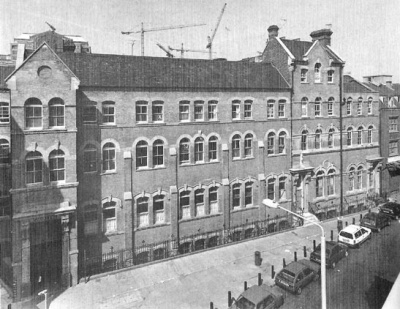
The Providence (Row) Night Refuge in Crispin-street.

ProvidenceRow
Providence Row Night Refuge

Between 1860  and 1931 the Refuge provided nearly 2,600,000 free nights’ lodgings, and 5,200,000 free meals. The article below originally appeared in the Standard in 1905. It’s a jaw-dropping piece of journalism.

In the series of articles by Mr. L. Cope Cornford now appearing in The Standard, on “the Canker at the Heart,” the writer in Tuesday’s issue gave a description of a visit paid to the Providence (Row) Night Refuge in Crispin-street.

Upon the evening of November 1st, the Providence (Row) Night Refuge, in Crispin-street, which adjoins Bishopsgate-street Without, opened its doors. Men and women, with children, who had waited patiently for hours in the rain, fought to get in. Some hundred and forty men, a little over a hundred women, and fifteen children were admitted. Very many were perforce turned away.

Now, this particular refuge has certain characteristics that distinguish it from others. Every one is admitted free, irrespective of creed. Everyone must give an account of himself, or herself, which is taken  down in writing, and each case is subjected to inquiry. About three out of five are in practice, found to be true accounts. Should they be proved fallacious, the ticket which all receive, entitling them to five nights’ board and lodging, is not renewed. In genuine cases the tickets are renewed, entitling the recipient to a further fifteen nights’ lodging. Upon their entrance a bowl of cocoa and a small loaf are given to all. The people eat, sitting at the scrubbed deal tables in the clean lofty rooms, which are warmed and pleasantly lighted. Then they have their baths and go to bed. They sleep in great dormitories, in wooden bunks, raised about eighteen inches from the floor. The mattress and pillow are covered with American cloth ; the covering is a hide of leather. The whole place is kept absolutely clean. By means of the particulars obtained with regard to the circumstances of each person, differentiation is established, and the sisters of charity are often able to get work for the women, while the secretary and manager, Mr. J. W. Gilbert, does what it is possible to do, in the present unorganised condition of the labour market, for the men. There are a school for girls and infants and a training establishment and home for girls who desire to be domestic servants, or who are waiting for a place. These establishments are also conducted by the sisters.

WHAT THE REFUGE DOES.

From the economical point of view, it may, of course, be said that the Providence Night Refuge encourages the wastrel, in so far as it gives food and lodging to more persons than it can benefit permanently by setting them to earn a livelihood. On the other hand, it may be said that such an institution does as much as any private enterprise can hope to do, in the absence of any State provision for dealing with surplus labour or habitual idleness. It finds work where it can ; it gives the man and woman every opportunity and every encouragement to find work for themselves : and, above all, it distinguishes one case from another, and conducts a careful and most laborious inquiry into its circumstances. It also enforces conditions which serve to eliminate to a large extent the kind of person who gives a bad name to the common lodging-house and the casual ward. It does in fact, very much what the casual ward was intended to do, and which it has lamentably failed to accomplish—it gives a man down on his luck another chance, without too much encouraging the professional idler.

Public recognition of the Providence Night Refuge has so far manifested itself in an attempt made by the London County Council to register the place as a common lodging-house, in an action brought against it by the Council with the object of enforcing registration, and in the eventual failure of that action consequent loss of ill-spent public money. Now who and what are the people who take refuge here ? Glance down the rows of seated, quiet figures in the men’s room, and you shall see the familiar types, the familiar aspect of dull resignation. Here are two sturdy labourers, young men of 20, grey-haired men of the clerkly kind, their clothes the respectable clerkly black, elderly nondescripts, the youngster who has grown out of his boy’s job and boy’s pay, to be sent upon the streets by his employer ; ex-soldiers, of course ; and a few indubitable wastrels, who will be sifted out very shortly. On the whole, the remarkable thing about this assembly is its respectability.  Look down the half-dozen lines which make the written record of each case, and you shall see that the most of them are described as employed ” on and off.” They are, in fact, casual labourers, of whom there are so many in London to-day—the reserve of Labour of the economist—that under no conceivable circumstances could they all be employed at once in full work. Here and there is the record of a skilled artisan, “discharged in time of slackness,” Occasionally, “was in trouble.”

THE WOMEN AND CHILDREN.

But with the men we ,have already made-acquaintance, in the street, in the shelter, in the common lodging-house, and in the casual ward. Here is but a variation of the individual, not of the type. But what of the women and the children ? Cross the passage, and you shall see the bitterest sight in all broad England, the homeless woman and child.

Tables are set along the sides of the ball, and the women and children sit on either side of the tables. The black-robed sisters who take the records of each person, who call the roll, and who superintend the serving of the meal, sit at small tables in the clear centre space. These are kind and wise women, of an unfaltering courage and devotion. (The society has just lost a sister who for forty years gave herself to the care of the destitute.) Now glance down the ranks of patient women, who are so tired that they do not care to talk one with another. Worn, lined faces are they all, near defeatured of all expression save that of endurance. Many are old, white-haired. They have the dignity of age, which is still the sign of an honest, hard-fought life. They are beaten at last, poor souls, but they are courageous still

One chooses to relate these things in the baldest plain outline. For if their mere recital does not serve to proclaim the indelible shame and unforgivable wickedness of the wrong done to helpless children every day, every hour, in the dark places of the great towns, and the peril of the accumulating black debt which our sons and sons’ sons will surely have to pay to the last farthing, then it would avail nothing were the truth to be heralded by the trumpet of the Archangel, and written across the whole vault of heaven.

Whose is the fault, and whose the responsibility? Those are questions which each must answer for himself. The good people of the Providence Night Refuge have answered it. That is why I have taken you there.

The above text was found on p.15, 11th November 1905 in “The Tablet: The International Catholic News Weekly.” Reproduced with kind permission of the Publisher. The Tablet can be found at http://www.thetablet.co.uk .

There are some photographs of the closing of the building on the spitalfields life website http://spitalfieldslife.com/2013/10/03/farewell-to-the-crispin-st-night-shelter/

The death of the Right Rev. 13th Lord Petre, 1893

The reason for including some of the Petres is partly they are a great story, and also that at George Lynch, and Carmela Lescher’s wedding, the present from “the Hon. Mrs. Petre” was “a writing case”.  She can only be Julia, who becomes the 15th Lady Petre in June 1908, and the Dowager Lady Petre five months later.

We regret to record the death of the Right Rev. Lord Petre, which took place at his London residence, 21, Hyde Park Gardens, on Monday last. The deceased Peer and Prelate was a son of the 12th Baron, by a daughter of the Hon. C. T. Clifford, and succeeded to the title in 1884. He was a Domestic Prelate at the Court of the Vatican, and a Deputy-Lieutenant for the county of Essex. The title goes to the late Lord Petre’s brother, the Hon. Bernard Henry Philip, who was born in 1858. Lord Petre was educated at Stonyhurst, leaving which College he attempted, but unsuccessfully, to embrace the religious life with the Jesuits. Failing this he resolved to pursue the vocation of a secular priest, and resided for some time at Downside, where his great benefactions are remembered with gratitude. Meanwhile he had long been cherishing a number of plans and giving expression to many desires in connection with the education of youth, and a few years after his ordination he resolved to take practical steps in carrying out his determination.

It was in 1877 that Lord Petre, then the Hon. and Rev. Mr. Petre, founded his school at Woburn about which there was destined to arise so vigorous a controversy. He had long been maturing his views upon the method of education in vogue among Catholics, and those views he presently strove to vindicate in two vigorous pamphlets which produced in the English Catholic world an enormous sensation. The first he entitled Remarks on the Present Condition of Catholic Liberal Education and this was quickly followed by The Problem of Catholic Education. His ideal, as explained in these two pamphlets, is well known to all, and need not be brought up again here. His one desire in life was to be a trainer of youth. “A French poet,” he wrote “once declared that God for his sins made him a poet. I fear I myself lie under a similar judgment for being an educator. Certain it is that for years my prayers, studies, and aspirations have been directed to this one aim—to train the minds of youth. But for one of my vocation what opening is there ? Stonyhurst, Downside, Edgbaston, Beaumont, are all charmed circles, the properties of closed corporations, offering nothing to persons situated as I am except on condition of assuming the religious state—a vocation not granted to all. Ushaw, Oscott, St. Edmund’s are in a state of transition, being in part ecclesiastical seminaries and wholly diocesan property. In existing institutions, therefore, there is no place for the free exercise of a vocation that I will venture to call holy. Can I then be blamed if unwilling to throw aside the work of years, and contradict the tried impulse of my character, I venture to open a school of my own ? Nor can I see that by so doing I am fomenting disunion. Disunion arises where private aims are preferred to the public good. From the nature of the case my views can hardly be sordid or selfish ; and I propose, if God gives me health and strength, to lay all my opportunities and powers at the service of the Catholic cause. I have no wish to avoid a healthy criticism, and I will accuse no one of ‘ attack ‘ who may choose to publish his opinion on the growth of my work—be that opinion hostile or the reverse. With advance I shall hope for co-operation. Surely the imputation of disunion or disloyalty can find no footing here.”

In this spirit, then, Woburn was founded, and lasted steadily until 1884, when, shortly before succeeding to the title, he sold the property in deference to the wish of his father. After his father’s death he continued no less fervently in his desire to treat education, as he himself expressed it, “as something of a fine art.” But circumstances were too strong for him. He migrated with his boys to Northwood, in the Isle of Wight. But the new school lasted for a very short time, and when he decided to give up the idea of personal training he practically decided to retire into privacy.

Into the merits of the great controversy upon which Lord Petre so confidently embarked, there is no need to enter here. As to the spirit in which he accepted his task there can be only one opinion. He fought for it with a high spirit that seemed indomitable. In his first pamphlet, not having had much practical experience in pamphleteering, he committed himself—as he himself confessed—to some incautiously expressed propositions relative to the Protestant public schools of England. He spoke in praise of the individuality and the force of character which seems to be so often generated and fostered by their influence among English youth, wished to contend that schools formed somewhat on the model of public schools but informed with Catholic spirit and principle might realize much for English Catholics which heretofore had existed but in desire ; that Catholics, in short, might see their sons growing up in the expansion of mind, definiteness of aim and earnestness of purpose which is said to distinguish their Protestant fellows. At once he was severely taken to task. At once he felt that nothing but a bold front,—an attitude even of defiance—would save his reputation as a Catholic. Such an attitude he declared himself to have unwillingly assumed, and in doing so he lost for the time many valued friends.

The precise value of Lord Petre’s influence over the common scholastic ideal of the time cannot be easily adjudged ; but there cannot be the least doubt that, indirectly at least, he spurred up all the colleges of England to new efforts in the training of their subjects, particularly in the inculcation of a certain refinement which heretofore had been allowed to stand somewhat at a discount. But, as we have said, for nearly eight years he had taken no prominent part in any question of the day. Readers of these pages may, however, remember that when some years ago, a warm controversy arose upon the merits of corporal punishment, Lord Petre took an active part in it, and upon the side where one naturally expected to look for him. His illness was very brief. He had been ailing somewhat ; but on Sunday a serious attack of epileptic fits seized him, and later in the same day he received the Viaticum from Cardinal Vaughan in full consciousness. Later Mgr. Gilbert administered Extreme Unction. He died at 1.30 p.m. on Monday. The body lay in the house in a temporary chapel until Thursday, when it was removed to St. Mary of the Angels, Bayswater. On Friday Solemn Requiem Mass was sung, and to-day (Saturday) the coffin will be conveyed for interment to Thorndon. R. I. P.

The above text was found on p.28, 13th  May 1893 in “The Tablet: The International Catholic News Weekly.” Reproduced with kind permission of the Publisher. The Tablet can be found at http://www.thetablet.co.uk .

The funeral of the 14th Lord Petre 1908

The reason for including some of the Petres is partly they are a great story, and also that at George Lynch, and Carmela Lescher’s wedding the present from “the Hon. Mrs. Petre” was “a writing case” . She can only be Julia, who becomes the 15th Lady Petre in June 1908, and the Dowager Lady Petre five months later.

chapel ThorndonParkThe funeral of Lord Petre took place at Thorndon Hall, Brentford, on Monday morning. A Requiem Mass was celebrated in presence of the Archbishop of Westminster, and the music was rendered by fourteen members of Westminster Cathedral Choir, under the conductorship of Mr. R. R. Terry. The following music was sung :—In the chapel : “Dies irae,” Anerio ; “De Profundis,” Tollemache ; ” Ne irascaris,” .Farrant; ” Libera me,” Casciolini ; “In Paradisum,” Gregorian ; and during the procession : ” Miserere,” Viadana ; ” Benedictus,” Terry. The priests taking part in the service were Father Norris, Father Musgrave, Father Grant and Father Shepherd. After the Requiem the body was laid to rest in the private cemetery in the grounds. A large number of people attended and all the chief county families were represented. Among the mourners were the Hon. Philip Petre (who succeeds to the title), and the Hon. Mrs. Petre, Mr. Lionel Petre, and Miss Petre, the Hon. Albert and Mrs. Petre, the Earl of Granard, Mr. and the Hon. Mrs. Bretherton, Count and Countess Blucher, Mr. and Mrs. S. H. Petre, Mr. Lawrence Petre, Miss Agnes Petre, Mrs. Chadwick, Lord Clifford, Lord Mowbray and Stourton, Mr. F. L. Petre, Mr. 0. T. Petre, Mr. B. Petre, Mr. Lydden Clark, Mrs. de Windt, Lord Howard, Sir Henry Bedingfeld, ord Howard, and Mr. R. Bedingfeld. R.I.P.

The above text was found on p.15, 27th June 1908 in “The Tablet: The International Catholic News Weekly.” Reproduced with kind permission of the Publisher. The Tablet can be found at http://www.thetablet.co.uk .

The marriage of Captain Edmund Molyneux Seel to Miss Clare Weld Blundell – 1894

The marriage of CAPTAIN EDMUND MOLYNEUX SEEL to MISS CLARE WELD BLUNDELL, youngest daughter of the late Mr. (Thomas) Weld Blundell, of Ince Blundell Hall, was solemnized at St. Mary’s, Chelsea, on Tuesday. The ceremony was performed by Cardinal Vaughan, assisted by Father John Vaughan and the Rev. Benedict Weld Blundell, O.S.B. The nuptial Mass, a Missa cantata, was sung by Father Adrian Weld Blundell. The bride, whose dress was of white satin, trimmed with old lace, with tulle veil, was given away by her brother, Mr. Henry Weld Blundell. Mr. Basil Scott Murray acted as best man. There were six bridesmaids—the Hon. Mary Fraser, Miss Helen Lane-Fox, Miss Dorothy Lane-Fox, Miss May Weld, Miss Lawson, and Miss Teresa Lawson. They wore costumes of green. faced cloth, trimmed with white moire, and black picture hats with black feathers and white lace. After the Mass a large gathering of friends and relatives assembled at 20, Cadogan Gardens, the residence of Mr. George Lane-Fox,[ the bride’s brother in law, through his second wife Annette Weld-Blundell, who he married in 1879] where the wedding breakfast was served. Later in the afternoon the bride and bridegroom left for Dover, en route for the Continent.

Among the wedding presents, which were exceedingly numerous, were : The Duke of Norfolk, diamond and turquoise brooch ; the Ladies Howard, diamond and sapphire brooch ; Lord Lovat, diamond ring ; Lady Lovat, silver tea set ; Lady Herbert of Lea, diamond and turquoise bracelet ; Mrs. G. Lane-Fox, diamond and enamelled brooch ; Mr. George Lane-Fox, a luncheon basket ; Lord and Lady Herries, fan ; Colonel Blundell, pearl and diamond pendant ; Mr. and Mrs. Johnstone, diamond watch bracelet ; Miss Lane, Fox, silver castors ; Lady Charlotte Dundas, silver mounted scent bottle ; Mrs. Hornyhold, ditto ; the Earl and Countess of Loudoun, silver mounted inkstand ; the Hon. B. and Mrs. Maxwell, pearl and diamond necklace ; Mr. Henry Weld Blundell, diamond ring ; the Hon. Mrs. Carrington Smyth, pearl and diamond locket ; the Right Rev. Mgr. Weld, enamelled writing set ; Mr. and Mrs. Robert Walmesley, pearl and diamond aigrette ; Mrs. Weld Blundell, silver mounted dressing bag ; Captain and Mrs. Edward Molyneux Seel, old silver punch bowl; Colonel and Mrs. Eyre Williams, silver mounted claret decanter ; Mrs. Wilmot, silver bowl ; Mr. and Mrs. Bullock, silver dishes ; the Dowager Lady Puleston, silver cigarette case ; Mrs. Charles Weld, lace fan ; the Hon. Lady Mostyn, silver mirror ; Mr. and Mrs. O’Brien, Venetian mirror ; Mr. and Mrs. J. Snead Cox, Dresden figures ; Lady Stafford, jewelled clock, &c. ; Colonel Wade, silver side-dish ; Mrs. Silvertop, silver-gilt salt cellars; Colonel and Mrs. Starkie, gilt spoons ; the Hon. Mrs. A. Fraser, silver spoons.; the Hon. Miss Fraser of Lovat, pearl and diamond bracelet ; the Hon. Ethel Fraser of Lovat, pearl and diamond brooch ; the Dowager Countess of Denbigh, silver tray ; Miss Molyneux Seel, silver lamp ; Miss Monica Walmesley, gilt box ; Captain and Mrs. Glynn, silverspoons ; the Hon. Mabel Sturt, silver jug ; the Hon. Teresa Maxwell, gold snuff-box ; the Hon. Mrs. Charles Petre, gold bowl ; the Count and Countess Torre Diaz, silver tea-maker ; Mrs. Ince Anderton, silver clock ; Lady Henrietta Riddell, silver bowl ; Lord and Lady Camoys, silver mounted paper cutter ; Mr. and Mrs. Parker, decanters ; Mrs. Molyneux Seel, silver Queen Anne coffee-pot ; Mr. H. Campbell, Crown Derby tea set ; Mr. and Mrs. F. Bretherton, Lord Lytton’s works ; the Hon. Mrs. Dundas, old silver mounted quaighs ; Mr. and Mrs. Day, ditto ; Mr. and Mrs. F. Langdale, ditto ; Sir P. and Lady Radcliffe, silver cruets ; the Hon. Mrs. Scott Murray, silver tea urn ; Mr. and Mrs. Walter Weld, silver coffee-pot ; the Hon. L.:.dy Sausse, silver fruit dish ; Mrs. Slade, silver candlesticks ; Mrs. Dalgleish Bellasis, silver vases ; Mrs. Fitzherbert Brockholes, silver vase ; Sir Henry and Lady Bedingfeld, silver vases ; Lady Vavasour, two pictures ; Mr. and Mrs. Russell Howell, antique silver spoons ; Major and Mrs. Ovred, gold and tortoiseshell umbrella ; the Hon. Albert and Mrs. Stourton, gilt box ; Mgr. de Stackpoole, silver box ; Marquise de Stackpoole, silver frame ; Mrs. William Langdale, ditto ; Colonel Thompson, King’s Regiment, silver mounted brushes ; Miss Weld of Leagram, Dresden china clock ; Mr. F. Lane-Fox, silver card. case ; Mr. and the Hon. Mrs. Stapleton Bretherton, mother-of-pearl opera glasses ; Mr. Herbert Stourton, silver salt cellars ; Miss A. Vavasour, oak chair ; the bridegroom, pearl necklace, and many others.

The above text was found on p.24, 3rd November 1894 in “The Tablet: The International Catholic News Weekly.” Reproduced with kind permission of the Publisher” The Tablet can be found at http://www.thetablet.co.uk .