Emily Foreman’s Uncles and Aunts

Emily Foreman is John Gray’s second wife, and John Laverton Foreman’s daughter

Wheelwright's workshop
Wheelwright’s workshop

Emily’s grandfather George Foreman Snr was born in 1802 in Warminster and died in about 1870. He was a wheelwright, so a skilled working man. Eliza Laverton was born two years later in 1804 in Shepton Mallet in Somerset, and they married in 1825. Eliza died in London in the autumn of 1860. They are my great great great grandparents. George and Eliza had nine children.

  • George Foreman Jnr. b. 1827
  • Walter Foreman b.1829
  • Seleana Foreman b. 1833
  • John Laverton Foreman b.1834
  • Richard Foreman b. 1835
  • Joseph Benjamin Foreman (Josh) b. 1837
  • Albert Foreman b. 1840
  • Alfred E Foreman b.1844
  • Sophia A Foreman b. 1847

The family were in Nelson Place Bristol by 1841, moved to Barnet by 1851, and then to Bermondsey by 1861. The majority of the boys are all wheelwrights at various times, in Albert’s case having been a gunner in the Royal Artillery.

By 1851 the family had moved to Nursery Row, Mimms Side, Barnet in Hertfordshire.  Where George Foreman Snr was working as a wheelwright, and George Jnr, then aged 24, as a coach wheelwright. 18 year old John was a labourer,  and Josh (Joseph) Foreman was a14 year old errand boy. Albert, Alfred, and Sophia were all at school.  There is no trace of Seleana, Richard, or Walter, though Walter re-surfaces again in 1871.

Royal Artillery Barracks,Woolwich 1900

By 1861, they are all starting to move properly into adult life. Eliza  has  died in the autumn of 1860.  The Georges Senior and Junior  are living in Southwark with Alfred and Sophia. 22 year old Albert has joined the army, and is in Woolwich Barracks.

JLF is 27 years old, married with a child, Emily, and living at 17 White Place, Bermondsey with Catherine’s widowed 71 year old mother (GGG Granny). John has obviously learned a trade by then because he describes himself as a boilermaker working in Hammersmith. In 1851, he was listed as an 18 year old labourer, and the Georges Senior and Junior, are working as a wheelwright, and a blacksmith respectively. Alfred is a “moulder”, and 14 year old Sophia is working in the silk trade.

There doesn’t appear to be any trace of Walter, Richard, or Selena.

By 1871, JLF is still living in Bermondsey, but at 27 Mint Street, with 12 year old Emily, and her 9 year old brother George Laverton Foreman. Ellen Montgomery, Catherine’s mother is still living with them having reached 81. Ellen’s place of birth is still listed as Liverpool, but Catherine’s place of birth has changed from Liverpool in the 1861 census, to Dublin in 1871.

Alfred has joined the Navy, and is serving on HMS Barrosa, which is at the Singapore Straits Settlement on the night of the census. He is 27 that year, and John Laverton Foreman is ten years older.

However Walter has reappeared living in Spital Road, New Windsor in Berkshire. He is now 42 years old, married and describes himself as a coach maker master employing 2 men. His wife Mary is a year older than him.

Sophia has moved out and is lodging with a policeman, and his family. She is 24, and working as a machinist, and living at 38 Frances St, a couple of streets north of Waterloo station.

There is no trace of the Georges Senior and Junior, Joseph, Richard, Serena, or Albert.

The Turks Head, 711 Old Kent Road c.1880

1881 is when it all appears to get interesting. John is still living in Southwark, but now at 12 Darwin Street. He is a 48 year old widower living with his son George who is 19 and describes himself as a teacher (Unemployed) (Schoolmaster), and 22 year old Emily, who marries John Gray two years later on October 21st 1883 at St Philip’s Church Camberwell,when he is 63 and she is 25, and are both shown living at 746 Old Kent Road.

Meanwhile over in Islington at 5 Hollingworth St North, in 1881, there is a very strange household.  No 5. was shared  with Richard and Mary Parker, and their six sons, three teenage, three younger, the youngest being four.  It was also shared with the Sable family with two sons, and two daughters. The census return for the third household in the building is as follows

  • George Foreman 61  head,   wheelwright,   wilts, warminster 
  • Carrie Foreman 45    wife                                surrey,lambeth
  • Albert Foreman 41    son      wheelwright,   somerset,bristol

The ages in this don’t appear to match up for it to be George Senior who should be 79, and if it is George junior he would be about 54. However they are right for Albert, and the professions, and places of birth are right. I’ll come back to the curious household later. or see this post.

However by now, Walter is still in Spital Road in Windsor. This time in Grove Cottage, which may,or may not have been the same address as 1871. This time he lists himself as a wheelwright employing two boys, rather than a coach-maker as previously. Richard Foreman has resurfaced as well, this time at 25 Brownlow Rd, Shoreditch, where he and his wife Elizabeth are sharing their house with a twenty four year old lodger.

Saint George Church, Hanover Square

Back in London, Alfred has come out of the Navy, and is living  at 10 Short St, New Cut, Waterloo with his wife and two year old daughter. They are about two miles away from John, and about three from George and Albert. Thirty seven year old Alf is working as a provisions porter.  He married Emma Spittle four years previously, in the summer of 1877 at St George’s, Hanover Square.  Emma is a south London girl, born in Lambeth.  Her father, David Spittle is an engine fitter in Lambeth, and Sophia Foreman, Alf’s sister married her brother David Spittle Jnr on 4th June 1876  at St Clement, Barnsbury, Islington. He is 41, and she is 29, and an engine fitter like his father.

JLF , remarries in 1883, the same year his daughter Emily marries John Gray. JLF marries on the 11th  January, as a 47 year old widower to Eliza Sparrow, 39 at St Mary Magdalene, Southwark. Her parents are witnesses. his father’s profession is a wheelwright, and her father Elijah Sparrow is a gardener.  Both are living at 12 Darwin Street, which just off the Old Kent Road.

bisnc_postcardAlf, Emma, and Eleanor emigrate the same year, leaving London on 5th November 1883, and arrive at Cleveland Bay, Queensland, 16 miles south east of Brisbane, on New Year’s Day 1884.  They traveled via Suez, and Batavia, now Jakarta, in Indonesia,  and finally Brisbane, on the Goalpara, a 285ft long steam ship, with one funnel, and two masts (rigged for sail). It was brand new, having been built in Glasgow for British India Steam Navigation’s Queensland Royal Mail Service the same year. It was the only voyage the ship made on the route, transferring the following year to the Mail Service between India and Singapore.

Finally to close this chapter, John Laverton Foreman dies in the autumn of 1885 aged 52, somewhere in Camberwell. That same year George, John and Emily Gray’s eldest son is born, also in Camberwell, followed by Jesse two years later, Auntie Kitty born a year after him in 1888, and Walter, in 1890.

Would the real Lady RP please stand up?

Viewer feedback is the posts have been flagging. So a new one


Help are these all the same woman?

The first one is definately Lady Roper Parkington, the second is at the OB wedding in 1924,  and the third is from the Mayor’s garden party in 1914. Both of them are behind the Cardinal in the photo (also on the home page)

Lady JRP Large 1Lady RP?Garden party

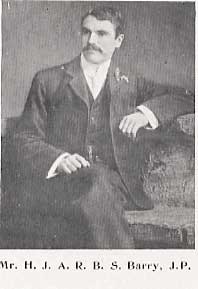
Standish Barry of Leamlara

I’m not quite sure why this page is so popular, but it’s getting the most views this year.

Originally, it was simply included because  Henry Standish Barry was a guest at Frank Purssell’s wedding. This could be something as simple as they went to school together, or could be a family thing. Or it could be a bigger Catholic/Cork merchant  thing. So I’ll do some work. It turns out to be almost certainly a school thing. Henry and Frank were at Downside together.

If there are directions people want me to head, post a comment or use the (private) contact form. W. 

leamlara-house-carrigtohill
Leamlara House

This branch of the great Barry family had been in possession of the Leamlara property since the Anglo-Norman invasion of Ireland in the reign of Henry II, when they accompanied Strongbow. The estates were confirmed to John Barry in 1636 by Charles I and again by Charles II to John’s son Garrett.

The latter’s son, David, married a daughter of Standish O’Grady, whose great-great-grandson was Garrett Standish Barry. Garrett Standish Barry was educated at Trinity College Dublin and was called to the Bar in 1811. Elected to the House of Commons for county Cork in 1832, Garrett was the first Catholic Member of Parliament elected after the Emancipation Act of 1829. He continued as M.P. until 1841. He was made High Sheriff of county Cork in 1830 and was also Justice of the Peace and Deputy Lieutenant for the county.

During his term as an M.P. Daniel O’Connell stayed a few times at Leamlara House. In 1841, Garrett Standish Barry offered to resign his seat in Cork in favour of Daniel O’Connell, if the latter had failed to be elected in Dublin, and he duly did so. O’Connell was the M.P. for Cork County from 1841 until his death in 1847.  He died in 1864, without issue and was succeeded in the estate by his younger brother, Henry Standish, whose son and heir, Charles Standish, married in 1869 the Hon. Margaret Mary, daughter of Lieut-Colonel the Hon. Arthur Francis Southwell, and sister of the 4th Viscount Southwell, K.P.

henry-standish-barryCharles’s only son, Henry Joseph Arthur Robert Bruno Standish Barry, was born in 1873 and was the 24th and last Standish Barry to live at Leamlara. He was educated at Downside, Bath. Henry was Justice for the Peace in Cork County and married Eleanor Lilian Helene, daughter of Major-General C.B. Lucie Smith, Madras Civil Service. Henry had two daughters and one son, Charles Henry Joseph Garrett Standish was born in 1900.


Nell St. John MontagueMrs. Henry Standish Barry was a well known fortune teller in London under the name of Nell St. Montague and is said to have foretold the sinking of the Lusitania. She was killed in a road accident during the blitz in the Second World War. Henry’s son Charles died at the age of 18, so Henry was succeeded on his death in 1945 by his daughters who later sold the estate to the Irish Land Commission.

Hurrah hurrah, I’ve found another convict………..(sort of )

This one makes me smile, though I can’t imagine eight days in a Regency prison was much fun.

British Library

James Herbert is the father of the splendidly named Clementina Penn, and Esther Penn’s grandfather. In 1841, he was living in Ossulston Street, in St Pancras, beside the present-day British Library, with his wife Esther, and six daughters. He describes himself as a tea dealer. By 1851, he is in Phoenix Street, round the corner from Ossulton St,also in St Pancras, with seven of nine children – five girls, and two boys. His eldest daughter Frances, then aged 16 is staying two roads up in Aldenham Road. James is now calling himself a grocer, and gives his place of birth as Gibraltar. 

JAMES HERBERT was indicted for stealing, on the 10th of March 1836, 1 fish, value 3s., the goods of Coles Tester. and tried on 4th April 1836

St John Street c. 1900

COLES TESTER . I am a fishmonger, and live in St. John-street. (St. John Street is on the edge of Smithfield, and Camberwell, about a mile and a half away from St Pancras, or about half an hour’s walk.)  On the 10th of March, about nine o’clock, I was in my back room, and saw the prisoner walk up and down by the shop window two or three times

At last I saw him take a cod fish. worth 3s.(£203.50 in today’s values), off my board, and walk away with it—he went one hundred or two hundred or two hundred yards with it—I walked after him, and said, “What did you take that fish for?”—he said, “I took it thought a lark”—he was quite a stranger to me—I said, “You must take it back to my door, “and I gave him in charge.

Prisoner’s Defence. A little while before this, I was in the hospital with a broken leg—this was the first day I left off crutches—I happened to meet a few friends, and got intoxicated, and this occurred through playing and larking along the street—I had no idea of felony.

GUILTY. Aged 42.—Recommended to mercy.— Confined Eight Days.

Reference Number: t18360404-929  www.oldbaileyonline.org

Hurrah hurrah, I’ve found a convict………..

This one gives me almost unadulterated joy. The only similar one was finding good old JROB mistreating his niece Pauline Roche in such a textbook Victorian villain manner that it would have been rejected by a publisher. If you haven’t seen it yet use the link on her name.

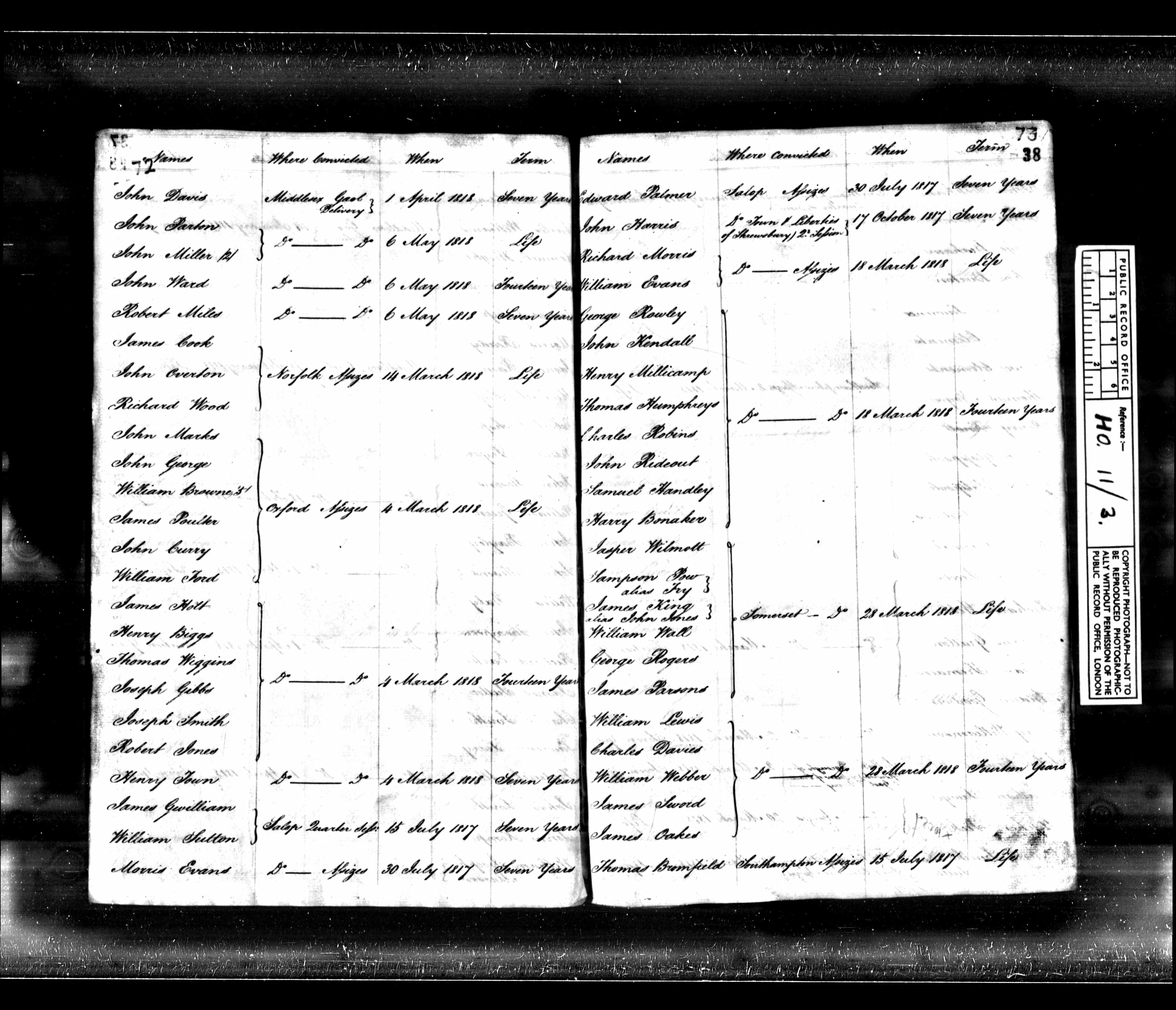
Robert Miles transportation 1818Robert Miles, born about 1798, was tried at the Old Bailey on the 6th of May 1818. He was found guilty of Larceny, and sentenced to seven years transportation. He was sent to New South Wales, on board the General Stuart leaving in July 1818. He was 20 years old, and according to the notes in the court register “an old offender”, so presumably it wasn’t a first offence. He is Esther Penn’s great-grandfather. He seems to have returned as soon as the sentence was up, and married in Tottenham in July 1826, eight years after the sentence.

So basically, he is a Norf London bad boy who got in a bit of bother with some laundry. Not quite the Dandy Highwayman……….or is he??

This is the court transcript from www.oldbaileyonline.org.

Old baileyROBERT MILES was indicted for stealing, on the 23d of April , one trunk, value 2s.; 18 shirts, value 5l.; 21 cravats, value 20s.; 20 pair of stockings, value 23s.; 15 handkerchiefs, value 10s.; two night-caps, value 1s.; six shifts, value 2l.; four sheets, value 10s.; eight table-cloths, value 2l.; three pillow-cases, value 3s., and two towels, value 2s. , the goods of George Woodfall . A total of £ 12. 11s. Aproximately £15,140.00 in today’s money. 

So maybe bad boy Bobby was on to something. Anyway back to the trial.

SECOND COUNT, the same, only stating them to be the property of William Rance 

MARY BERRYMAN. I am laundress to Mr. George Woodfall , who lives at Shepperton. On the 23d of April I sent a box, containing the articles stated in the indictment, to town. I delivered it to Rance, to take to Great Dean’s-yard, Westminster.

WILLIAM RANCE. I am a carrier from Chertsey to London. I received the box from Berryman, and brought it safe to the White Horse, in Friday-street , on Thursday night, the 23d of April. I did not unload the waggon until next morning. I do not know what became of it.

CHARLES STARK . I am servant to Rance. About half-past nine o’clock at night, I got into the waggon at the White Horse, and fell over the box; it laid on the chaff that I wanted for the horses – I left it safe in the waggon.

JOHN TILLEY . I am a watchman of Whitechapel. On the 23d of April, about a quarter past ten o’clock at night, I came up with three men in French-street – each of them had a bundle; I attacked the last man, he dropped his bundle and escaped-the other two turned the corner. I sprang my rattle and pursued, calling Stop thief! I picked up another bundle at the corner of Halifax-street, the prisoner was taken in Halifax-street. He is not the man who escaped.

JOHN COKELEY. I am a watchman of Spitalfields, which joins Whitechapel. I heard the rattle sprung, went to the corner of Halifax-street, and saw the prisoner with a bundle; he laid it down on a step. I pursued, calling Stop thief! A man who stood at a door, stopped him – He did not run above ten yards, and was not out of my sight. I am sure he is the man.

JOHN WILSON . I am a carpenter. I came out, hearing the alarm, and heard some person running on the other side of the way; I crossed over, and collared the prisoner, the watchman came to my assistance. On going along Osborn-street he was rescued from us. I took him again, and am sure he is the man. I put him in the watch-house.

RICHARD PLUNKETT . I am a beadle. The prisoner and property were delivered to me at the watch-house.

Prisoner’s Defence. I was passing and the man caught me.

Robert Miles sentance 1818
Robert Miles sentence 6th May 1818

GUILTY . Aged 20.

Transported for Seven Years .

Second Middlesex Jury, before Mr. Recorder.

Reference Number: t18180506-87

The children of Roger Purssell and Charlotte Peachey

Roger Purssell, 1783 – 1861 and Charlotte Peachey 1789 – 1886 had the following children according to a copy of the entries in a family bible.

  • Purssell letter006
    Copied entries in a Purssell family bible

    Charlotte 1811 -1812

  • John Roger 1812 -1821
  • Joseph 1815-
  • William 1816 -1821
  • James 1821 –
  • John Roger 1823 –
  • Edmund 1825 -1833
  • Frances Jane 1827 -1914 (Mother St George)
  • Alfred Purssell 1831 -1896?/97 (Grandpapa)

This didn’t prove to be as accurate as it appears. It certainly gives the impression that  Alfred and Frances are the only ones who survived into adult life which isn’t the case, and I think there are a few more children who died young, who may yet turn up

But the following is more accurate.

  • Charlotte 1811 -1869 in London
  • John Roger 1812 -1821
  • Joseph 1815- 1888 died in Victoria, Australia
  • William 1816 -1870 probably in Pangbourne, Berkshire
  • James 1821 – March 4, 1887 in New York City
  • John Roger 1823 – 1902 in London
  • Edmund 1825 -1833
  • France Jane 1827 -1914 (Mother St George) in Norwood
  • Alfred  1831 -1897 

The Purssells in 1851

By  1851 most of the family are bakers or confectioners, although Joe is a butcher. He is married, with two daughters and living at 3 Wellington Street, in Bethnal Green. Joe Purssell’s first wife is Mary Ann Forsbrey. They marry at St George’s the Martyr, Southwark on 1st October 1940. He is 25, and she is 23. Her father Joseph Forsbrey is a butcher.He and his first wife Mary Anne Foresbury may have had more children. But at that  point they had seven year old Mary Jane, and Priscilla Grace who died the following year, and is buried at Christ Church Spitalfields aged 3yrs 10 months. His son William is born in 1852, the same year Priscilla dies.

He emigrates to Australia sometime between 1852  and 1860 where marries Mary Ann Crook (1837–1893) in Australia in 1860. He is 45 she is 23.  It is also unclear whether Mary Ann 1 has died, or whether he has a bigamous marriage to Mary Ann 2. Joe and Mary Ann 2  have a daughter Martha who is born in 1860 and dies in 1861, and another daughter, Emma who is born in 1863 and dies in 1874, and Joseph Benjamin Purssell who is born and dies in 1865.

In the meantime Mary Jane, and William, Joe’s children from his first marriage  emigrate to Australia arriving in Melbourne on 29 Aug 1864. Mary Jane appears to stay in Australia, and dies in Williamstown, Victoria in 1927.

Charlotte is living at 118 Cheapside, and lists herself as a shopkeeper, though the 1856 London Post Office Directory calls her a biscuit baker. She is listed on the line below James and Alfred.

Purssell James and Alfred, biscuit bakers, 78 & 80 Cornhill, & 4 & 5 Finch Lane

Purssell Charlotte (Miss), biscuit baker, 119 Cheapside

Thirty five year old William is also married, to Eliza Newman, and living at 3 Lea Road (parish St Mary’s Leyton). The ages they give in the census, 40, and 37, are doubtful, but the rest of the details – his profession – confectioner, and place of birth- Limehouse, are right. Eliza is an Essex girl, born at Stanford Beeches.  William was in partnership with James, trading as William and James Purssell, in Cornhill.Wm & Jas Purssell

They dissolve the partnership in March 1854, probably when William decides to retire.

Twenty nine year old James is living above the premises in Cornhill, and the census return is for one building comprising 78 and 80 Cornhill, & 4 French Court. On the census return, James says he is employing thirty three men, four women, and two boys. He and his twenty one year old wife Eliza (nee West) are sharing the building with 4 house servants, 3 shopmen, 4 biscuit bakers, 4 porters, and a stock keeper.

James and family move to New York in 1859, where he set up a catering business on Broadway near Twenty-First Street.

John Roger is also living above the shop, but in his case 20 Ludgate Hill, just down from St Paul’s and advertising himself as

“John R. Purssell & Comp., 20, Ludgate Hill, opposite the Old Bailey : French and Italian ices to-day. “French, English and Italian confectioners. Dinners, rout and ball suppers provided.”

“Soups and jellies, a large assortment of pastry, biscuits, cakes, &c. A large refreshment room for ladies and gentlemen.”

He had married Elizabeth Davies on January 11 1848 at St Pancras Church, with both of them shown as living in Euston Grove. By 1851, twenty six year old John had two sons, two year old John Junior, and one year old Alfred. Both the boys are listed as being born in the parish of St Martin’s Ludgate, so presumably at 20 Ludgate Hill. John says he is employing five men, and has two confectioner journeymen, and a waiter living at Ludgate Hill, along with two female household servants. It is a very young household, the oldest person is 27 year old Catherine Diddy who is one of the servants. The shop staff are a good London mix resembling a branch of Costa Coffee today with an east-ender, a French confectioner, and a German waiter.

Alfred, the youngest brother,(he’s 20) is also living above the shop at 10 Hart Lane in the City. 5 New London Street is also shown on the census return. He calls himself a confectioner & baker, and says he is the brother of the head of the household. I think we can safely assume that Hart Lane is John’s bakery. Alfred is sharing the house with Thomas Joyce and William Payne, both bread bakers, James Ridge a fifteen year old errand boy, and Hannah Pennal, a general servant from Hull.

Adding together the households at Ludgate Hill, and Hart Lane would give the correct number of employees for John’s business, and it makes sense to have them living in-house, and for a member of the family to be on each premises. It also makes sense for the youngest member of the family to be doing the hard work, and baking was a tough business.

According to A.N. Wilson in The Victorians, the baking life was a tough one. It only became worse during the London Season when bread orders increased. Eleven at night was the start of a baker’s day, when he made the dough. He was able to sleep on the job for a couple of hours while the bread rose, then had to do the rest of the physical tasks of preparing rolls and loaves. Kneading was sometimes done with feet, perhaps making for a less-than-clean product. The bakehouse was alarmingly hot as well, up to ninety degrees Fahrenheit. Some bakers had to deliver the bread they made, too. They only had five to ten hours off per day and all but none during the Season. Wilson says statistics show London bakers rarely lived past the age of forty-two. Wilson, A.N.,  The Victorians, 2011.

Finally, Frances Jane, the future Mother St George is living in the Convent of the Faithful Virgin, Norwood where she had been professed a nun at the age of 21 in 1848. In just over three years time, she will be with Florence Nightingale at the Crimean War.

The Ladies make a point…….

I really like the fact that both these two make a point about how to treat refugees….. Just so you know who they are, Alan O’Bryen, Lady O’B’s son marries Lady RP’s grandaughter

Lady O'Bryen
Lady O’B

Letter from the Mayoress of Hampstead September 1914

From The Tablet Page 18, 12th September 1914

ST. DOMINIC’S, HAVERSTOCK HILL: BELGIAN REFUGEES.— The St. Dominic’s Parish Magazine publishes the following letter from the Mayoress of Hampstead (Mrs. E. O’Bryen) on behalf of Belgian Refugees in the district : “I appeal to the inhabitants of Hampstead for the Belgian Refugees, who consist mainly of women and children, and who are arriving here in hundreds almost daily. After the gallant resistance that Belgium has offered, with the result that their country is overrun by the German army, it is only right that we here in England, who are luckily exempt from this scourge of invasion, should do something to help these people who have lost their homes and all they possess. They are arriving absolutely penniless, and in most cases with only the clothes they stand up in. The War Refugees Committee have asked me (i.e., the Mayoress) to make a Refugee centre in Hampstead, and I shall be glad to hear of any lady or gentleman willing to offer a home to one or more Refugees, and would ask them to apply personally to me here at the Town Hall, Haverstock Hill, giving me particulars as to the numbers and sexes of the Refugees they would be willing to accommodate. Those who are unable to help in this way would be giving great assistance by sending any clothes, new or old, for the use of these Refugees, either to me here (at the Town Hall), marked : ‘For the Belgian Refugees,” or direct to the general receiving office, 39, St. George’s Road, S.W.”

Lady RP’s Appeal for Montenegrin Families 1912

From The Tablet Page 28, 19th October 1912

Lady RP
Lady Roper Parkington

FOR MONTENEGRIN FAMILIES.

SIR,—May I appeal through your columns for help on behalf of the families of the brave Montenegrins who are fighting in the present sad war? They are so very poor that all contributions will be welcome, either in the form of money or provisions, such as tinned food, &c. ; blankets or woollen clothing especially will be acceptable, their mountain climate being extremely severe in the winter.

I will undertake to forward any goods which your readers may be kind enough to send me. Cheques should be crossed ” Union of London and Smith’s Bank,” and large parcels should be addressed, carriage paid, to Lady Roper Parkington, Montenegrin Consulate, 24, Crutched Friars, E.C.

Yours faithfully,

MARIE LOUISE PARKINGTON. 58, Green Street, Park Lane, W.,

October 16, 1912.

A Table of Kindred and Affinity from the Book of Common Prayer

I’ve stuck this in because there seems to be quite a lot of family marrying family. I think canon law is broadly similar in the Catholic Church, but this came to hand first.

common-prayer
Book of Common Prayer 1551

The Book of Common Prayer 

A TABLE OF KINDRED AND AFFINITY WHEREIN WHOSOEVER ARE RELATED ARE FORBIDDEN BY THE CHURCH OF ENGLAND TO MARRY TOGETHER.

A man may not marry his:

  • Mother
  • Daughter
  • Father’s mother
  • Mother’s mother
  • Son’s daughter
  • Daughter’s daughter
  • Sister
  • Father’s daughter
  • Mother’s daughter
  • Wife’s mother
  • Wife’s daughter
  • Father’s wife
  • Son’s wife
  • Father’s father’s wife
  • Mother’s father’s wife
  • Wife’s father’s mother
  • Wife’s mother’s mother
  • Wife’s son’s daughter
  • Wife’s daughter’s daughter
  • Son’s son’s wife
  • Daughter’s son’s wife
  • Father’s sister
  • Mother’s sister
  • Brother’s daughter
  • Sister’s daughter

A woman may not marry her:

  • Father
  • Son
  • Father’s father
  • Mother’s father
  • Son’s son
  • Daughter’s son
  • Brother
  • Father’s son
  • Mother’s son
  • Husband’s father
  • Husband’s son
  • Mother’s husband
  • Daughter’s husband
  • Father’s mother’s husband
  • Mother’s mother’s husband
  • Husband’s father’s father
  • Husband’s mother’s father
  • Husband’s son’s son
  • Husband’s daughter’s son
  • Son’s daughter’s husband
  • Daughter’s daughter’s husband
  • Father’s brother
  • Mother’s brother
  • Brother’s son
  • Sister’s son

Theft from William Purssell – August 1849.

Old bailey
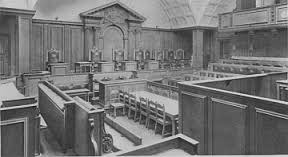
Courtroom No 1, Old Bailey

Case number: 1520. ALEXANDER DAVIDSON stealing 1 firkin, and 125lbs. weight of butter, value 5l. 10s.; the goods of William Purssell, his master.

MR. PAYNE conducted the Prosecution. 

WILLIAM PURSSELL . I am a biscuit-baker, of Cornhill; the prisoner was in my employ on 23d May—he had the charge of all the goods that came in—I have been shown a firkin of butter by the policeman; it was mine, and had my mark on it; I had not sold it—the prisoner had no authority to part with it—it was to be used in my business—his salary was 1l. 5s. per week—he left about one o’clock on 23d May, and I received this note from him—(read—”Mr. Purssell,—I have been taken so ill, and so suddenly, that I expect I shall have to go to the hospital; should I recover, you will hear from me. A. D.”—I did not see him again for about two months, when he was in custody.

cornhill
Copy of a print of Purssell’s kitchen in Cornhill in 1840


SAMUEL HARBOTTLE (City-policeman, 584). On 23d May, between eleven and twelve o’clock, I was in King William-street, and saw Morley with a firkin of butter—I spoke to him, and he pointed out a woman behind him—she got away while I was taking the firkin off his shoulder—I took it to the prosecutor—the prisoner was afterwards taken in York; I do not know when—I went to his house in Swan-court, in the Borough—I made inquiries at the hospitals, but could not find him.

HENRY MORLEY . I was stopped by the policeman in King William-street, with the firkin of butter—I got it from the prisoner at Mr. Purcell’s, in Cornhill—I was to follow a woman with it, who was outside the door, and take it where she pointed out—she went away, and I never saw her afterwards.

Prisoner’s Defence. I never saw this man; I was ill.

Newgate-prison-exercise-yard. Gustave Dore 1872

GUILTY . Aged 30.— Confined Nine Months.

(There was another indictment against the prisoner.)

It’s not clear where he was imprisoned, but Newgate prison was next door to the Bailey until 1902.

All courtesy ofwww.oldbaileyonline.org

Reference Number: t18490820-1520.