The Delegate-Apostolic to The Philippines – Gathering of Old Augustinians – 1904.

This one doesn’t have too many members of the family in , but it does have Uncle Edmund (Bellord), Agnes Purssell’s husband; and from a completely separate part of the family great,great, grandpa RP.  Commendatore Agius, is Edward Tancred Agius , who was a very old friend of the Roper Parkingtons going right back to both their early married days in Chiswick. Father Ambrose is ET Agius’s younger brother. We’ll let the Tablet take up the story

GATHERING OF OLD AUGUSTINIANS 1904

Hotel Cecil, the Strand 1910

A dinner in honour of the Most Rev. Ambrose Agius, 0.S.B., Archbishop of Palmyra and Delegate-Apostolic to the Philippines, was given at the Hotel Cecil on Wednesday evening by the Society of Old Augustinians. On the previous day his Grace held a reception at the College at Ramsgate. The President of the Society, the Abbot of Ramsgate, was in the chair, and amongst others present were the Archbishop of Westminster, the Bishops of Newport, Clifton, and Southwark, the Mayor of Ramsgate, Count Rivarola, the Marchese Mattei, the Abbot of Downside, Sir Roper Parkington, Dom T. E. Egan, 0.S.B., Rector of St. Augustine’s, Ramsgate, Canon Pycke, Commendatore Agius, Commendatore Eck, Commendatore Hicks, Mr. Leonard, Lindsay, Mr. Hugh Burns, and many others,old students of St. Augustine’s. After dinner the Abbot of Ramsgate read a letter of regret at inability to be present from Mr. Choate, the American Ambassador, and proposed the loyal toast of Pope and King. The company was then photographed by Messrs. Fradelle and Young.

St Augustines, Ramsgate

The Lord Abbot next proposed the health of the Archbishop of Palmyra. His Grace was not only an Archbishop and a Delegate-Apostolic, but an Old Augustinian, and whilst he rejoiced at his being raised to so high a dignity, he could not but regret having to say farewell to an old friend and associate of 30 years. The College might well be proud of one who, after being the first boy of his year, became a worthy priest and a model monk of St. Benedict. He had watched over the College finances and they had been all the better for that, and later as their Procurator in Rome he had always devoted himself to the interests entrusted to his charge, and with tact and obligingness had succeeded. The Pope had been drawn to him by his care of, and labours for, the poor, and now he was going as the representative of his Holiness to a people of faith, under a nation amongst whom liberty was supreme. They wished him long life and success in his new sphere of labour. The Abbot then presented his Grace with a beautiful travelling clock from the members of his old school.

Archbishop Agius. courtesy of the Agius family

The Archbishop of Palmyra, in reply, thanked all for the good will and kindness they had shown to him. He would be glad to have as many to help him in his work as possible. There were 1,400 islands, and 8,000,000 Catholics to look after. Some sees there were vacant, doctors and lawyers would be useful, and so would a financier, for the American Government had been, very generous. Military men he should only want as friends, for he was going out with the old Benedictine motto of “Pax,” and to carry out the Pope’s policy of restoring all things in Christ. The Holy Father had told him to do in the Philippines what he had been doing during recent years in Rome. After some words to show the greatness of heart and loveable disposition of the Pope, his Grace thanked the past students for their hand some present of a clock. Another present he had received was a portable altar. He accepted the omen ; he would “watch and pray.”

The next toast, that of ” the Archbishop of Westminster and Bishops of England” was proposed by Mr. Edmund J. Bellord, who, speaking as the oldest of the old boys of St. Augustine’s, expressed their gratitude at the compliment done their old school by the presence of the Archbishop of Westminster and the other Bishops.

The Archbishop of Westminster [Archbishop, later Cardinal Bourne] , in reply, spoke of the pleasure and gratification he felt at being present on the occasion. He was a debtor in many things to Father Ambrose Agius in Rome, and his gratitude and affection for him were the motives of his hearty wishes of God-speed. He had been successful in Rome, and success would surely attend him in the Philippines. He hoped, too, that his presence there that evening would be taken as what indeed it was—a mark of his affection and esteem for the Abbot of Ramsgate and St. Augustine’s College.

Cardinal Bourne

Mr. Arthur a Beckett proposed the toast of “St. Augustine’s College and Old Augustinians.” The College needed no advertisement, and Sir W. Broadbent had spoken as to the healthiness of the town in which it was situated. Mr. a Beckett then gave interesting reminiscences of the old school plays in which the present Rector had figured so creditably.

Father Egan, the Rector, replied. The school was naturally proud of Archbishop Agius, for in his elevation they recognised the seal of the Pope’s approval of the training given at St. Augustine’s. Mr. Gerald Flanagan also replied on behalf of the Old Augustinians who had entered heartily into the project of doing honour to one who had shed such lustre on their old school.

Father Donald Skrimshire then gave the toast of “The Visitors,” to which the Abbot of Downside, in reply, said that all Benedictines rejoiced with those of Ramsgate in the honour that had been conferred on St. Augustine’s in the person of the Archbishop of Palmyra. Sir Roper Parkington also replied, and congratulated Mr. E. T. Agius on the distinction that had been conferred by the Holy See upon his brother and himself. [ The distinction was that E.T. Agius had been made a papal Chamberlain (Cameriere Segreti di spada e cappa) that year about the same time his brother had been consecrated an Archbishop. It’s a nice touch because Edward Agius and John Roper Parkington had been friends for almost thirty five years.] Commendatore Eck also spoke.

The last toast of the Chairman, “The Abbot of Ramsgate,” was briefly proposed by Mr. E. T. Agius. The Abbot having expressed his thanks, the proceedings terminated.

The above text was found on p., 22nd October 1904 in “The Tablet: The International Catholic News Weekly.” Reproduced with kind permission of the Publisher. The Tablet can be found at http://www.thetablet.co.uk .

Previously it had been announced in Rome that Father Ambrose had been appointed the papal Delegate to the Philippines.

THE DELEGATE TO THE PHILIPPINES.

Sant’ Andrea delle Fratte

Father Ambrose Agius, 0.S.B., of the Cassinese Congregation of the Primitive Observance, has been appointed by the Holy Father to succeed Mgr. Guidi as Apostolic Delegate to. the Philippine Islands. Mgr. Guidi succeeded in settling with the United States authorities the vexed question of the Spanish Friars and their possessions in the Archipelago, but many other delicate and intricate matters still await solution. The position of Delegate is, therefore, one of much difficulty. Much speculation has been wasted in the American Press as to the successor of Mgr. Guidi, and Father Ambrose’s name has never once been mentioned in this connection. Yet the selection is an ideal one in every way. The new delegate is a native of Malta: he speaks all the principal European tongues with equal fluency ; but English is really his mother tongue, and during his long residence in Rome he was one of the two English Confessors at the Church of Sant’ Andrea delle Fratte. [ In a nicely convuleted twist, a role that Mgr. Henry O’Bryen had fulfilled in Rome for about fifteen years from 1875; albeit at St. Andrea della Valle by the Piazza di Spagna]  He was also spiritual director of the Roman community of the Institute of the Blessed Virgin, better known as the “English Ladies,” and for some time acted in that capacity to the “Little Company of Mary.” Father Ambrose is a young man—not much over forty one would say—full of zeal and energy, and of exquisite tact.  The above text was found on p., 3rd September 1904 in “The Tablet: The International Catholic News Weekly.” Reproduced with kind permission of the Publisher. The Tablet can be found at http://www.thetablet.co.uk .

And then finally, the consecration itself on Sunday, September 18th.

Sant’ Ambrogio della Massima

This morning his Excellency the Most Rev. Ambrose Agius, 0.S.B., Delegate Apostolic to the Philippines, was consecrated Archbishop by Cardinal Merry del Val, Secretary of State to his Holiness, assisted by his Excellency Mgr. Chapelle, Apostolic Delegate to Cuba and Porto Rico and Archbishop of New Orleans, and by his Grace Mgr. Stonor, Archbishop of Trebizond. [ In another nice twist, Cardinal Merry del Val was a student at Ushaw with Father Philip O’Bryen, whilst  Father Philip’s much older half-brother Mgr. Henry O’Bryen was a domestic chaplain in the Vatican at the same time Mgr. Stonor was.]  The solemn ceremony took place in the Church of Sant’ Ambrogio, attached to the monastery in which “Father Ambrose” has spent many fruitful years. Rome is supposed to be empty of English-speaking residents just now, yet the church seemed to be full of them this morning, and whatever space they left was occupied by representatives of the religious orders, with Benedictines naturally in the majority. Mgr. Giles, Bishop-elect of Philadelphia, came from Monte Porzio to be present at the ceremony. A special place in the church was reserved for the Apostolic Delegate’s relatives, many of whom made the journey from England for the occasion.

Cardinal Rafael Merry del Val

Among them were his mother, Mrs. Agius, his sister, Mrs. Edward Vella, his brothers, Mr. Edward Agius and Mr. Edgar Agius, his nieces, Mrs. Salvo Cassar, Miss Agius, Miss C. Agius, and Dr. E. Vella, Captain A. Arrigo, E. Vella, C. Vella, Major Muscat and Mrs. Muscat with their son and daughter, and Father Cartin. Among the Benedictines present were Abbots Krugg, President-General of the Cassinese Congregation, Vagioli, Ciaramella, General of the Vallombrosians, Policari of the Silvestrini, Strozzi of the Canons Regular of the Lateran, besides the Procurators-General of the Capuchins, Carmelites, Dominicans, Servites, Pious Missioners, and Brothers of the Christian schools. The Archbishop will leave for his destination in about a month, the routine work of the Delegation being transacted in the meantime by Father O’Connor, P.S.M., who has acted as secretary to the late Mgr. Guidi for the last four years.

The above text was found on p., 18th September 1904 in “The Tablet: The International Catholic News Weekly.” Reproduced with kind permission of the Publisher. The Tablet can be found at http://www.thetablet.co.uk .

Purssell marriages in the 1890’s

It has always been a slight curiosity that whilst Uncle Frank’s (Purssell) wedding was well written up, none of the Purssell sisters seemed to have had as grand a wedding. Of the seven children, Laura had married Max Winstanley in 1884, Lucy had married Henry Grant Edwardes in 1892, and Frank had married Lily Kuypers in 1896, and Alfred J. never married. But at least almost all of them got a brief mention in the Tablet.

Parker-Purssell marriage notice July 1898

PARKER—PURSSELL.–On June 30, at St. Dominic’s Priory, Haverstock Hill, by the Very Rev. F. A. Gasquet, D.D., Wilfrid Watson, second surviving son of the late Sir Henry Watson Parker, of Hampstead, and Lady Watson Parker, of 22, Upper Park-road, N.W., to Frances Charlotte, third daughter of the late Alfred Purssell, C.C., of Hampstead.9th July 1898, Page 13

Wilfrid Parker was the groomsman at  Frank and Lily’s wedding, and he, Frank, and their Kuypers brothers-in-law all went to Downside, which is where they met Father (later Cardinal) Gasquet.


O’BRYEN—PURSSELL.—On the11th inst., at St. Dominic’s Priory, Haver-stock Hill, by the Rev. P. A. O’Bryen, B.A., brother of the bridegroom, assisted by the Rev. George Cox, Ernest A. O’Bryen, of the Indian Forest Service, son of the late John Roche O’Bryen, M.D., to Gertrude Mary, youngest daughter of the late Alfred Purssell, C.C., of 9, Belsize Grove, Hampstead. (Burma papers please copy.) 15th October 1898, Page 13


BELLORD—PURSSELL.—On the 11th inst., at St. Dominic’s Priory, Haver-stock Hill, N.W., by the Rev. James Bellord, Chaplain to the Forces, Edmund Joseph Bellord to Agnes Mary, fourth daughter of the late Alfred Purssell, of Belsize Grove, N.W. 14th January 1899, Page 11

It was Edmund Bellord’s second marriage.James Bellord was appointed the Vicar Apostolic of Gibraltar and Titular Bishop of Milevum on 16 February 1899, and his consecration took place on 1 May 1899.

Downside Annual Dinner – June 1898

This one makes me smile for lots of different reasons. It’s ever so slightly pompous, and smug, how could any event being attended by “the Rouge Dragon, Mr. Everard Green” not be?  It’s also got quite a lot of the family in it, though strictly speaking only really two, Great Grandpa (OB), and Uncle Frank at this point in the year. Uncle Wilfrid (Parker) and Charlotte Purssell are married nine days later by Father (later Cardinal) Gasquet, Great Granny and Grandpa OB are married in the October, and then finally Agnes marries Edmund Bellord in January 1899.

I also really like the weird quirk that has this dinner happening about a mile and a half away from the Roper Parkington’s Silver Wedding celebration in Bond Street. So both family events happening the same day, but neither yet connected.

And even better, also attending was the current Olympic Gold Medalist for both the Men’s Singles, and Doubles at Tennis, John Pius Boland who was Irish.

Holborn Restaurant c.1900

The Downside Annual Dinner took place this year on Tuesday last, the 21st inst., in the Gordon Room at the Holborn Restaurant. The Very Rev. F. A. Gasquet, D.D., 0.S.B.., occupied the chair. Among those present were the Bishop of Newport, the Right Rev. Mgr. John Vaughan, the Very Rev. H. E. Ford, Prior of Downside, the Right Rev. Abbot Snow, O.S.B., and the Revv. T. L. Almond, H. N. Birt, V. Corney, Wilfrid Corney, Gilbert Dolan, F. M. Fulton, 0. Langdale, and E. Mostyn, Sir Walter Smythe, Bart., Sir Roland Blennerhassett, Bart., Sir John Talbot Power, Bart., the Rouge Dragon, Mr. Everard Green, and Messrs. I. A. Baillon, E. J. Bellord,  H. Behan, C. Berington, P. T. Blackwell, George Blount, P. J. Boland, H. Campbell, T. B. Corney, W. FitzGibbon, A. Ford, T. B. Fulton, E. Gape, J. S. Gradwell, L. Green, E. G. Hansom, E. J. Harting, W. S. Jackson, A. A. Kelly, F. B. Kindersley, A. J. Mitford, E. O’Bryen, W. S. Page, Watson Parker, F. W. Purssell, C. G. Rose, A. W. Sells, E. E. Ware, E. Willett, and E. G. Stillwell, the Hon. Secretary.

After the toasts of the Pope and the Queen had been proposed by the Chairman and duly honoured, Sir Walter Smythe, Bart., gave the toast of Alma Mater, coupled with the name of the Prior of Downside.

In reply the Prior spoke of the very satisfactory condition of the school and of the great progress it was making in its work, and of its many recent successes. Of “Old Gregorians” they had also reason to be proud ; they were not a very large body numerically, but still they got through a good deal of work. There was every reason to be proud of the work accomplished at the house in Ormond-street, though that was only in its inception. Then again at Cambridge University Father Butler had greatly distinguished himself, and his work there was so appreciated by the authorities that it alone was considered sufficient reason to confer a degree of distinction upon him without further examinations. Father Kuypers had also distinguished himself there, and had been awarded the prize for Hebrew. Then at Westminster, where was now being raised the new Cathedral, they were to build up a new house and there carry on the great work of the Order. His earnest wish was that they might all live to see these great works accomplished.

Downside

Mr. George Blount then gave the toast of ” The Visitors “ coupled with the name of the Bishop of Newport who, in reply, said that although he was not an “Old Gregorian” yet he was a very old friend of Downside, and some of his dearest memories were connected with that place, and it was his greatest pride and satisfaction to hear of successful work achieved by “Old Gregorians” whether as Churchmen or as laymen. They were all proud of the work being carried out at Great Ormond-street, at Cambridge University and elsewhere, but their thoughts were mostly turned to Downside itself, the parent stem. There was a great fight before Catholics in these days in the matter of education, and the clergy looked to the laity for assistance. The laity of St. Gregory’s were the crutches which upheld the ancient walls of Downside, and every member present would remember his association with and his duty towards that place.

Cardinal Gasquet

The Right Rev. Mgr. Vaughan then proposed the toast of “The Chairman” He said it was a special privilege to propose this toast. His memory went back with pleasure to the old days in the study and in the playground when both the Chairman and himself were at Downside together. Father Gasquet had distinguished himself greatly. His name was known not to old Downside boys only but to all Catholics in England. He had heard him praised on all sides. His books were of the utmost importance to their non-Catholic brethren. He was an example for them all to follow. He therefore now asked those present to drink the health of the chairman and to wish him health and many years of life in which he might continue his labours.

Father Gasquet in reply said it was a pleasure to know his work was appreciated. Anything he had done had been done for the sake of Alma Mater.

The proceedings closed with a vote of thanks to the Hon. Secretary. During the evening selections were given by handbell ringers and glee singers. [which sounds grim beyond belief]

The above text was found on p.27, 25th June 1898 in “The Tablet: The International Catholic News Weekly.” Reproduced with kind permission of the Publisher. The Tablet can be found at http://www.thetablet.co.uk .

Diamond Jubilee Dinner at Providence Row 1897

Providence Row

On Thursday, June 24, in connection with the Princess of Wales’ Jubilee Fund, a dinner to three hundred very poor inhabitants of Whitechapel was held in the Refuge, Crispin-street, E., which was founded by the late Mgr. Gilbert in 1860. The large refectory was gaily decorated for the occasion with flags, banners, and flowers, a portrait of the Queen being placed at one end of the room, and one of the Princess of Wales at the other. Mr. F. W. Purssell, who had been courteously invited by the Lord Mayor to join the Mansion House Committee, presided, and was supported by many friends including Messrs. W. Towsy, and E. J. Bellord, Misses Irving, Towsy, Latham, Russell, and Mr. J. W. Gilbert (Secretary), who represented the institution on the Whitechapel Committee of the Fund.

Queen Victoria

The dinner, which was served by the Sisters of Mercy, the visitors, and the inmates of the Boarders’ and Servants’ Homes, consisted of cold roast beef, new potatoes, bread, pickles, lettuce, fruit-tarts, oranges, and ginger-beer by way of refreshment. This was followed by an entertainment, to which Miss Lynch, Messrs. P. Donovan, J. Schrappel and others, contributed. Afterwards hot tea and buns were distributed, and, on leaving, each was presented with a packet of tea or a pouch of tobacco.

The Princess of Wales

During the course of the afternoon, Mr. F. W. Purssell explained in a few words the object of the dinner, and called for three cheers for the Queen and the Princess of Wales, which were given most heartily. The poor people also showed their appreciation of the efforts of the voluntary ” waiters,” by giving three more cheers for the Sisters and other helpers. It must be a great gratification to all concerned in the management to know that the guests thoroughly enjoyed themselves, and went away loudly expressing the hope that another jubilee might soon occur.

The remains of the dinner were afterwards distributed among the poor of the neighbourhood. Thanks to an additional generous gift of bread, pastry, &c., from Messrs. W. Hill and Son of Bishopsgate-street, some hundreds of poor families have been helped in-this manner, and on Friday, the 25th, the Sisters entertained over two hundred poor school-children at tea. The Whitechapel Committee of the Fund have also made a grant of food to the Refuge Committee for destitution amongst the sick and needy of the district, who are unable to be present at the dinner.

The above text was found on p.36, 3rd July 1897 in “The Tablet: The International Catholic News Weekly.” Reproduced with kind permission of the Publisher. The Tablet can be found at http://www.thetablet.co.uk .


The Catholic Union of Great Britain. A.G.M.1912

Church Hall, Farm Street W.1

The annual general meeting of the Catholic Union was held on the afternoon of Friday, the 28th ult., in the Hall, 114, Mount Street, W, the Duke of Norfolk, president, being in the chair. There was a good attendance of members. The annual report was read by the Secretary, and, in moving its adoption, the Duke of Norfolk dwelt on the various topics dealt with in it, and especially urged the members of the Union to attend in as large numbers as possible the forthcoming Catholic Congress at Norwich. The adoption of the report was seconded by Mr. Hornyold, who observed that, in addition to the matters mentioned in it, important confidential business had been transacted which it was not desirable to set forth.

Henry Fitzalan Howard 15th Duke of Norfolk

After some remarks by Sir Westby Perceval, Sir J. Roper Parkington, the Mayor of Barrow-in-Furness, and Mr. Stuart Coats, the President observed that, from the first, the Union had been careful not to trench upon the spheres of other Catholic organisations while desiring to work in harmony with them, and stated that the Council would at any time welcome suggestions from members for increasing and extending the usefulness of the Society. Mr E.T. Agius drew attention to the Eucharistic Congress to be held at Malta next year, and hoped that an English Committee would be formed in aid of it. The proceedings closed with a vote thanking the Earl of Denbigh and Sir John Knill for their services as treasurers during the past year and re-electing them, and with a similar vote in respect of the auditors, Mr. F. Harwood Lescher and Mr. A. M. Colgan.

The above text was found on p.13, 6th July 1912 in “The Tablet: The International Catholic News Weekly.” Reproduced with kind permission of the Publisher. The Tablet can be found at http://www.thetablet.co.uk .

This time it’s a GG Grandpa, and a 1st cousin (by marriage) 3 times removed..


The Most Reverend George Joseph Plunket Browne (1795–1858)

Two entries in John Roche O’Bryen’s family bible are as follows

“John Roche O’Bryen was married a second time to Celia Mary Grehan, only daughter of P Grehan Esq, late of Worth Hall Sussex at Mount Plunkett, Athlone, Ireland Oct 1st 1857 by Right Revd Dr Browne, Bishop of Elphin, in presence of her brothers & family & with issue.”  

“Mary Frances (O’Bryen) at Bellvue, Janr 30th, 1844, 6 ½ P.M. GdF Right Revd Dr Brown &  GdM Mrs Js O’Connell, died Janr 5th 1858 & was buried at Arnos Court.”

The Most Reverend George Joseph Plunket Browne (1795–1858) was an Irish Roman Catholic clergyman. Born to a “well-known Roscommon family”, he served as Bishop of Galway from 1831 until 1844, and afterward as Bishop of Elphin, until his death on 1 December 1858. He was charged with being a “Cullenite” in 1855, that is, a follower of ultamontane Paul Cardinal Cullen. [“the Cullenite church”, was used to describe the Irish church until the 1960, a church strongly allied to the “rural bourgeoisie” and the rising class of what are called “strong-farmers”.]

Browne was born in 1795 in Dangan House in the parish of Kilmore, diocese of Elphin, near Carrick-on-Shannon. His ancestors came originally from Coolarne, Athenry, Co. Galway. The family residence was at Cloonfad, Co. Roscommon. At 17 years of age, in 1812, he entered Maynooth College, and was ordained in 1818. He was appointed Administrator of St. Peters Parish, Athlone from 1823 – 1825, and again in 1826 – 1831. In 1829 he lived at King Street, now Pearse Street, in Athlone. At the age of 36 he was chosen to fill the new see of Galway. On 31 July 1831 the Pope approved his appointment. Dr. Browne was consecrated in Athlone on October 23 that year. The ceremony was performed by Archbishop Oliver Kelly of Tuam, and assisted by Bishops Burke of Elphin, and McNicholas of Achonry. His motto was “Fortiter et Fideliter (Firmly and Faithfully). He carried out his administration in a peaceful and diplomatic manner. The great Daniel O’Connell justly called him “The Dove of Galway”.

Browne was an enthusiastic learner of the Irish language, but found it difficult to master and by 1844 he proposed in a public letter that to facilitate this learning, it should be written phonetically. He encouraged secondary education and with Dr Ffrench he was joint patron of the new Patrican Brothers boys boarding school which opened in 1837 at Clarinbridge. He brought the Ursuline Order of nuns to Dangan on the Oughterard road beside his own residence in May 1839. He recognised the need to increase the number of church buildings and in May 1837 he left for England to collect money for the new St. Patrick’s Church in Galway. He dedicated a new church in Oughterard in August of the same year. He had the disadvantage of being both popular & poor and was unable to make his ad limina visit to Rome in 1836 but instead sent a detailed written report. He estimated that his income was about one seventh of that of the average Irish Bishop of the time.

Browne was involved in the two dynamic social factors at the time, politics and religion. He was an ardent supporter of O’Connell. He presided at meetings in Galway of the Precursor Society founded by O’Connell to bring about reforms in October and November 1838, and from 1840 he actively supported the Repeal movement. Following the death of Bishop Burke of Elphin in 1843, Dr. Browne was proposed by the Elphin priests to succeed him. Archbishop MacHale attributed Dr. Browne’s conciliatory manner, wisdom and ability to the pacific and flourishing state of the diocese at the time. He acknowledged to Dr. Paul Cullen in Rome that he did not know anyone more fitting for the diocese of Elphin. His great knowledge and piety prompted the clergy in such numbers to give him preferences, although Dr. Browne made no move to secure the more prosperous see for himself. He adopted a deliberate policy of silence. On 10 March 1844 the Pope gave his assent to transfer him to Elphin. Dr. Browne of Elphin continued to actively support Daniel O’Connell and in 1844 he presided at a meeting of protest against his imprisonment. Later the Bishop fell foul of the Young Irelanders and Charles Gavan Duffy, who wrote him a letter of protest. When O’Connell heard this he sent a sympathetic letter to Dr. Browne which is now preserved in the Elphin Diocesan Archives. Mother McCauley of the Mercy Order greatly esteemed the Bishop, whose meek suave character so much impressed her friend O’Connell that he used to call him the Dove, and on his translation to another see the ‘Dove of Elphin’.

The Ursuline Order followed Browne to Elphin, first to Summerhill in Athlone and then to Sligo. He raffled his carriage to raise funds to compensate the sisters for the financial loss they suffered by removing to Sligo. According to Fr. Martin Coen, he was a man of singularly mild temperament, well liked by the majority of his priests and people. An entry in the Annals of the Sisters of Mercy, by Mother McCauley in 1840 reads …‘You may be sure patronage is greatly divided here, each house has its party, Presentation, Dominican, Augustinian, Franciscan, Ursulines etc., and now Sisters of Mercy. The Ursulines are said to enjoy most of episcopal patronage, but Bishop Browne has love and charity enough for thousands and embraces all with genuine paternal care and apostolic affection’.

In the Freemans Journal of 29 April 1848, it stated that by late 1847 the Strokestown Estate had become a byword for mass-eviction. Browne was one of a number of influential individuals who publicly attacked Irish Landlords, including Major Mahon, for their harsh policy of eviction. The Mahons responded with an attempt to embarrass the Bishop by reporting that his own brother Patrick Browne had evicted tenants from his holdings at Cloonfad, Co. Roscommon. The Bishop retaliated by publishing a list townland by townland of 605 families dispossessed of their lands and houses in the immediate vicinity of Strokestown, Co. Roscommon amounting to 3006 persons evicted by the Mahon family. A letter written by the Bishop on 26 April 1848 to the Earl of Shrewsbury on the ‘Mahon Evictions’ was also printed in the journal on that date.

Browne died on 1 December 1858, at his home in Abbey St., Roscommon. He was buried in the church now known as the Harrison Hall. His remains were removed to the Priests’ burial ground immediately behind the Church of the Sacred Heart when it was built.

Cassar – Agius, 23rd Jan 1900.

The marriage of Professor S. Cassar, M.D., with Inez, eldest daughter of Mr. and Mrs. E. T. Agius, of Belsize Grove, Hampstead, London, took place at the Church of St. Ignatius of the Jesuits’ College, Valetta, Malta, on Tuesday the 23rd ult. The Rev. Father Ambrose Agius, 0.S.B., uncle of the bride, celebrated the Nuptial Mass and officiated, assisted by the Very Rev. Father Kenny, Rector of the College, and an appropriate address was delivered by Father Agius. The Holy Father sent a special Blessing to the couple on an illuminated parchment scroll, signed by Cardinal Rampolla. The bride, who was given away by her father, wore a gown of rich white satin, with a train from the shoulders of white striped brocade, lined with satin and chiffon, adorned with ruches of soft silk—some beautiful Honiton lace was arranged fichu-fashion on bodice, and caught up at the side with a bunch of real orange blossoms. Her veil was composed of net, edged with lace, while her jewels were pearls and diamond-stars, given by the bridegroom, together with a lovely bouquet of white roses and orange blossoms.

There were four bridesmaids—Miss Marie Agius, sister of the bride, and the Misses Muscat, Mifsud and Cassar, cousins of the bride. They wore white muslin and lace with pink fringed sashes, white chiffon picture bats, and pink roses to match. They carried baskets of pink geraniums which, with gold bangles, were presented by the bridegroom. The sister of the bride, Miss Marie Agius, was picturesquely dressed in pink Oriental satin and hat to match. The bridegroom was attended by Mr. Joseph L. Galizia, M.D. After the ceremony, a reception was held by Mr. and Mrs. Ed. T. Agius at ” Capua Palace,” Sliema, kindly lent by Marchese A. Mattei, LL.D., the guests numbering over 300.

The Marylebone Fair – December 1916

Queen Amelie of Portugal was present on Wednesday and formally opened the Marylebone Fair at Claridge’s Hotel, Brook Street, which this year devotes its energies to the aid of the Church of St. Charles, Ogle Street. There was a brilliant gathering assembled on the occasion. Sir Roper Parkington presided, and in his opening remarks said he wished in the name of the committee to express his high delight at such a distinguished and large gathering. He thought the committee were to be congratulated on having obtained the kind assistance of Her Majesty Queen Amelie. ” We all desire to express,” he said, ” in no measured terms our sincere and grateful thanks to Her Majesty, and offer her a most hearty welcome. Her Majesty, like all the members of our own Royal Family, is always willing to aid the cause of charity, no matter at what inconvenience to herself.” Sir Roper referred to Queen Amelie’s recent visit to Southend, and to King Manoel’s visits to Liverpool and Leeds, and said, ” These gracious acts deserve the gratitude of the English nation, more especially in these anxious and troublous times.”

St Charles Ogle Street

Speaking of St. Charles’ Church, he said :—” It is undoubtedly one of the poorest, as well as one of the most deserving churches in London. It was built by a student of the English College in Lisbon, and most of the money was collected in Portugal fifty-five years ago. Some of the statues in the church are by Portuguese artists. Unfortunately, this church is now in difficulties owing to several reasons, among which are the departure for the war of the many foreigners in North Soho who used the church and contributed largely to its upkeep ; the number of factories and shops replacing houses, causing people to live away from their work, and be no longer able to use the church; and the gradual and constant increase of the Jewish element, which is driving out the Christians from the neighbourhood of the church. St. Charles’ Church must, however, continue to exist, for it serves, and has served for the past fifty years without any financial assistance, the Middlesex, University, and Orthopedic Hospitals, all of which now accommodate many sick soldiers requiring the comforts of religion. The income of the church does not even cover current expenses. Then there is the interest on a mortgage of £1,000, and the interest on a loan of £500. The restoration of the outside of the church owing to the serious decay of the stonework will cost at least £500, and it is a work now absolutely necessary.” After setting forward- thus clearly the needs of the church, Sir Roper said he could not sit down without voicing the feeling of gratitude of Father O’Connor to those distinguished persons whose names were on the programme for so kindly associating themselves with the Fair. Their help and support was much appreciated.

Queen Amelie of Portugal

Queen Amelie then declared the Fair open, and wished it every success. After being presented with a number of purses towards the object of the Fair, and listening to a few words of special thanks from Father O’Connor, Her Majesty proceeded to inspect the stalls. The Fair was opened on Thursday by Lady Roper Parkington, Mr. Ernest Oldmeadow presiding.

The above text was found on p.26,16th December 1916 in “The Tablet: The International Catholic News Weekly.” Reproduced with kind permission of the Publisher. The Tablet can be found at http://www.thetablet.co.uk .


Christmas at the Hospital of St John and St Elizabeth, St John’s Wood 1903

I love this one

hospital-of-st-john-and-st-elizabethThe sated pessimist who looks upon all things that are made and finds them soil, who distills poison from every flower, who, himself drinking life to the lees, would close the springs to others, need seek no other tonic to his disordered system than he would have found on Wednesday afternoon among the poor little afflicted innocents to whom the Sisters of Mercy minister at their hospital in St. John’s Wood.

edwardian-christmas-treeThe children’s ward was transformed into a fairy palace of delight, with electric lights glowing everywhere among the most graceful festoons, and a tall Christmas tree laden with wonderful gifts, and also glistening with electric sparks that hung like gems among the branches, and the little sufferers, bearing vicariously the world’s sorrow in their frail bodies, fairly beaming with smiles and laughter as they reflected the sunny looks of the Sisters that are ever beneficently bent upon them. They lay in their little beds tricked out in gay and graceful costumes, bright, eager, fluttering with excitement, veritable blossoms of humanity, each hearing shining witness to the good deeds that redeem a naughty world. And a great company was there to share in the pleasure, first of whom must be mentioned Mr. Sperati, who personally contributed, designed and executed all the beautiful decorations.

There’s a nice mixture of the family peering at the sick children, and getting their mementos, including Charles Russell, his sister in law, quite possibly the nephew who inherits his baronetcy, Lady Watson Parker, Charlotte Purssell’s mother in law, and almost inevitably the Roper Parkingtons.

Among other visitors were the Count and Countess de Torre Diaz, Mrs. Witham and family, Mrs. Frank Eyston, the Lady Hylton, Hon. Charles Russell, Hon. Mrs. Cyril Russell and children, Mrs. and Miss Louis Taylor, Mrs. Wegg Prosser, Madame Van de Velde, the Misses Van de Velde, Mrs. Semper, Mrs. Bellamy and family, Miss Barton, Lady Fleming, Miss Sperati, Miss Burke, Mr. and Mrs. O’Connor and son, Mr. and Mrs. George Herbert, Miss de Zulueta, Mrs. J. Weld and family, Miss Weld, Lady and Miss Vavasour, the Right Rev. Mgr. Canon Fenton, V.G., Mrs. Macdonell, Mrs. Cuthbert Macdonell and children, the Very Rev. Canon Rymer, D.D., the Very Rev. Canon Delaney, Mrs. Barry Ball and family, the Misses Dawson the Hon. Mrs. le Poer Trench, Mrs. Charles Roskell and children, Miss Roskell, Dr. and Miss Blackett, Mrs. Le Grande, Dr. and Mrs Harold, Mrs. Madden, Lady Watson Parker, Mrs. Colvin, Mrs Clementi Smith, Sir Roper and Lady Parkington, Signora Campione, Mrs. and Miss Walthew, Dr. Constable and family, the Misses Cahir Miss Pownall, Miss Fanny Pownall, the Misses Judd, Mr. and Mrs. Sperati, Dr. and Miss Ware, Mr. and Mrs. Blackett, and many others. A post-office was set up, and each of the visitors received therefrom directed, sealed, stamped and delivered a parcel containing some memento:of their visit. xmas-at-st-john-and-st-elizabethThere was music too contributed by Miss Pinto Leite and Miss Perret, and all the scene was filled with a gladness that will not die out of the faces of of those innocent sufferers for many a day in the new year.

The hospital is beautifully placed in Grove-end-road, and is a spacious, well-appointed building, fit in every way for its purposes. The work of completion of the men’s wing is unhappily suspended, owing to a plentiful lack of funds. The King’s Hospital Fund contributes £500 a year, and granted a donation of £500. It remains for the Catholic public to do the rest.

The above text was found on p.34, 10th January 1903 in “The Tablet: The International Catholic News Weekly.” Reproduced with kind permission of the Publisher. The Tablet can be found at http://www.thetablet.co.uk .
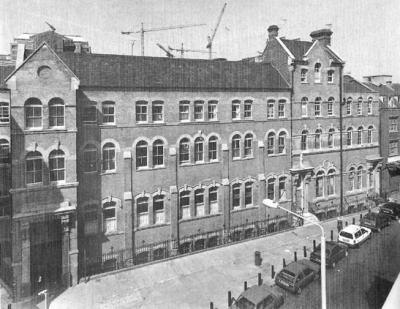
A Historic Essex Convent – the 125th anniversary of New Hall, Essex in 1925

New Hall Essex
New Hall Essex

I stumbled across this when I was looking for more  information on the Roper Parkingtons, and this was on the same page as the notice of Lady RP’s death.

PARKINGTON.—Of your charity, pray for the soul of Marie Louise Parkington, wife of the late Col. Sir John Roper Parkington, who died on June 13, fortified by the rites of Holy Church, at Broadwater Lodge Wimbledon. R.I.P. 

It is all part of a very small world because Great, Great, Great, Great Aunt Jane Grehan joined the convent  about 1800, and Great, Great, Great Grandpa Patrick Grehan Senior left her, and presumably the convent, £ 1,500 in his will of 1830. It was a huge sum of money. New Hall was the girls’ equivalent of  either Douai, or more probably Stonyhurst (though 100 years later than either). It’s also entertaining that the house belonged to Thomas Boleyn because he was Jane Grehan’s third cousin about seven times removed, and the Butlers got the Earldom of Ormond back on the grounds of Thomas Boleyn not having any male heirs. The execution of his son George along with his sister Anne having something to do with it…

Anyway back to the Tablet in 1925

The one hundred and twenty-fifth anniversary of the foundation of the Convent of the Holy Sepulchre, New Hall, near Chelmsford, was commemorated on Tuesday, when new school buildings were opened by His Eminence Cardinal Bourne, in the presence of a distinguished gathering of clergy and laity. New Hall is an historic Tudor mansion, purchased at the end of the eighteenth century for the English branch of the Canonesses of the Holy Sepulchre, which was founded at Liege in 1642, and came over to England in consequence of the French Revolution. The place originally belonged to the Augustinian Canons of Waltham Abbey, and was the summer residence of their Abbots, who frequently entertained royalty here on their way, via Harwich, to and from the Continent. It subsequently became Crown property. Henry VIII, who acquired it from Sir Thomas Boleyn, father of the ill-fated Anne, gave it the name of Beaulieu, and kept the great feast of St. George here with his whole Court in 1524. His arms are to be seen to this day in the chapel ,of the Convent, which was originally the ” great hall ” of the mansion. The blessed Thomas More, the martyr, visited here with the Court, and it was Mary Tudor’s favourite abode. Queen Elizabeth also visited here, and on the front entrance over the chapel door are the Royal Arms and an inscription to her. The new school buildings, designed by Mr. Sidney Meyers, consist of six new class rooms, a dormitory, an art studio, and practising rooms. The principal addition is a spacious hall to serve as gymnasium, as a theatre for the performance of plays, and as a recreation room in inclement weather.

Pontifical High Mass, “Coram Cardinale” was celebrated by the Bishop of Brentwood, with Father Wilfrid Thompson, rector of Chelmsford, as deacon, and Father M. Wilson, of Brentwood, subdeacon. The assistant priest was Canon Dolan, of Sheffield (brother of the Mother Prioress), and the deacons at the throne were Canons Shepherd (of Stock) and McKenna (Southend). Mgr. Wm. O’Grady, V.G., was assistant priest to the Cardinal, and Mgr. G. Coote master of ceremonies to His Eminence. In the sanctuary were the Archbishop of Bombay ; Abbots Smith and White, C.R.L. ; Mgri. Watson and Rothwell ; Canons Bloomfield, Shepherd, and Driscoll ; the President of St. Edmund’s College, Old Hall; the Rector of Beaumont College; the Rector of Manresa House, Roehampton ; the Superior of the London Oratory (Father Crewse); Revv. B. S. Rawlinson, O.S.B., Bede Jarrett, 0.P., C. Galton, S.J., Bradley, C.SS.R., G. Nicholson, C.SS.R.,Burnham, Blackett, S.J., James Nicholson, S.J., E. King, S.J. O’Gorman, S.J., P. L. Craven, Coughlan (Braintree), Gay (Kelvedon), and P. Butler (chaplain of the convent).

Among the laity were Audrey Lady Petre, Sir Thomas and Lady Neave, Lady Shiffner, Lady Horder, Lady Keith Price, Admiral and Mrs. Haggard, Commander and Mrs. Fell, Mr. Mitchell Banks, K.C., M.P., Captain and Mrs. Curtis, Major and Mrs. Fleming, Mrs. Hunter Blair, Major, Mrs. and Miss Tufnell, Madame Girod de l’Ane, Colonel and Mrs. E. Blount, Mr. and Mrs. Turville Petre, Mr., Mrs. and Miss H. S. Petre, Mrs. Weld Blundell, Miss Trappes Lomax, Mr. C. Trappes Lomax, and Mr. Robert Trappes Lomax (who was train-bearer to the Cardinal).

After lunch a splendid performance by the pupils was given of ” A Midsummer Night’s Dream,” which was beautifully staged in the new Hall and produced by Miss Winifred Dolan. The young performers displayed a fine dramatic •instinct, and had an enthusiastic reception. At the close they sang for the first time “New Hall School Song” (in which are traced the historical associations of the place), the words by Miss Dolan. It was composed by Madame Emilie Clarke, who played selections from her own compositions, while the incidental music was played by Miss Janet Curtis.

THE CARDINAL’S ADDRESS.

Speaking at the close of the performance, Cardinal Bourne offered the very sincere congratulations of all to the Mother Prioress and the community of New Hall on the anniversary they had been celebrating. One hundred and twenty-five years !—well, they had not invented a name for such a celebration. They had jubilees of different kinds—silver, golden, diamond—and centenaries. What they would call 125 years he did not quite know. A century and a quarter, and on that occasion it marked the opening of what he believed was certain to be a new epoch in the history of the school. The community had, to his mind very wisely, not been afraid to embark on a great enterprise. They had seen that day in the splendid entertainment provided for them what one might call the first fruits of the new enterprise ; and in expressing to the children of the school their appreciation of what they had shown them, the excellent way in which every-thing had been staged and presented, he took that as an augury of the future. What they had done that day showed what they were capable of, and although they might be the first to admit that such an entertainment was not the most important thing in their school life, still it did take an important part in it, and gave them courage and to us all the assurance that in the most important things they would do as they had done in that entertainment. That morning in the chapel they had what he regarded as something to be welcomed—a truly liturgical High Mass with not a single word in the vernacular, and he appreciated a liturgical Mass like that very much. Then very wisely the community set an example for all of them that might be pursued in other places : there were no speeches at the luncheon. And so until that moment they had not an opportunity of offering their good wishes to the Mother Prioress, the community, and the children on what had been achieved and what that achievement meant for the future. The school occupied a very important place in the educational life of the country, and he hoped that would never be forgotten. It represented a very old and very important tradition. There was a time not so long ago when the number of children there seriously diminished, and, as he had said, the community had determined to place the school once again in the forefront of Catholic schools for girls. They had done so very wisely, and on behalf of the visitors he wished all those connected with the school, the Mother Prioress, the community, the young girls and the old girls, the realization of their hopes and dreams for the future. He had said that school had occupied a very special place on account of its links with the past, and he thought those communities that go back in the history of this country now for 125 years, and go back in their own history for a much longer period of time, had a very special place in the history of the Catholic Church in this country. They were one of the answers, and a very important answer, to the false theories of continuity that had become rife in this country in more recent years. New Hall, the Benedictine houses, the Canonesses Regular of the Lateran, and other religious houses were founded abroad, remember, because their existence was impossible in England ; their existence in England would not have been impossible had there not been a radical change in the religion Of the country. Let them never forget that. It was because their English Catholic maidens who had desired a religious life could not find that religious life in England, owing to the religious change of the sixteenth century, that those houses were founded abroad. They were living in happier and better times, and thanked God for it. Let them never forget the history of the past. They do no service to their country or to its religious interests if they forgot that. And so, said His Eminence in concluding, I thank this religious community for their continued existence. Their presence among us, their continuance in difficult and easier times, are things for which the country and the whole Catholic Church in this country have reason to be thankful. Looking at the new buildings and upon the children, we look forward to the future full of hope and confidence that the next seventy-five years, which will have to elapse between this and the second centenary, will see New Hall always growing in strength, always filling that religious place in the educational life of this country, and always doing the work for which it was founded.

THE BISHOP OF BRENTWOOD.

The BISHOP OF BRENTWOOD thanked His Eminence for coming there and also for speaking words of encouragement to the good nuns who were living on that historic spot and doing a splendid work that had been carried on for 125 years. The existence of New Hall was one of the brightest features in the diocese of Brentwood. He believed there were some people who would not have known anything about the diocese of Brentwood or of Essex except for New Hall. One class knew of Essex by Southend, and another knew of Essex by New Hall. He had been in many parts of the country, and everywhere met people who had told him that they had been brought up at New Hall, and that meant to him that New Hall had made the diocese and the county known. He wished to thank the community for all they had done. When the nuns first came there 125 years ago they found the place very much dismantled. They paid a good sum of money for the property. They found the children were separated too far from the rest of the community, and it took them a year before they were able to get the work accomplished. He could not help thinking as he looked at the new buildings that day that the spirit of the nuns of New Hall was exactly the same spirit of 125 years ago. Anybody who had been associated with New Hall would say that those who had come from that school had always had the same charming homelike spirit. There was something about it, something about the children, that produced a most charming type and at the same time a love of New Hall that brought people back there again and to send their children in order to get the benefits of the place. He wished to thank the nuns for creating that spirit, and re-echoed the words of His Eminence the Cardinal. There was a charm, but they could not be content merely with that. They must move with the times. He thought the community had come to a right decision ; that they would go on singing the Divine Office and saying all the prayers, and also go on educating the children put into their charge. In order to do that properly they must have the buildings and equipment which’ they saw that day. He congratulated the nuns, and echoed the words of the Cardinal that that might be the beginning of a new epoch, and the next 525 years a more glorious period than the last in educating children to be staunch workers, and so help on the great work they were trying to do here in England.

FATHER JAMES NICHOLSON, S.J., who is acting as one of the chaplains, conveyed the thanks of the Mother Prioress and the community to the visitors. In a tribute to New Hall he observed that there is a home feeling in it that comes of the charity that exists there.


The above text was found on p.16, 27th June 1925 in “The Tablet: The International Catholic News Weekly.” Reproduced with kind permission of the Publisher. The Tablet can be found at http://www.thetablet.co.uk .