On Tuesday the opportunity was afforded to a great crowd of lay Catholics of offering their respectful congratulations and affectionate homage to their Cathedral at Archbishop’s House. The numbers that attended and kissed the ring and spoke a few words of congratulation and good wishes, testified both to the popularity of the Cardinal Archbishop and the delight with which his people have welcomed the honour conferred upon him by the Holy Father.
Previous to the general reception his Eminence received the members of the Catholic Women’s League of the Province of Westminster. Mrs. J. S. Hope, on behalf of the League, presented him with an address, and the design, prepared by Mr. John A. Marshall, the Cathedral’s architect, of the metropolitan processional cross which they purpose presenting to the Cardinal on its completion in May or June next. This beautiful work of art will be in silver, and of Byzantine design, while it will bear the following inscription : “To the glory of God and in homage to Francis Bourne, Cardinal Archbishop, this cross is dedicated and offered by the Catholic Women’s League of the Province of Westminster, 1912.”
Cardinal BourneBishop Bidwell
The Cardinal bore traces of fatigue after his recent exertions, and, as he informed his visitors in greeting them, suffered from loss of voice, In attendance were his Gentiluomo, Mr. M. Dunlop, and his private chaplain, Father Lionel Evans. Also present were the Right Rev. the Bishop of Amycla, the Right Rev. the Bishop of Cambysopolis, the Bishops-Auxiliary of the Archdiocese, the Chancellor, the Right Rev. Mgr. Bidwell, the Very Rev. Mgr. Jackman, the Very Rev. Mgr. Carton de Wiart, and Father Henry Daly. The crowds that poured in inconveniently crowded the Reception Room early in the afternoon, and overflowed into the great Throne Room, which before long became also uncomfortably thronged. In this room, laid out, with its great tassels extended, on a table beneath Mr. Ponsonby Staples’ picture of Cardinal Manning’s reception of the laity, was the great Cardinal’s hat, the striking emblem of the Archbishop’s new dignity.
No formal address was offered, the presentation of an address and testimonial on the part of the laity, which the Duke of Norfolk is organising, will be made at a later date. Among the well-known people who joined the throng of those anxious to evince their filial devotion were the Duke of Norfolk, Viscountess Clifden, Admiral Lord Walter Kerr, Lady Gifford, Lady Paget, Baroness Gudin, Sir Charles Cuffe, Sir John, Lady, and Miss Knill, Sir William Dunn, Count de Torre Diaz, Comte Jean de Saint-Seine (naval attaché at the French Embassy), the Mayors of Wimbledon and Hammersmith, Captain E. M. Vaughan, Sir Roper Parkington, Agnes Lady Lawson, Sir Westby and Lady Perceval, Lady Boynton and the Misses Boynton, the Hon. Mrs. Erskine, Mrs. Francis Blundell of Crosby and the Misses Blundell, Lady Clifford and Miss Clifford, Lieut.-Col. W. Haskett Smith, Col. C. H. Plowden, Lady Shephard, Sir Charles Paston-Cooper, Mr. and Mrs. Snead-Cox, Mr. and Mrs. Wilfrid Ward, the Earl of Denbigh, Lord Braye, Mr. and Mrs. Witham, Colonel and Mrs. Smith, Mrs. and Miss Mayne, Mr. and Mrs. Charles Walmesley, Mrs. Moore, Hon. Mary Thesiger, Hon. Mrs. Stapleton Bretherton, Lady A’Beckett, Mr. C. Faudel Phillips, Contessa Maffei, Captain R. H. Spearman, C.B.B., Major F. T. Hemelryk, C.B.B., Miss Martindale, Mrs. George Law, and Mrs. Carmody.
The above text was found on p.33, 27th January 1912 in “The Tablet: The International Catholic News Weekly.” Reproduced with kind permission of the Publisher. The Tablet can be found at http://www.thetablet.co.uk .
In the Catholic cathedrals throughout the kingdom solemn requiem Masses have been offered for the repose of the soul of Benedict XV. The great gathering at Westminster Cathedral on Friday of last week, when a requiem was sung in the presence of representatives of the Royal Family and members of the diplomatic corps of many nations, was the central official function ; but in the other dioceses also the scenes were no less impressive in the gathering together of prelates and clergy, with civic and other public representatives and overflowing congregations, in homage to the memory and prayer for the soul of the late Sovereign Pontiff.
From an early hour in the morning, Catholics from all parts of London were assembling at Westminster Cathedral, and long before the hour appointed for the requiem all the unreserved seats were occupied and the aisles filled with standing crowds. A large portion of the nave had been reserved, and among those received and conducted to their seats by Mgr. Howlett, the Administrator, were the Lord Chamberlain (the Duke of Atholl), representing the King, and Earl Howe, representing Queen Alexandra ; besides a large number of distinguished Catholics and others. Almost every State in the world sent its representatives, whose brilliant uniforms relieved the prevailing black of the congregation. The catafalque, covered with a pall of black and gold, was surmounted by a facsimile of the papal tiara. The Mass was sung by Bishop Butt, assisted by Fathers Tibot and Smith as deacon and subdeacon. Father Hall was the assistant priest, and Fathers Dove and Beckett M.C.s. Nearly two hundred prelates and clergy, secular and regular, of Westminster and the neighbouring dioceses were present in the sanctuary, including Bishop Bidwell, Bishop Keatinge; Mgri. Canons Surmont, V.G., Moyes, Brown, and other members of the Cathedral Chapter and clergy ; Mgr. Carton de Wiart, Mgr. Brown, V.G. (Southwark); the Abbots of Farnborough, Fort-Augustus, and Woolhampton ; Priors O’Connor and Higgins, C.R.L. ; Fathers Bodkin (Provincial) and Galton (Superior, Farm Street), S.J., Bede Jarrett (Provincial) and Vincent McNabb, 0.P., Dr. Brendan, O.S.F.C., and many other representatives of religious orders and congregations. The music was Anerio’s Mass for four voices unaccompanied, with Motet by Miller at the offertory, ” Justorum Animae,” and some plainsong settings. The Absolutions were given by the three Bishops present and by Mgr. Surmont and Mgr. Moyes. At the conclusion Dr. Terry played the Dead March in ” Saul.”
Among the diplomatic and other representatives present were the following :—The Spanish Ambassador and Mme. Merry del Val, the German Ambassador and Mme. Sthamer, the French Ambassador and the Countess de St. Aulaire, the Belgian Ambassador and Mlle Moncheur, the Brazilian Ambassador ; Signor Giuliano Cora, Counsellor to the Italian Embassy, and staff ; the Ministers of Austria, the Argentine,Hungary, Liberia, Nicaragua, Switzerland, Peru, Czecho-Slovakia, Norway, Sweden, Finland, Chile, and Bolivia ; Mr. Henry Harris, Secretary to the Legation to the Holy See; Sir Philip Sassoon, Bart., representing the Prime Minister; Sir William Tyrrell, repre-senting the Foreign Office, and Miss Tyrrell ; Mr. A. W. Leeper, of the Foreign Office; representatives of the Pontifical Court ; representatives of the Legations of Cuba, Columbia, the Nether-lands, Poland, Bulgaria, Ecuador, Serbia, Portugal, Greece, Peru, Persia, Latvia, and Rumania, the Chargé d’Affaires of the Chinese Legation ; Mr. Frederick Pearson, representing the U.S.A. Embassy, and Mrs. Pearson.
Others present included Princess Nina of Russia, the Duchess of Norfolk, Earl and Countess Haig, the Earl of Denbigh (President), Sir Henry Jerningham, Bart. (Vice-President), and Mr. J. S. Franey (Secretary), representing the Catholic Union ; the Dowager Marchioness of Bute, Lord and Lady Rosslyn, Lord. and Lady MacDonnell of Swinford, Adele Countess Cadogan, Lord Lovat, Lord Leigh, Lord Morris, the Right Hon. J. F. Hope, M.P., Viscount and Lady Campden, Sir John Gilbert, K.C.S.G., K.S.S., Mr. Edward Eyre, K.C.S.G., Colonel Sir Arthur Dick, C.B., Sir Roper Parkington, Sir Pierce Lacy, Bart., K.C.S.G., and Lady Lacy, Major-General Sir William Western, K.C.M.G., C.B., Major Wegg-Prosser, and many others.
The above text was found on p.14, 4th February 1922, in “The Tablet: The International Catholic News Weekly.” Reproduced with kind permission of the Publisher. The Tablet can be found at http://www.thetablet.co.uk .
A SILVER WEDDING CELEBRATION.—The Grafton Galleries presented a brilliant appearance on Tuesday night (21st June – two days early) on the occasion of a reception Major Roper Parkington, J.P., and Mrs. Roper Parkington gave to celebrate their silver wedding and their eldest daughter’s birth-day. Guests to the number of 360 were present, each receiving a very warm welcome from the host and hostess, who, in turn, received the hearty congratulations of their friends. Some charming music was contributed by Gottlieb’s Viennese orchestra. Among the entertainers were Signor Tito Mattei, Mr. H. Linwood, Mrs. Beatrice White, Miss Florence Venning, and Mr. Fred. Russell. An elegant supper was afterwards served by M. Benoist.
Among those present were Sir John Williams, Bart., Miss Roper Parkington, Alderman Sir Joseph Dimsdale and Lady Dimsdale, Mr. and Mrs. Hasslacher, Mr. and Mrs. L. A. Bidwell, Mr. and Mrs. H. Bennett, Mr. and Mrs. E. Cary-Elwes, Captain Windsor Cary-Elwes, General Smith and Miss Smith, Mr. and Mrs. Maroy, Baron de Bush, General Blake, Captain H. Lawrence, Major Benson, Mr. and Mrs. F. Tagart, Sir W. McCormac and Lady McCormac, Colonel Clifton Griffith, Colonel Gordon Watson and Mrs. Gordon Watson, Mr. and Mrs. F. Homer, Judge Bagshawe and Mrs. Bagshawe, General Law, C.B., Dr. Colman and Mrs. Colman, Sir Albert Rollit, M.P., Mr. and Mrs. Kenric B. Murray, Dr. and Mrs. Snape, Mr. and Mrs. Agius, Alderman Sir Joseph Renals, Bart., and Lady Renals, Mr. E. Bird, J.P., Sir Donald Macfarlane and Lady Macfarlane, Mr. and Mrs. Pfungst, Alderman Sir David Evans and Lady Evans, Mr. and Mrs. A. Radford, Mr. Alderman Bell and Mrs. Bell, Dr. Dundas Grant and Mrs. Grant, Mr. S. Pope, Q.C., Mr. J. Bailey, M.P., and Mrs. Bailey, Major Isaacs, Mr. and Mrs. Cremieux Javal, Dr. Radcliffe Crocker and Mrs. Crocker, the Rev. Dr. Ker Gray, Commander Smith, General Young, C.B., Major Worthington, Captain Sanders, Captain Burgess, Major Burgess and Mrs. Burgess, The O’Clery, Mr. Owen Lankester, Mr. Gabriel Lindo, Dr. Turner, Mr. and Mrs. Pugin, Sir Henry Cartwright and Lady Cartwright, Colonel Cowan and Mrs. Cowan, Colonel T. Davies Sewell and Mrs. Sewell, General Newton Barton and Mrs. Barton, Mr. and Mrs. Keetley, Mr. and Mrs. Paul Blouet, Mr. and Mrs. C. Tagart, Alderman Sir James T. Ritchie, Mr. and Mrs. Burgoyne, Mr. and Mrs. Rose, Mr. Henry Kimber, M.P., Mr. Ernest Hatch, M.P., the Hon. E. Mansfield, Mr. R. Keating Clay, J.P., Dr. Ball and Mrs. Ball, Mr. and Mrs. Greenwell, Mr. and Mrs. Sims, Dr. Hedley and Mrs. Hedley, Mr. and Mrs. Taylor, Mr. and Mrs. Prince, Dr. Cantrell and Mrs. Cantrell, M. and Madame Testard, Dr. Seymour Taylor and Mrs. Taylor, Mr. A. Serina, Mr. and Mrs. Irminez, Dr. Percy Dunn, Mr. and Mrs. Marino, and Mr. and Mrs. Gayford.
The above text was found on p.27, 25th June 1898 in “The Tablet: The International Catholic News Weekly.” Reproduced with kind permission of the Publisher. The Tablet can be found at http://www.thetablet.co.uk .
At St. James’s Church, Spanish Place. W., on Tuesday morning, the marriage took place of MR. CHARLES EDWARD CARY-ELWES, third son of Captain Windsor Cary-Elwes (late Scots Guards), of Blackmore, Worcestershire, and MISS EDYTHE ISABEL PARKINGTON, second daughter of Major Roper Parkington, 6, Devonshire Place, W. The Bishop of Emmaus officiated, assisted by the Rev. Mgr. Barry, V.G., and the Rev. Dudley Cary-Elwes, cousin of the bridegroom. The bride’s father gave her away, and Mr. Guy Chetwynd, cousin of the bridegroom, was best man. There were four bridesmaids—Miss Irene Cary Parkington (sister of the bride), Miss Edith Cary-Elwes (sister of the bridegroom), Lady Mary Pepys (cousin of the bridegroom), and Miss Maria de Frietas Branco. Miss Dagmar Bennett, Miss Eileen Bennett were train-bearers, and Master Brian Hunt acted as page. The bride wore a dress of ivory white satin, the bodice being trimmed with pearl lace and small sprays of orange blossom, a full Court train of brocade of handsome floral design hanging from both shoulders. Her embroidered tulle veil covered orange sprays, and was fastened with a diamond star, the gift of the bridegroom. A reception was given by Mrs. J. Roper Parkington at 6, Devonshire-place, after the ceremony, and was largely attended.
The above text was found on p.28, 27th November 1897 in “The Tablet: The International Catholic News Weekly.” Reproduced with kind permission of the Publisher. The Tablet can be found at http://www.thetablet.co.uk .
The cousin thing is Charles and Guy (later Sir Guy Chetwynd, [1874–1935] ) and Lady Mary are all third cousins. They share a great, great, grandfather in Henry Paget (1744 – 1812) the 1st Earl of Uxbridge, and the father of the first Marquess of Anglesey.
Also quite amusingly, Charles and Edythe’s eldest daughter Lilian (1902 -2000) married Maj. Hon. Arthur Michael Cosmo Bertie ( 1886 – 1957). on 7 May 1949 as her second husband. She was the widow of Lt Cdr Frank Dayrell Montague Crackanthorpe RN. It was a second marriage for both. His sister was Winston Churchill’s sister in law, though by the time of their marriage both Jack Churchill, and Lady Gwendoline were dead.
Lady Gwendoline Theresa Mary Bertie (1885–1941). married John Churchill (1880-1947), in 1908. He was the son of Lord Randolph Churchill and Jennie Jerome, and younger brother of Winston Churchill. She was the mother of Clarissa Churchill (b. 1920), who married Anthony Eden. Arthur Bertie’s son, and Lilian’s step-son became the 14th Earl of Lindsey and 9th Earl of Abingdon in 1963; and their nephew Fra’ Andrew William Ninian Bertie,(b. 15 May 1929; d. 7 Feb 2008) was elected in 1988 His Most Eminent Highness, the 78th Prince and Grand Master of the Sovereign Military Order of Malta. Prior to his election, he had taught modern languages at Worth in Sussex.
ROPER-PARKINGTON—SILVESTER.—At the Church of Our Lady of Grace, Chiswick, W., on June 21st, 1873, by the Rev. F. Doherty, MR., assisted by the Very Rev. Abbot Burder, J. Roper-Parkington, J.P., of Melbourne House, Chiswick, to Marie Louise, daughter of the late A. Sims Silvester, Esq., of Stanhope Lodge. Chiswick, and of the Stock Exchange.
The above text was found on p.17, 23rd June 1923 in “The Tablet: The International Catholic News Weekly.” Reproduced with kind permission of the Publisher. The Tablet can be found at http://www.thetablet.co.uk .
On Saturday the 16th of February, at the Pro-Cathedral, Kensington, was celebrated the marriage of the Marchese Mattei, of Capua Palace, Malta, and the Middle Temple, and Miss Teresa Bagshawe, daughter of his Honour Judge Bagshawe, K.C., of 249, Cromwell-road.The ceremony was performed by the Right Rev. Dr. Bagshawe, Bishop of Nottingham, uncle of the bride, assisted by the Rev. Michael Fanning and the Rev. J. Bampton, S.J. During the Nuptial Mass Gourod’s Ave Maria and Niedermayer’s Pater noster were sung by Signor Caprili. The bride wore a white satin dress trimmed with orange-blossoms, and with a long court train of while satin. Her ornaments were a long pearl chain and a diamond pendant, the gifts of the bridegroom. A special blessing was sent from the Holy Father by telegram from Cardinal Rampolla.
The bride was given away by her father, and was attended by four bridesmaids, the Misses Gertrude and Helen Bagshawe, her sisters; Miss Hilda Bagshawe, her cousin, and Miss Mildred Turnbull. The bridesmaids’ dresses were of white crepe de chine over white silk, trimmed with cream lace, and gold belts. Their hats were of black chiffon trimmed with white roses, and they wore gold curb bracelets set with turquoises, and carried bouquets of two shades of Parma violets, the gifts of the bridegroom. Mr. Paul Strickland attended the bride-groom as best man. The guests were numerous, and among those invited were his Grace the Duke of Norfolk, K.G., H.E. the Turkish Ambassador, the Charge d’Affaires for Italy, Sir E. T. Reed, M.P., Lady Sykes, Sir Donald and Lady Macfarlane, Sir J. Montefiore, Mrs. Latter, Mr. and Mrs. Field Stanfield, Mr. and Mrs. C. W. Bagshawe, Madam O’Grady, Major and Mrs. Blacker, Mr. and Mrs. H. K. Bicknell, Mr. and Mrs. Herbert Stanfield, Mr. and Mrs. Thomas Turnbull of Whitby, Mr., Mrs. and Miss Jessop, the Rev. Francis Stanfield, Canon Gordon, Canon Bagshawe, D.D., Canon Rymer, Mrs. John Grace, Mrs. and Miss Fuller, Miss Eyre, Mr., Mrs. and Miss Spielmann, Mr. and Mrs. Doughty Brown, Mr. and Mrs. B. Cuddon, Mr, T. M. Turnbull, Mr. Murland Evans, and Major O’Connor (Militia), R. A. M. S.
The presents included the following : Bridegroom to bride, diamond pendant, long pearl chain, sapphire and diamond ring, diamond ring, gold muff chain set with turquoises, diamond and emerald pendant, garnet and white sapphire necklace, &c., &c. ; brothers and sisters of the bridegroom, old Georgian silver tea and coffee service and tray; Judge Bagshawe, ivory crucifix ; Mrs. Bagshawe, bronze benitier, silver candlesticks ; his Grace the Duke of Norfolk, K.G., emerald and diamond brooch ; H.E. the Turkish Ambassador, gold fruit spoons ; Sir D. and Lady Macfarlane, embossed silver toilet set and case ; Lady Sykes, silver candelabra; Mr. and Mrs. Field Stanfield, turquoise and diamond bangle ; Misses G. and H. Bagshawe, calling-bag, Mr. and Mrs. H. K. Bicknell, silver coffee service; Major and Mrs. Blacker, large silver-framed mirror ; Sir J. Montefiore, old Florentine gold tea-spoons ; the Misses Muriel and Gladys Bagshawe, “Oakes,” Derbyshire, silver card-case ; Mr. and Mrs. E. H. Stanfield, silver sugar-sifter ; Lady Knill, Victorian scent-bottle ; Lady Mathew, old silver wine-taster ; Dr. and Mrs. Jessop, silver-framed mirror ; Mr. and Mrs. A. J. Walton, gold-mounted umbrella ; Mr. and Mrs. Thomas Turnbull, silver rose-bowl ; Miss Turnbull, silver sugar-basin ; Lady Austin, sapphire and diamond bangle; Mr., Mrs. and Misses Fuller, pearl brooch ; Mr. and Mrs. Michael Grace, old silver vases ; Mrs. John Grace, silver cake-basket ; Lady Mary Milbanke, silver taper-holder ; Judge Bacon, Japanese vases ; Mr. Paul Strickland, Venetian bowl ; Canon Gordon, portrait of his Holiness Leo XIII. ; Mr. J. R. Bagshawe, oil painting ; Mrs. Latter, silver tea-spoons ; Miss Stanfield, jewel-case; Father Stanfield, table-writing set.; Dr. and Mrs. Bagshawe (Hastings), silver scent-bottle ; Mr. Wainer and clerk, silver tantalus ; Servants at Cromwell-road, statue.
The above text was found on p.28, 23rd February 1901 in “The Tablet: The International Catholic News Weekly.” Reproduced with kind permission of the Publisher. The Tablet can be found at http://www.thetablet.co.uk .
If you are driving from Enfield towards Stoke Newington down the A10, a little to the south of White Hart Lane, you find yourself on Bruce Grove. It’s all fairly run-down now, but on the right-hand side there is a small terrace of late Georgian houses which includes No. 7. which was one half of a pair of symmetrical villas, built in the late 18th or early 19th century and part of a consecutive group (1-16). It became the Tottenham Trades Hall in 1919. Currently it is derelict. On the front wall facing the street is Tottenham’s only blue plaque. The house also has a great view south, and east, across the Lee river valley, and the City, and East End. It must have been a great place to watch clouds, although Luke Howard was only there for the last twelve years of his life.
This is almost my most favourite English Heritage plaque in London; it is certainly one of the most thought-provoking, and probably one of the coolest, possibly only rivalled by this pair in Brook Street.
It’s a staggering thought that one man classified all the main cloud types in 1803, and more to the point what did people use before – fluffy? straight? round?
Luke Howard 1772-1864
Luke Howard was born in London on 28 November 1772, the eldest son of Robert Howard and his wife Elizabeth, Robert Howard was a lamp manufacturer. Luke was a Quaker, later converting to the Plymouth Brethren. He was educated at a Quaker school at Burford, in Oxfordshire and was then apprenticed to a retail chemist in Stockport, just outside Manchester. He set up his own pharmacy in Fleet Street in 1793. In approximately 1797, he went into partnership with William Allen to form the pharmaceutical company of Allen and Howard in London. A factory was opened on the marshes at Plaistow, to the east of London. The partnership was dissolved in 1807 and the company became Howards and Sons in 1856. He spent the years 1824 to 1852 in Ackworth, Yorkshire, and died in Tottenham in 1864.
He made a number of significant contributions to the subject of meteorology besides his cloud classification, and published “The Climate of London” (first edition 1818, second edition 1830), “Seven lectures on meteorology” (1837), “A cycle of eighteen years in the seasons of Britain” (1842) and “Barometrographia” (1847). But the most important was “On the modification of clouds” in December 1802.
The success of Howard’s system was his application of Linnean principles of natural history classification [i.e. using Latin, and that species were grouped into genera (singular: genus), genera were grouped into orders (higher level groupings), and orders into classes. Classes in turn were parts of “kingdoms”, of which he, along with his contemporaries and predecessors, recognised three: mineral, plant, and animal. Species bore a double (or “binomial” name) — the first term of which gave their genus, and the second their species.]and his emphasis on the mutability of clouds.
But he named clouds, and I’d be really, really proud if I’d done that.
“On the modification of clouds” 1802 introduced three basic cloud types:
Cirrus (Latin for a curl of hair), which he described as “parallel, flexuous, or diverging fibres, extensible in any or all directions”.
Cumulus (meaning heap), which he described as “convex or conical heaps, increasing upward from a horizontal base”.
Stratus(meaning something spread), which he described as “a widely extended, continuous, horizontal sheet, increasing from below”.
He combined these names to form four more cloud types:
Cirro-cumulus, which he described as “small, well-defined roundish masses, in close horizontal arrangement”.
Cirro-stratus, which he described as “horizontal or slightly inclined masses, attenuated towards a part or the whole of their circumference, bent downward, or undulated, separate, or in groups consisting of small clouds having these characters”.
Cumulostratus, which he described as “the cirrostratus blended with the cumulus, and either appearing intermixed with the heaps of the latter, or super-adding a widespread structure to its base”.
Cumulo-cirro-stratus or Nimbus, which he called the rain cloud, “a cloud or system of clouds from which rain is falling”. He described it as “a horizontal sheet, above which the cirrus spreads, while the cumulus enters it laterally and from beneath”.
Luke Howard is almost family as well; his son-in-law, John Hodgkin junior (1800-1875) is a first cousin, five times removed.
John Roche was a mystery right from the start, and remains so. But it’s probably time to put together some bits of the jigsaw. He’s a great, great, great, great, great grandfather to the youngest generation.
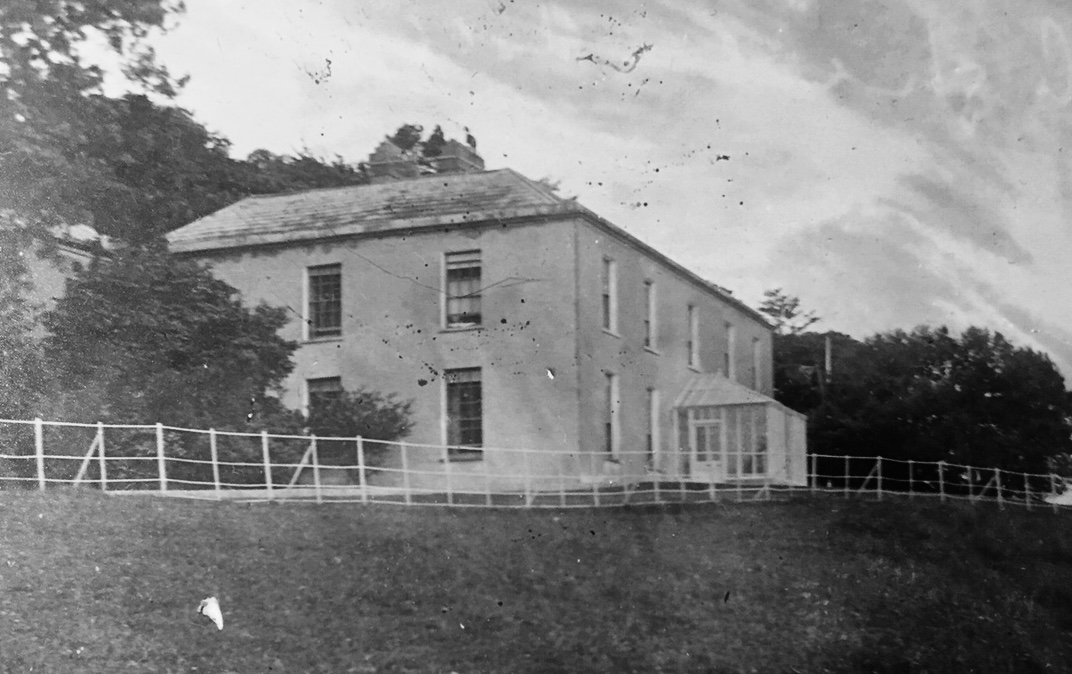
Aghada Hall
We know a few documented bits; from the “Barrymore Records” [1902] he “amassed great wealth during the French wars, and built Aghada House.” Aghada Hall was, apparently, a large Georgian house designed by the Cork architectAbraham Hargrave (1755-1808); though it seems to be “a comfortable gentleman’s residence rather than a vast mansion.”It was completed in 1808. John Roche was also responsible for building the Aghada National School in 1819. The house remained in the family until 1853.
He seems to have made quite significant efforts to establish some sort of Roche dynasty to maintain the family name, and the house that he had built for himself. From Henry Hewitt O’Bryen and Mary Roche’s marriage settlement of 1807, we know that John Roche had at least one child, Mary, and can speculate, probably, a son called John. The two trustees of the settlement are “John Roche the younger, and Stephen Laurence O’Brien,” but by the time John Roche [senior] drew up his will in January 1826, there is no reference to John Roche the younger, and we can probably conclude he had died. It would be likely that family members were the trustees of the settlement, and also likely that John Roche the younger, and Stephen Laurence O’Brien, were the brothers of the bride and groom respectively.
There were three significant beneficiaries of John Roche’s will of 1826, with a later codicil. They were his nephews James Joseph Roche, and William Roche; they seem to be cousins rather than brothers. The third main beneficiary was John Roche’s eldest grandson, John Roche O’Bryen. The total estate amounted to about £ 30,000 when John Roche died in 1829, the modern day equivalent of £45,000,000.
The house and land was left to James, and his male heirs, first of all, and then William, who also inherited £ 10,000, “in case of his not coming into possession of the estate by the means before-mentioned,I leave him£6,000″ plus John’s grand-daughter, Jane O’Brien’s ……£4,000 £4 per cent. stock ;” . Jane O’Bryen, John Roche’s granddaughter was married to his nephew William Roche, and their daughter Pauline Roche inherited their share as a one year old orphan. The final third was John Roche O’Bryen’s £ 10,000, presumably in the expectation that a male Roche heir would inherit the house and land.
John Roche O’Bryen, and Jane O’Bryen were Catholic. All their five remaining younger siblings were Church of Ireland. JROB and Jane/William Roche are the only O’Bryen beneficiaries of John Roche’s estate. The O’Bryen siblings seem to be John Roche’s only grandchildren.
John Roche also left a series of £ 100 legacies (present-day £ 150,000) to various sisters, and nephews and nieces, and “To the parish of Aghada, I leave the school-house, and £20 ( £ 30,000) a-year for its support, and also the chapel and priest’s houseI leave to the parish rent-free for ever, as long as they shall be used for such qualified purposes ; the five slate houses I built in the village, I leave to five of the poorest families rent free ; to David Coughlan I leave the house he now lives in during his life ; to my servant, James Tracy I leave the house his wife now lives in;and to my wife’s servant, Mary Ahearne, otherwise Finne, her house rent-free during their lives ; and to each of those three, viz.,David Coughlan, James Tracy, and Mary Ahearne,otherwise Finne, I leave £10 (£15,000) a-year during their lives :”
So working from the above, we know that John Roche [c.1755 – 1829] is the father of Mary Roche, [1780 – 1852] who married Henry Hewitt O’Bryen (1780 – 1836) in Nov 1807; and the grandfather of John Roche O’Bryen, Jane Roche (nee O’Bryen), and their siblings, Hewitt O’Bryen, Robert Hewitt O’Bryen, Henry Hewitt O’Bryen Junior, Stephen Hewitt O’Bryen, and Mary O’Bryen . At the same time, he is both the great-grandfather, and great uncle of Pauline Roche. Pauline Roche’s mother is John Roche’s grand-daughter Jane O’Bryen, and her father is his nephew William Roche.
John Roche appears to have two brothers, and two sisters:
Hugh, who is the father of James Joseph Roche and Hugh Roche
Lawrence who is the father of William who married Jane O’Bryen and is the father of Pauline Roche
Ellen m. John Verling and mother of Bartholomew Verling, Dr James Roche Verling, Catherine Ellis (nee Verling), and Ellen Verling Jnr.
Julia m. ? Enery [the surname is unclear from the transcript of John Roche’s will]
At this stage there are only hints, rather than facts, but John Roche (Senior) seems to be part of the merchant class in late C18th Cork, and the family’s marriages appear, at least in part, strategic. Bartholomew Verling,[the non-doctor one] was also a Cork merchant, and the Spanish Consul in Cork. He also seems to have been politically linked to Daniel O’Connell, and slightly ironically, to have been responsible for getting Cobh renamed Queenstown when Queen Victoria visited Ireland in 1849. There is also the mercantile/political connection between John Roche and the Callaghans with James Joseph Roche’s marriage to Catherine Callaghan, where JR provided her marriage settlement fund of £4,000, and left instructions in the codicil to his will that she should receive the money even if the marriage didn’t go ahead. So he really did have a lot of money or was really keen on a deal going through.
Sources:
From www.landedestates.ie What is clear is our Bartholomew Verling isn’t this one “In the 1870s Bartholomew Verling, Springfield Lodge (Oxclose), Newmarket, county Cork, medical doctor owned 883 acres in county Limerick and 110 acres in county Cork. He appears to have acquired his county Limerick estate post Griffith’s Valuation. Bartholomew Verling (1797-1893) was a naval surgeon of Oxclose, Newmarket, county Cork. He was the son of Edward Verling and his wife Anne Ronayne. The Verlings were established at Newmarket by the late 18th century.” http://www.landedestates.ie/LandedEstates/jsp/estate-show.jsp?id=2728 But they are almost certainly relations.
From the Irish Journal of Medical Science, January 1971, Volume 140, Issue 1, pp 30-44 – regarding the Irish doctors who attended Napoleon on St Helena including James Roche Verling. Dr James Roche Verling is the Doctor Verling referred to in John Roche’s will. The source references (Ellen Verling) and her brothers John and Laurence Roche of Aghada as members of the council of Cork. It also refers to James Roche Verling having a brother Bartholomew who was a J.P.
From Roche v O’Brien, and his will, we know that John Roche has two sisters
Julia Enery [though the spelling and therefore the name is unclear], Ellen Verling
And at least four nephews
James Joseph Roche, William Roche, Bartholomew Verling, and Doctor (James Roche) Verling
And at least two nieces
Ellen Verling jnr, and Catherine Ellis (nee Verling)
From Burke’s Landed Gentry 1847 entry we know there is another brother Hugh, who is the father of James Joseph Roche, and Hugh Roche Junior.
Roche Of Aghado
Roche, James Joseph Esq of Aghado House, co Cork b. 12 May, 1794 m in Nov 1821 Catharine youngest dau of the late Daniel Callaghan Esq of Lotabeg in the same county and has issue
Maria Josepha
Emily
Mr Roche, a magistrate for the co. Cork s. his uncle, the late John Roche Esq in March 1829. He and his brother Hugh, an officer in the navy, are sons of Hugh Roche, Esq by Anne, his wife dau. of Daniel McCarthy Esq, a Spanish merchant son of JohnMcCarthy Esq.Seat. Aghado House co. Cork.
We know William Roche is the son of Laurence Roche from“Barrymore Records of the Barrys of County Cork from the Earliest to the Present Time, With Pedigrees. London:” published 1902
“Patrick Barry, of Cork, gentleman, died 1861, having married Mary Anne, daughter of Stephen Murphy, of the city of Cork, draper, and had with an elder son, Stephen Barry, of H. M. Customs, Cork, and a daughter, Kate, who both died unmarried, a younger son, William Henry Barry, of Ballyadam, gentleman, J.P., who was heir to his uncle, Henry Barry, of Ballyadam, and was for many years postmaster of Cork. He married in 1857 Pauline Roche, only child of William Roche, son of Lawrence Roche, whose brother, John Roche, amassed great wealth during the French wars, and built Aghada House. John Roche’s only daughter, married to [Henry Hewitt] O’Brien, of Whitepoint, Queenstown, J.P., left a daughter [Jane O’Bryen], who married her cousin, William Roche, and with her husband died shortly after the birth of their only daughter, Pauline, who was entrusted to the guardianship of her uncle, Dr. O’Brien, of Liverpool [sic], and at marriage had a fortune of £7,000.
As with most of the Roman posts this one is included a. because it’s fun, and b. because Uncle Henry – Mgr HH O’Bryen was there.
THE PAPAL JUBILEE.
(FROM OUR SPECIAL CORRESPONDENT.)
DEPARTURE OF THE BRITISH PILGRIMAGE.
The Irish pilgrims to Rome had anticipated our day of departure. Therefore it is that I must take up the thread of our combined Roman chronicle after our own arrival in Rome. We met then, English and Scottish pilgrims, some five hundred strong, at the Pro-Cathedral, Kensington, on Monday night, February 13. The Archbishop of St. Andrews and Edinburgh delivered an address on the object of our journey, and the fitting spirit in which we should go, and Benediction concluded this opening ceremonial. On the following morning, at II a.m., we began our journey from Victoria, two special trains containing the pilgrims travelling in succession the one to the other. Of our crossing the Channel I need say no more than that we were compelled to endure considerable mortifications ; it was very rough, and the special boat was crowded to repletion ; nevertheless the pilgrim train arrived in Paris not more than two hours late. The Gare du Nord, immediately after our arrival, was thrown into unexampled confusion. Nobody was able to find, much less identify, his luggage, and the French officials were perfectly apathetic to our distressful condition. After much struggling, however, and perspiring exertion, we reached our several destinations in Paris safely.
On the following morning we assembled in strong force at Notre Dame, where, after Mass and the distribution of ashes, the great relic preserved in the Cathedral (the Crown of Thorns of Our Lord) was, by special favour, offered for the veneration of the pilgrims. The reliquary is in the form of a cross, about two feet long, and a circular case in the centre contains the precious relic.
At 11.45 we left Paris, and dinner was served at Dijon. Here in truth we learned a sorrowful necessity of patience. There was a rapid raid made on the Buffet, which, in effect, nearly developed in a free fight. By the vigilance of the Committee, however, all disastrous effects were avoided ; we consumed a certain quantity of food, and were quickly back in our train making preparation for the night journey. This was accomplished without mishap, and the morning sun rose as we travelled down—down—from the bleak hills into the most gracious levels of Italy. We went with the sweep of a wind from this bleakness into this hospitality ; and enjoyment was once more a visitor to our souls when we reached Modane, and were compelled to endure another scene of turmoil by reason of the enforced examination of our lesser baggage. Steadily keeping unpunctual by the two hours to the bad which had marked our arrival at Paris, we reached Genoa at half-past five, and left the train to take some rest within sight of the curving Mediterranean, and the lean sloping hills of Italy. Rain greeted us in the morning, and it was in a deluge that we left Genoa at halfpast eight ; but the weather quickly cleared up, and, by the time we had arrived at Pisa, with its extremely modern looking station, the sun was shining.
Duke of Norfolk c.1908
Some of us took the opportunity of an hour’s delay at this town to take a hasty glance at the famous leaning tower, but the effect of this curiosity was to retard still more the heavily laden train, which arrived at half-past eleven, three hours after the appointed time. I may add in passing that, owing to the lateness of the hour, no luggage could be obtained that night. We were met by quite a crowd of the English colony, and by a deputation of the Circolo di San Pietro accompanied by the Vice-President of the General Pilgrimage Committee in Italy ; while the Rector of the Scots College and many of the students, with their purple cassocks and black ferraiouli, were present to welcome the Scottish pilgrims. On the arrival of the train, a deputation was presented to the Duke of Norfolk, who returned formal thanks for the attention.
THE IRISH PILGRIMS.
Irish College, Rome
Meanwhile it is now necessary for me to return to the Irish Pilgrims who arrived on the Tuesday, and to chronicle their doings, as I have them by hearsay, down to our own arrival in the Eternal City. The Irish pilgrims, then, arrived on Tuesday night, and were met at the station by the Rector of the Irish College and by a deputation of the Circolo di San Pietro. On the following morning they all assembled in the chapel of the Irish College to assist at the Mass celebrated by Cardinal Logue, who also distributed the ashes to them, the, pilgrims singing together several parts of the Mass. At the end of it they sang the hymn, “God bless the Pope,” and then “Faith of Our Fathers.” Dr. Kelly, the Rector, while his Eminence was unrobing after Mass, delivered a little discourse, describing the chapel and its antiquarian interest. He also drew the attention of the pilgrims to the beautiful monument erected there to the memory of O’Connell, which encloses his heart. He recalled O’Connell’s words on his death-bed, when he said that he gave his soul to heaven, his body to Ireland, and his heart to Rome.
The pilgrims then assisted at the unveiling of a commemorative slab to the memory of Cardinal Cullen. The slab is on the wall of the first landing of the big staircase leading inside the College. The Cardinal, surrounded by pilgrims, had just taken his seat opposite the slab, and the ceremony was about to begin, when the venerable figure of Archbishop Kirby, the late Rector, who for many years had held that post, appeared through the crowd of pilgrims. He is indeed just recovering from rather a bad illness ; yet in spite of his being ninety years of age he determined to make the exertion of appearing amongst the pilgrims and welcoming them to Rome. The pilgrims received him with hearty cheers. The Rev. P. Maguire recited an ode in the Irish language, dedicated to the Cardinal, who in reply delivered a few pleased and appreciative words. On the Thursday morning, the day before our arrival, the Irish pilgrims assisted at Mass in the Church of San Clemente, after which Father Hickey, Prior of the Irish Dominicans, showed the pilgrims over the celebrated underground Church of San Clemente, which, being the first basilica dedicated to this saint, was discovered and excavated in 1857 by the late Father Mullooley.
On the same afternoon Cardinal Logue took possession of his titular Church of Santa Maria della Pace. The pilgrims were all assembled in the church by four o’clock. At a quarter after the hour, his Eminence entered the church, accompanied by the procession, and took his seat on the throne erected in the sanctuary on the gospel side of the altar. The different Bishops that have come with the pilgrims were seated in reserved seats immediately before the sanctuary. There were also present several Italian Bishops, and the Rectors and Priors of the different Irish communities in Rome. The Cardinal was assisted by the Rector of the Irish College and by Mgr. O’Bryen, while Mgr. Cocci acted as master of ceremonies. Mgr. Pericoli, the Apostolic Notary, read the Pontifical Bull conferring the church, and the Rector of the church, after the reading of the Bull, delivered a speech congratulating the Cardinal on the occasion. The Cardinal returned thanks, and stepping from the throne, addressed the pilgrims from the sanctuary rails, giving, in fact, an interesting account of the Church assigned to him by the Pope. A Te Deum closed the ceremony, and the same evening the Cardinal gave a reception of the pilgrims in the Halls of the Arcadia. Cardinal Vaughan, Cardinal Macchi, Archbishop Stonor, the Bishops of Clifton and Emmaus, the Austrian Ambassador, and many distinguished personages were present. The reception was, I am assured, a brilliant success.
IN ROME.
Borghese chapel Santa Maria Maggiore
I return now to our own fortunes. We all assembled on Saturday morning in the Borghese Chapel of Santa Maria Maggiore, having wended our way to the great church from all the points of the compass. My own way led me, with several others, past the Palazzo Barberini, and the Quattro Fontane, by the Via Nazionale. Climbing the great exterior steps, then, and entering the church, we met, as I have said, in the Borghese Chapel. The altar was for the time, occupied by a Neapolitan Bishop ; but after he had finished Mass, the Bishop of Clifton began to vest, and Mass began shortly after ten o’clock. The picture of the famous Madonna, said to have been painted by St. Luke, was exposed to view, and kneeling in front of the sanctuary was our Cardinal, in purple, with scarlet zucchetto.
During the Mass the Litany of Loretto and “Hail Queen of Heaven” were sung, and I cannot easily describe the devotional effect of those five hundred English voices uplifted and echoing among these springing Italian arches, and amid this gay and florid decoration. I think that even Mr. Francis Whitgreave, Jun., might have been persuaded, for the moment, into the tolerance of this noble and most unsinning architecture, and for the moment have overlooked the immoral sins of commission which have been heaped upon these poor stones. At the end of Mass Cardinal Vaughan delivered a short discourse upon the relics which this Church contains, and afterwards accompanied the pilgrims upon a visit to the crypt.
When this ceremony was concluded, we all repaired to the Hotel de Rome, the head-quarters of the Pilgrimage, to receive our tickets for the great function on the following day. We received injunctions to be at St. Peter’s, if possible, by five o’clock on the following morning, on account of the crush that was expected. Personally, having some little knowledge of the ways of Roman functions, I suspected my ticket ; and, observing that it had no encouragement endorsed upon it for any entrance to a tribune, only serving (as I supposed) for the body of the Church, I made subsequent effort to exchange it for a tribune ticket. This, by a stroke of good fortune, I was enabled to effect.
BEFORE THE FUNCTION.
I am told that pilgrims began to gather round the Facciata of the great Cathedral as early as three o’clock in the morning, and that cafes and restaurants were up betimes with their fires lit in busy provision of breakfasts. I started with my tribune ticket for the Apse at half-past six, and having resolved to avoid crossing the Tiber by the temporary iron bridge near St. Angelo, which the Romans in satire call the Gabbthne (huge cage), over which the new tram lines run, I drove a long but clear round across the new Ponte Margherita and through the Prati di Castello quarter, and so effected an entrance into the Piazza of St. Peter’s at the Colonnade of Constantine.
Here lines of Italian soldiers were drawn across the middle of the vast space, and further progress was only granted to those who were in the possession of tickets, whether for the tribunes near the high altar, or for standing room in the nave The doors had been opened at 6.30, and I learn that much disappointment was expressed by many of the Irish and English pilgrims on the discovery, for the first time, that no special places had been reserved in the Basilica for them. “It caused,” writes one, whose letter I have permission to quote, “a certain amount of dissatisfaction amongst the pilgrims who, having undergone all the fatigues of the long journey for the special purpose of attending this Mass, considered themselves entitled to rather more consideration than they received on this occasion. Nevertheless we resigned ourselves to standing in the seething crowd for some three hours, a resignation which the splendid function that followed amply justified.”
The Irish pilgrims, I should here remark, marched into the Basilica four abreast, displaying great spirit, bearing a banner aloft, and carrying all before them. Father Ring acted as Captain of the Irish forces. Most of these were stationed near the statue of St. Peter, which had been arranged for the Jubilee in the pontifical robes, and wore a tiara and ring—a ritual usually restricted to the Feast of St. Peter in June. The pilasters of the great nave and the dome were draped, as usual, with rich crimson brocade, bordered with gold lace, not tinsel or fine copper wire, as some contemptuously suppose, but real gold-woven work. By seven o’clock the tribunes in the apse were filled with various ladies and gentlemen, together with many religious, priests, and sisters—the English Nuns, founded by Lady Georgiana Fullerton (the Servants of the Mother of God), and the Nottingham Sisters (the Little Company of Mary), with their blue lined veils, the ladies of the Sacre Coeur, and others.
St Peters Basilica
The High Altar was illuminated with many tall wax lights and immense bouquets of natural flowers were massed between the Altar and the “Confession.” In the long three hours before the function began—appointed for nine, it was delayed till a quarter to ten—the tribunes gradually filled chiefly with members of the Roman aristocracy and of the Diplomatic Corps. Some of the uniforms were gorgeous, and some curiosity was aroused by the appearance of three German Catholic students arrayed in black velvet braided jackets, white leather breeches, and long boots ; they carried large black velvet caps with white feathers, and silk scarves of the Papal and German colours, white and yellow, black and white intermingled. Down the great Church the view was most impressive. The heads of the crowd were packed together from altar to great door, and it is calculated that from sixty to eighty thousand people were gathered in the building. The black lace veils worn by the women set against the black and white of the men’s evening dress contrasted with the gay red and yellow of the Swiss guards, with their halberds and baggy knickerbockers, and again with the white and blue of the Guardia Nobile. Two men, I have been credibly informed, overcome by the crush had to be lifted insensible over the palisade in the centre of the nave and carried to one of the five ambulances prepared in various parts of the Church for emergencies of the kind. From where I sat, in one of the Apse tribunes, the 150 choristers perched aloft in the Dome seemed like black and white dolls moving about in the vague spaces of the giant cupola.
THE RECEPTION OF THE POPE.
At last, after long waiting, a thrill of emotion swept through the dense crowds, for the Pope had descended from his apartments, and knelt at prayer in the Chapel of the Holy Sacrament ; he was not yet to be seen, for the right nave was screened by heavy crimson damask curtains down to the Chapel of the Pieta, where all the Canons of St. Peter’s, with the Cardinal Archpriest Ricci Paracciani,, received his Holiness. Here he was robed in the white and gold chasuble presented by the Roman ladies for his Sacerdotal Jubilee, and the precious mitre offered on the present occasion by his Noble Guards. The Holy Father wore also the great white fala’a, reserved exclusively for the Sovereign Pontiff, clasped with jewels, and the train held by the two Monsignori, who are his camerieri partecipanti.
The tiara was placed on his head, and when the Pontiff was seated in the sedia gestatoria, the procession up the great nave slowly began ; and the silver trumpets sounded from the Loggia of the Beatifications above the great central door of St. Peter’s. The Pontifical choir led the way, singing Tu es Petrus, but their voices had scarcely broken into the air when a great burst of cheering went up from the immense concourse of people. It was like the roar of the sea breaking on a strand. The enthusiasm was unbounded, and deafening cries of “Viva il Papa Re,” “Viva il Vicario di Cristo,” arose as the seated figure of the Pontiff, leaning gently from side to side in benediction of his flock, was borne up the nave. The progress to the High Altar, the enthusiasm ever growing greater and greater, till at length that vast congregation seemed almost beside itself with emotion.
THE POPE’S MASS.
Calm was only restored when Leo XIII. stood before the altar of the Confession to begin the Holy Sacrifice. He said a Low Mass, and was assisted by the two Archbishops of the Chapter of St. Peter’s, Monsignori Tamminiatelli and Cassetta, his Auditor, Mgr. Fausti, and the Sacristan, Mgr. Pifferi. During Mass the choir of the Sixtine Chapel, led by their old Maestro, Mustafa, sang the Jubilate Deo. Every eye was fixed upon the venerable white old man absorbed in prayer, who celebrated with the same touching reverence and humility as if in his own private chapel. There was a solemn hush through the whole multitude, and many were moved to tears at the moment of the elevation, when the cool liquid strains of the silver trumpets streamed through the building, and the choir chanted the chorus by Mustafa, Domine Salvum fac, re-echoed by the fresh young voices in the cupola.
Mass being ended, the Holy Father recited the usual prayers and thanksgiving; then for a few minutes he retired to a pavilion under the choir to partake of some slight refreshment, having, of course, fasted from the preceding evening. Meantime, the choir sang the prayer of the Holy Father, Sancte Michael, &c., to music composed by Mustafa. Then his Holiness returned to the foot of the altar, and the Pontifical robes, including the tiara, being again put on, the Te Deum was intoned and taken up by the choirs, and the responses joined in by thousands of voices in every part of the church. Although the Holy Father did not himself intone the great hymn, he joined with all the people in the responses, greatly to the distress of his attendants, who trembled lest the fatigue should overcome him. In fact, the great emotion did overcome His Holiness and he became quite faint for a few moments. But quickly rallying his strength Leo XIII. was again borne in the sedia gestatoria, in the same order of procession as before round the altar to the front of the Confession. Here His Holiness gave the Papal Benediction, standing up and reading it from the Pontificale Romanum held before him. The prayers and Indulgences are as follows : Sancti Apostoli Petrus et Paulus de quorum potestate et auctoritate confidimus, ipsi intercedant pro nobis ad Dominum. Precibus et meritis beatae Mariae semper Virginis, beati Michaelis Archangeli, beati Joannis Baptistae, et sanctorum Apostolorum Petri et Pauli, et omnium Sanctorum, misereatur vestri omnipotens Deus, et dimissis omnibus peccatis vestris, perducat vos Jesus Christus ad vitam aetemam. Amen. Indulgentiam, absolutionem, et remissionem omnium peccatorum vestrorum, spatium verae et fructuosae poenitentiae, cor semper poenitens et emendationem vitae, gratiam et consolationem Sancti Spiritus, et finalem perseverantiam in bonis operibus, tribuat vobis omnipotens et misericors Dominus. Amen.
These prayers being read, the Sovereign Pontiff blessed all the people, making three times the sign of the Cross, and saying : ” Benedictio Dei omnipotent’s, Patris, et Filii, et Spiritus Sancti descendat super vos, et maneat semper.” Then three solemn “Amens” were uttered, and Cardinals Mazzella and Verga promulgated the Plenary Indulgence attached to this solemn Papal Benediction. Another indescribable ovation greeted the Holy Father as he was carried down the centre of the nave and returned to the Chapel of the Pieta.
THE SEQUEL.
It was a considerable time before this great multitude could emerge from St. Peter’s. The exit seemed more difficult than the entrance, and standing on the steps, looking out through the pillars of the Great Colonnade, the whole Piazza appeared black with human beings, who, however, dispersed in the most orderly manner. Nothing, in a word, occurred to mar the splendour of that function, which was probably one of the finest of its kind ever seen.
Benediction was given in the afternoon by Cardinal Vaughan at the English Convent in the Via San Sebastianino, and his Eminence held a reception there afterwards. In the evening the city was illuminated. I must, in closing my letter, add that on Tuesday the Pope received the Irish pilgrims, headed by Cardinal Logue, in the Grand Hall of the Consistory. On this occasion Cardinal Logue read an address in which the pilgrims congratulated the Pope, and expressed their devotion to the Holy See.
Another address was read by the Bishop of Galway, thanking the Pope for having so honoured Ireland in raising its Primate to the rank of Cardinal, and expressing the devotion of the Irish people to the Supreme Pontiff. The address stated that during Jubilee week prayers were being said in Ireland for the Pope, and that more than 2,000 priests were saying Mass for him. The Pope, who, I am told, seemed exceedingly pleased during the reading of the speech, replied in Latin, and, having said a few words, said that he was suffering from a sore throat, which prevented him from speaking at any length. His Holiness then charged Mgr. Bisleti to continue the reading of the reply, which, like the address from the Irish Catholics, was of an essentially religious character.
The Pope, after expressing his satisfaction over seeing before him the faithful sons of St. Patrick, thanked the pilgrims for having organized in Ireland an Association comprising a million Catholics, who, being unable to come to Rome, combined themselves from afar with the pilgrimage by daily attendance at special Masses for the Sovereign Pontiff. His Holiness went on to refer to the traditional faith and piety of the Irish Catholics, whose devotion to the Holy See had always been the same in good and evil days. In conclusion, the Pope exhorted the pilgrims to persevere in their attachment to the Chair of St. Peter, and not to forget the saying of St. Patrick — Sicut Christiani ita et Romani sills. His Holiness then gave his hand to each person present to kiss the “Fisher’s Ring,” and dismissed the pilgrims after pronouncing the Benediction upon all Catholics, both present and absent.
I have to add that in the evening the Duke of Norfolk held a brilliant reception of pilgrims, both British and Irish, at the Hotel de Rome. The Duke of Norfolk wore the Grand Cross of the Order of Christ, and was assisted in the reception of his guests by his sisters, Lady Mary and Lady Margaret Howard. Amongst those present were the Earl of Gainsborough, and no fewer than fifteen Archbishops and Bishops, including the Archbishop of Edinburgh, the Archbishop of Trebizond, and the Bishops of Nottingham, Clifton, Southwark, Birmingham, and Aberdeen. The reception lasted from 9 o’clock until late. Of the Cardinal’s taking possession of his titular church you will receive an independent account.
Roma, Via del Corso
Meanwhile, it only remains to add that we are doing very well here, and know how to take care of ourselves. Last night I walked down the Corso, from the Piazza del Popolo to the Piazza Colonna, upon which shines the white glare of those Roman Whiteleys, Fratelli Bocconi. The street was indeed Italian, the sky with its stars and moon was Italian ; the skyline of the houses was Italian, despite all the changes which have in these past years sacrificed the picturesque in Italy. But the prevalent voice was the voice of England and Ireland. Above the din of the newsboys rushing out into the streets from the newspaper offices, calling with their inimitable emphasis upon the penultimate syllable—Fanfiella Opinione Din/to /—you heard the murmur of an English accent, or an Irish brogue.
Among the benches of the Caffe Greco Englishmen supped black coffee ; there were English greetings here and there, and little groups of Italians would gather silently to observe English meetings and laughter, and to listen without understanding to our pure native criticism. We lounged at our ease, and we too watched these Italian groups, some gay with the blue-gray cloaks of Italian officers, or strange by reason of an alien costume ; or a group of Bersaglieri would post past us as if their hearts were bursting for the enforced rapidity of their motion. Yet we felt perfectly at home ; for, as I have said, everywhere you heard the echo of English speech or recognized English faces. And our universal feeling was that we had all been singularly privileged to assist at a demonstration so imposing, so impressive and so devotional as that which took place on Sunday at St. Peter’s.
The above text was found on p.8, 25th February 1893 in “The Tablet: The International Catholic News Weekly.” Reproduced with kind permission of the Publisher. The Tablet can be found at http://www.thetablet.co.uk .
My Great Grandfather John Elworthy left England in 1864, leaving behind his wife Sarah, and twins, John and Sarah, both born in 1863. He never visited them again before he died in 1887. He married Elizabeth Pritchard in 1876 in Sydney, and then had all my great aunts and uncles. (Well the 1st one was born before the wedding).
He followed his brother William who went to Australia the previous year. They started logging together on the river Mary near Logan and then moved to Gympie in 1870, to follow the gold rush. They failed to make a fortune in gold (though I still have one piece of gold ore), but then started rearing beef at Imbil in partnership with two brothers from Devon (Mellor brothers who were butchers) and sold beef to the gold prospectors in Gympie and made a considerable fortune.
I had always been told that Great Grandfather John was a squatter but not in the way you think! Australian squatters were people who ran a fence (normally just a single strand of barbed wire) around an unclaimed piece of land, grazed it for a year and then registered their ownership, which is how the family acquired Imbil and then supplied the miners of Gympie with beef. How nice they weren’t greedy and seem to have stopped at 34 sq miles. The truth is slightly more prosaic
The first squatter in Imbil was John MacTaggart who acquired about 32,000 acres of land (about 50 square miles, or two-thirds of the size of inner London, or six times the size of the City of Westminster). He sold out his interest in the land to Clement and Paul Lawless in 1857, and in turn, the Lawless family sold on the station in 1873 to John Ellworthy and Matthew Mellor who had a mortgage of £6,000 using 3000 head of cattle as collateral. So they bought the land….. but it was an additional 16 square miles ( or two Cities of Westminster)
Was John a bigamist? According to English law yes, but in Australia they changed the law to reflect that many wives were left behind in the UK and were unlikely ever to come to Australia. So to start with the law was changed to “if you had no contact with your wife for seven years” you could remarry and then to “if you had contact but she was never going to come to Australia” then after 7 years you could remarry. So, John was probably Ok at least in Australia
These pictures were taken by Uncle Arthur, John and Elizabeth’s son in 1903


 No formal address was offered, the presentation of an address and testimonial on the part of the laity, which the Duke of Norfolk is organising, will be made at a later date. Among the well-known people who joined the throng of those anxious to evince their filial devotion were the Duke of Norfolk, Viscountess Clifden, Admiral Lord Walter Kerr, Lady Gifford, Lady Paget, Baroness Gudin, Sir Charles Cuffe, Sir John, Lady, and Miss Knill, Sir William Dunn, Count de Torre Diaz, Comte Jean de Saint-Seine (naval attaché at the French Embassy), the Mayors of Wimbledon and Hammersmith, Captain E. M. Vaughan, Sir Roper Parkington, Agnes Lady Lawson, Sir Westby and Lady Perceval, Lady Boynton and the Misses Boynton, the Hon. Mrs. Erskine, Mrs. Francis Blundell of Crosby and the Misses Blundell, Lady Clifford and Miss Clifford, Lieut.-Col. W. Haskett Smith, Col. C. H. Plowden, Lady Shephard, Sir Charles Paston-Cooper, Mr. and Mrs. Snead-Cox, Mr. and Mrs. Wilfrid Ward, the Earl of Denbigh, Lord Braye, Mr. and Mrs. Witham, Colonel and Mrs. Smith, Mrs. and Miss Mayne, Mr. and Mrs. Charles Walmesley, Mrs. Moore, Hon. Mary Thesiger, Hon. Mrs. Stapleton Bretherton, Lady A’Beckett, Mr. C. Faudel Phillips, Contessa Maffei, Captain R. H. Spearman, C.B.B., Major F. T. Hemelryk, C.B.B., Miss Martindale, Mrs. George Law, and Mrs. Carmody.