Mrs E. Burton (Corinne O’Bryen) Obituary 1907

The Tablet 8th June 1907 

MRS. E. BURTON.

The death is announced of Mrs. Burton, widow of the late Major Edwin Burton, and sister to the late Mgr. O’Bryen, D.D. The deceased lady who was seventy years of age, passed away after a long illness in the presence of her step-sons the Revv. Edwin and Harold Burton, at her residence 39, Pembridge Villas, Bayswater, on Saturday, June 1. More than one mission and several charities have lost in her a benefactress. The Requiem Mass and funeral took place at Mortlake on Wednesday. R.I.P.

The Tablet Page 22, 19th December 1925

VERY REV. CANON BURTON, D.D.

With deep regret we have this week the task of recording the death of the Very Rev. Canon Edwin Burton, D.D., which took place last Sunday at Convent Lodge, Harrow. It is now some months since he was stricken with the illness which has proved fatal. Failing eyesight came upon him in the spring, and it was not long before this was recognized as the symptom of more serious trouble. Everything possible was done, and for a time the Canon was under treatment at St. Andrew’s Hospital, Dollis Hill ; but the disease had taken too firm a hold upon his constitution. After a short rest at the house of his friend Mr. Mitchell Banks, M.P., he was taken back to his own home at Sudbury Hill, Harrow, to die, realizing the sure and swift approach of death, and meeting the will of God with fervour and priestly recognition. In the following survey of Canon Burton’s career we shall attempt no more than a bare chronicle of facts by way of outlining the story of a busy and ungrudging life of service to the Church—service manifested in administrative work, from the pulpit, and through laborious hours of literary research and writing. We hope to print next week an estimate of the late Canon’s worth and work from one more closely associated with him and more qualified to do justice to his memory. Meanwhile, in another column, it is noted how the death of Dr. Burton deprives The Tablet of a valued friend and contributor.

Edwin Hubert Burton was born on August 12, 1870, and was the eldest son of Major Edwin Burton, of the 4th Battalion Royal Fusiliers, his mother being Sarah, daughter of Thomas Mosdell Smith, of Vinieira House, Hammersmith. After early education at Baylis House School, Slough, he went to Old Hall, and thence to Oscott and Ushaw. As a schoolboy he was never very keen on games; his tastes lay in reading, particularly in reading history, and anything concerning the theatre also interested him. He was at first intended for the clerical life, but after leaving Ushaw he studied for a time as articled clerk to Messrs. Oldman, Clabburn &. Company, solicitors. It was at this period of his life That he began acquiring that wide knowledge of the Metropolis which enabled him, long afterwards, to write the article on London in the Catholic Encyclopedia and more recently the informing papers—since gathered into a volume —on London Streets and Catholic Memories for our own columns. In 1893 he qualified as a solicitor, but shortly afterwards resumed his clerical studies, this time at Oscott, which had become, since his former sojourn there, an ecclesiastical seminary. His ordination took place not far away, at St. Thomas’s Abbey, Erdington, in 1898, at the hands of Hie Grace Archbishop Iisley, then Bishop of Birmingham.

Canon Burton’s priestly life found him, for a short time, at Commercial Road, E. where at that time there was a pastoral college, to which Cardinal Vaughan sent him to labour under the late Canon Akers ; incidentally, one of his seniors here was Father Amigo, the present Bishop of Southwark. Shortly afterwards he was appointed a professor at St. Edmund’s College, Old Hall, where he was destined to spend many fruitful years ; he was chosen in 1902 as Vice-President by Mgr. Bernard Ward, whom he succeeded in the Presidency on the latter’s appointment as first Bishop of Brentwood in 1917. It was about this time that he received from Rome the honorary degree of Doctor of Theology, and he was shortly afterwards made a Canon of the Cathedral Chapter of Westminster.

The strain of ruling at Old Hall in the very difficult circumstances of the war-time, and particularly the haunting thought of the number of his former pupils who were being killed, undermined still further the Canon’s health, already impaired by a serious illness and operation during his tenure of the Vice Presidency. Consequently he resigned in 1918, and after a period of recuperation at Hanwell, he became, two years later, parish priest at Hampton Hill. Parish work, however, by no means exhausted his energies ; for apart from writing, preaching frequently in and around London, and the spiritual direction of a number of convents, he found time for much useful work on the committees of the Catholic Record Society, the Catholic Truth Society, and other bodies, and in addition undertook the duties of Diocesan Archivist at Westminster.

The last phase of Canon Burton’s active life began when, in June, 1924, he went as chaplain to the Visitation Convent at Harrow, partly for reasons of health and partly to leave himself the needed free time for literary tasks, particularly that of writing the history of the Old English Chapter, an undertaking for which he had gathered much material. Here he continued to work as long as he was able—a brief time only, as the sequel was sadly to show.

Of Canon Burton’s writings, the biggest and most important is the well-known Life and Times of Bishop Challoner : this work had occupied him for many years, and won high praise on both sides of the Atlantic on its appearance in 1909. He edited for the Catholic Record Society the Third, Fourth, and Fifth Douay Diaries ; was joint editor, with the late Father J. H. Pollen, S.J., of Kirk’s Biographies of English Catholics in the Eighteenth Century and of Lives of the English Martyrs ; and produced, in conjunction with Canon Myers, the present President of St. Edmund’s College, a volume on The New Psalter and its Uses. The accounts of London Streets and Catholic Memories, referred to above, appeared in book form, reprinted from The Tablet, within the past year. To the Catholic Truth Society’s list he contributed several widely read pamphlets of English historical and biographical interest : The Penal Laws and the Mass; Bishop Challoner ; Bishop Talbot; and Bishop Milner. For the Catholic Encyclopedia he wrote an almost amazing number of articles on persons and places. Probably not many readers know of the Canon’s Yesterday Papers, privately printed in 1908. He also produced Richard Rolle’s Meditations on the Passion put into modern English. Add to all this his many occasional articles in The Tablet, Dublin Review, and other periodicals, his book reviews and compiled catalogues, and it will be seen that the life now closed was one of great literary fertility.

Canon Burton leaves a brother in the priesthood, the Rev. Harold Burton. To him, and to all other relatives of the deceased priest, wide and heartfelt sympathy will go out in their bereavement.

THE FUNERAL SERMON.

The funeral took place at St. Edmund’s College on Thursday. Preaching at the Requiem Mass, the Rev. Dr. J. G. Vance, Vice-President, said : In this venerable college it has been an ancient custom that those who have ruled and loved St. Edmund’s faithfully and well should be commemorated by word ere they are laid to their long rest. There falls to me, therefore, this morning the sad task of endeavouring to express something of all that Edwin Burton was to those who knew and appreciated his gallant soul, his unswerving loyalty, his zeal, unobtrusive learning, and his genius for friendship. If I crave your indulgence I use no mere formula of words. It is not easy to do justice to our dead. There are things that must remain unsaid, high deeds of his soul that lie hidden with God. There are intimacies of a friend that none Should reveal, which lie not hidden but unspoken in our own hearts. There is the overwhelming sadness of relatives and friends shared in full measure by the friend who speaks these few poor broken words to-day.

The name of Edwin Burton will start different crowding associations in the minds of us all. We think of the direct, simple faith, with its unbounded sense of dependence on God, its deep love, and its humble confidence in Christ Jesus; of the schoolmaster who always erred on the side of mercy and leniency ; of the confessor whose gentleness and understanding brought to his penitents both resoluteness of purpose and consolation; of the Vice-President who, always a centre of unity, gave an unaltering loyalty to the President and his Bishop, and an equal loyalty to all his colleagues; of the historian who collected his material with such scrupulous care before using it with the skill of a master hand; of the President whose brief but fruitful spell of office was darkened by war-clouds ; of the struggling rector of a new mission ; of the staunch protagonist of the canon of the English Martyrs ; of the preacher whose eloquent words had a special quality of sincerity and fire. But there are many more associations still. We think of his vivid sense of humour ; his hearty, spontaneous merriment ; of stories told with a special legal gravity which ended in happy and strangely sudden laughter ; of a very impulsive character disciplined and restrained for the love of Christ ; of the natural instinctive likes and dislikes of a keenly sensitive soul ; of a very great distinctive personal charm; of a character again essentially English—foreigners existed, indeed, but these were rather incomprehensible, with their unusual contractions and expansions of mood, and in any case not very interesting; of a very honourable gentleman who could stoop to nothing mean or questionable ; of a curiously versatile mind and nature which had its keenest interest in its own old legal profession—of which he was always genuinely and rather boyishly proud—in English literature, in English history, in the drama and theatre, which were to him a source of special delight ; in the eighteenth century in all its moods, its coteries, debates, politics, art, and theatre ; in the long, unfolding story of the Catholic Church, especially of the Church in England since the days of the Reformation—as on this subject he was one of the few specialists in existence, his loss will in very deed be irreparable; in the long and splendid story of the City of London down the centuries —he was, he said, a denizen of no mean city, and he loved to wander, fancy free, around the old romantic roads and waterways ; and—for this varied list must close—in all that concerned the ancient history, interests, or present endeavour of St Edmund’s College. As these and other associations press through the mind, I yet feel no hesitation in singling out certain great outstanding traits in this lovable character.

Edwin Burton was one of the most self-forgetful of men ; indeed, the whole of his priesthood is marked with this great seal of Christian virtue. When he became a priest he relinquished a profession which he dearly loved and a hundred interests that claimed his heart. Leaving all things, and forgetful of every personal wish, he followed Christ. After ordination he would have liked to work on the mission in London, the city which claimed so much of his generous and splendid enthusiasm. He was, after a brief spell, sent to teach at St. Edmund’s. For teaching, though he had great and even remarkable skill, he had little or no interest. He used to say that he had none of the instincts—whatever they be—which make a schoolmaster. But he taught the second class of rudiments for many years, without a word of complaint. He never wanted to be Vice-President of the college. Again he suffered the appointment, and threw himself With a characteristic keenness into every possible detail of collegiate life and history. There is not a place in the college, not a department of its manifold work, which does not show daily traces of his organizing capacity, of his great orderliness of mind, of his love for ancient traditions and his zeal for their perpetuation. There was no ambition in this man, who, centre, mainspring, heart and life of the college during all those years, attracted no praise to himself. And the work was done at the bidding of his Bishop for the love of Jesus crucified, in entire and absolute self-forgetfulness. There was, I repeat, no ambition in the man who, against the prayer of all his colleagues, resigned from the presidency because he thought that others were better fitted for the task and the grave responsibility. Nor can I fail to refer to that singularly touching act of self-forgetfulness which led him, an ex-President of the college and a Canon of Westminster, to open a little mission, far enough away from the main highways and waterways of the London that he loved. While he ruled or shared in the rule of St. Edmund’s his life was marked by this same self-forgetfulness. To his superiors went all the credit for the deed done, to himself he allowed whatever blame there might be to attach. His silences were sometimes almost terrifying to those who knew the facts. In his dealing with colleagues or junior priests, he was so self-forgetful that he absolutely never knew what jealousy was or what it might mean. Any success of a junior priest or colleague was to him a source of joy as the happy smile and unstinted congratulations bore constant witness. It was this same quality which gave him such a strange power and manliness of character. When faced a few months ago with a serious operation, which would almost certainly have involved his death, he made all his arrangements very quietly and with the same singular efficiency and the old orderliness of mind. He worked at these his own affairs with the same perfect self-forgetfulness that had characterized his priesthood from the beginning. He little knew how friends who visited him drew inspiration from this splendid, soldier-like manliness, which so well became the son of a soldier and a disciple of Jesus Christ.

Yet while he held the inmost citadel without breach for his captain Christ, Edwin Burton had a great genius for friendship. He was rather quick in his sympathies, which he did not scruple to express. He was equally quick in his antipathies though of those he would be silent. He made friends easily, and wou’d give his confidences unquestioningly to those whom he loved and trusted. With friends he was expansive. To them his whole manner would be one of deep consideration and real affection. Thoughts, feelings, random ideas, plans and hopes, dreams and fears, old memories—all came to be shared in the joys of friendship. There are fhose in friendship whose nature is to give and to give generously of their intimate selves, and others who cannot give themselves but only take the gift of others. Edwin Burton did both–he gave of himself and encouraged others to give of themselves—and in this probably lay the secret of so much of his charm and his power of attracting and keeping friends. His friends were always friends for life—grappled to his soul with hoops of steel. They might correspond or not, years might pass without the crossing of a word, and at the end Edwin Burton would expect just the same unbroken tenacious friendship which he himself so generously gave. Moreover, loyalty to friends was with him not a habit of mind or will, so much as a fundamental and inalienable instinct. Of him it may be said that he never failed a friend, that he never faltered in the cause of friendship, that he loved his friends with an extraordinary fidelity, that he redoubled their joys and halved their sorrows, and that he helped to keep in their ears the melodies of childhood amid the confusion of sounds and the distracted cries of life.

I have finished. With heavy hearts, Edwin Burton, we bear your body from before the Altar where you have so often offered the sacrifice of the Mass for the living and the dead, past the Lady Altar where you prayed with pure heart as child and man and older priest, to the shrine where you will rest peacefully in sight of the relic of our St. Edmund whom you so greatly loved. If the tears start, you with your understanding of friendship will forgive us. But through our sorrow we pray earnestly that you may soon find the realization of every impulse of your generous soul, of your clinging love of beauty, of your desire for the full and plain truth of things, and of your eternal priesthood in a way of which even you, with your deep understanding of the things of the spirit, have never dreamed in the triumphant vision of the Living God.

May his soul and the soul of all the faithful departed through the mercy of God rest in peace.

Page 22, 26th December 1925

THE LATE CANON BURTON: REQUIEM AT WESTMINSTER CATHEDRAL.—At the funeral of the Very Rev. Canon Edwin Burton on Thursday of last week, at St. Edmund’s College, the relatives and family friends present included, among others, Mr. Lennox B. Dixon, Mr. Wynyard Dixon, Miss Gladys O’Bryen, Sir Henry Jerningham, and Mr. Herbert. A requiem Mass was sung also at Westminster Cathedral, by the Rev. Herbert F. Hall. A large body of the clergy was present in the choir, including the Right Rev. Abbot Butler, 0.S.B., Mgr. Canon Surmont, V.G., and Mgr. Canon Moyes; Mgr. Canon Brown, Mgr. Carton de Wiart and Mgr. Evans; Canon Norris, and many members of the Cathedral chapter. King Manoel was represented by M. de Sanpayo. There were also present the Rev. H. Burton, Miss Gladys O’Bryen, Sir Charles Fielding, Lady O’Bryen, Mr. and Mrs. Reginald O’Bryen, Mr. Alfred O’Bryen, Miss Clare Atwood, Mr. F. Atwood, the Rev. J. Cuddon, Mr. D. Ovington Jones and Miss Agnes Ovington Jones, Mrs. Beresford, Lady Euan-Sinith, Mr. James Farmer, Lady Farmer, Mr. Robert Cornwall and Miss Cornwall, Mrs. Gray, and others.

The Tablet Page 28, 7th July 1917

MRS. F. MOSDELL SMITH.

The death recently took place at Kew of Mrs. Fanny Mosdell Smith, the widow of the late Thomas Mosdell Smith, of Vimeira House, Hammersmith. The venerable lady, who was in her eighty-sixth year, was the daughter of Mr. and Mrs. Richard Atwood, of Laborne Lodge, Kew, and in her childhood was the playfellow of Princess Mary of Cambridge, the mother of Her Majesty the Queen. She was received into the Church nearly seventy years ago by the Rev. Joseph Butt, of Brook Green, and had many memories of that mission before the present church was built. She also retained many interesting recollections of the London clergy in the early days of Cardinal Wiseman ‘s episcopate. She became the second wife of Mr. Mosdell Smith in 1872, and survived him forty-four years. Her death occurred on June 13, when she passed away painlessly after receiving the sacraments of the Church. The funeral Mass was celebrated at Mortlake by Canon Burton, who also read the burial service.—R.I.P.

The O’Mores of Ballina, County Kildare

The Genealogies contained in the Appendix refered to in the O’More of Laois post are titled “The O’Mores of Ballina, County Kildare and The O’Mores of Cremorgan and Raheenduff, Queens County.”

The main reasons for including the O’Mores is that Celia O’Bryen is the great, great,great, great, great, great, great, grand-daughter of Rory O’More, and Margaret Butler.

The appendix continues: Most references claim that Rory O’More the famous Confederate leader of 1641 was from Ballyna or Ballina, Kildare County.

The O’Mores of Ballina are descended from Callough, the youngest son of Rory caoch O’More, Chief of Leix, who was slain in 1545.

Callough O’More was granted Ballina in 1574.He died on the 27th March, 1618.By his wife Margaret daughter of Walter Scurlough, of Frayne, in the County Meath, he had two sons and two daughters, viz.:-

  1. Col. Rory (or Roger) O’More of Ballina, the famous Confederate leader of 1641.He died on the 16th February, 1655, leaving issue by his wife Jane, daughter of Sir Patrick Barnewall, Kt. of Turvey, two sons and four daughters, viz.:-
  • a. Col. Charles O’more, of Ballina killed at the Battle of Aughrim, Co. Galway, 12th July, 1691.He had no issue by his wife Margaret, daughter of Thomas FitzMaurice, 18th Lord Kerry and Lixnaw.He was succeeded at Ballina by his first cousin Anthony, son of his uncle, Col. Lewis O’More.
  • b. Connell O’more, died without issue, 20th November, 1653.
  • a. Anne, married Partrick Sarsfield, of Tullly, Co. Kildare, and was the mother of the famous Patrick Sarsfield, Earl of Lucan.
  • b. Elenor, married first Brian O’Kelly, of Cadamstown, County Kildare; and secondly Donnell mac Murrough Kavanaugh.
  • c. Mary, married Col. Trilough mac Henry O’Neill.
  • d. Elizabeth, married Christopher Beeling, of Killashee, County Kildare.

2.  Col. Lewis (or Lisagh) O’More, of whom presently.

3. Margaret, daughter of Callough O’More, married Thomas Plunkett, of Clonbreny, Co. Meath.

4. A daughter,daughter of Callough O’More, who married a FitzGerald of Ballagh, Co. Westmeath.

Col. Lewis O’More, of the Confederate Catholic Army, second son of Callough O’More, married Mary, daughter of Philip mac Hugh O’Reilly, by whom he had a son:-

Anthony O’More, of Ballina, first cousin and heir to Col. Rory O’More.By his wife Anne, daughter of Alexander Hope, of Mullingar, he had two sons and two daughters, viz:-
1.Lewis O’More of Ballina, of whom presently.

2.Roger O’More, who died in 1747; he married Elinor, daughter of William Wright, and had issue

  1. a. General Anthony O’More, of the Spanish Army.
  2. b. Anne, married to Robert Daly, of Caulfield.
  3. c. Mary, married Pacington Edgeworth, of Longwood.
  4. C.. Mary, married Captain Conor O’Reilly.
  5. D.. Catherine, the mother of General Manus O’Donnell, in the Austrian Service in 1772.

Lewis O’More, of Ballina, eldest son of Anthony O’More, died on the 13th February, 1737, aged 63. By his wife Alicia, daughter of Con O’Neill, he had issue, a son and a daughter, viz:-

  1. James O’More, of Ballina, of whom presently.

James O’More, of Ballina, son and heir of Lewis O’More, died on the 19th November, 1779 aged 77.By his wife Mary, daughter of Ambrose O’Madden, of Derryhoran, county Galway, he had an only daughter:-

  1. Letitia, of Ballina, who married Richard O’Ferrall.Her death took place in 1778, and her husband’s in 1790.From this couple are descended the More-O’Ferralls, now in Balina, who thus claim a direct descent from the ancient Chiefs of Leix.

Mr. E. Pyke, J.P. – Obituary 1911

from the Tablet,Page 26, 28th October 1911

The death of Mr. Edward Pyke, J.P., which we have already briefly announced, is a great loss to the town of Preston and to Catholics in the neighbourhood of Preston and Southport, at which latter place be resided. He was the head of the old firm of Joseph Pyke and Sons, corn merchants, of Preston and Liverpool. Born in 1834, Mr. Pyke was the elder son of the late Mr. Joseph Pyke, J.P. He received his education at St. Edward’s College, Liverpool, and at the close of his scholastic career joined his father’s business pursuing a commercial life with indefatigable energy and far-seeing enterprise. Although successfully engaged in business affairs, says The Preston Guardian, Mr. Pyke so completely identified himself with Preston and its welfare that no townsman enjoyed a larger measure of esteem. Mr. Pyke never entered into municipal life, which to many was a source of great regret, but in every other direction be was actively associated with religious and social work. Though of a somewhat retiring disposition, Mr. Pyke found himself occupying important offices, the whole of which he discharged with characteristic zeal, ability, and diligence. He was the doyen of the Preston borough justices, having been placed on the Commission of the Peace in September, 1869, while on August 8, 1906, he was created a county magistrate. No one discharged his magisterial duties more fearlessly or more kindly than the subject of this notice. His long and close experience of the Bench endeared him to everyone with whom he came in contact, and no firmer or more liberal friend to the police force of the town existed than Mr. Pyke. He exhibited deep concern in everything the constabulary did, and on more than one occasion has been publicly referred to as “the policeman’s friend “—a richly merited tribute. Another phase of Mr. Pyke’s busy life was his genuine regard for the little ones. He believed in saving the child, physically and morally, and the local branch of the National Society for the Prevention of Cruelty to Children found in him a vice-chairman who took an abiding interest in the organisation and its great work. Neither creed nor party stayed his generous hand, for his life’s work was to aid all deserving movements. He was chairman of the Police Court Mission, and was connected with the Preston and Mid-Lancashire Discharged Prisoners’ Aid Society. He was at one time chairman of the Preston Burial Board, a commissioner of income-tax, a vice-president of the Royal Lancashire Agricultural Society, and on March 26, 1905, was elected a trustee of the Preston Savings Bank, and up to the time of his decease was connected with large colliery interests, being a director of two important and well-known companies in the Wigan district. Mr. Pyke was one of the original trustees of the estate of Mr. John Mercer, J. P., of Alston Hall, Grimsargh, and, along with his co-trustee, the late Mgr. Taylor, took an active interest in the famous Shire horse stud. Mr. Pyke also exhibited unflagging concern in educational matters, and at one period was a representative of the diocese of Liverpool in London in connexion with the administration of the Education Acts.  As a prominent Roman Catholic Mr. Pyke was held in the highest respect among his co-religionists throughout the County Palatine. When the Catholic Truth Conference was at Preston he took an active share in the proceedings, and all through his life was prominently identified with various committees connected with the Catholic community. A high honour was paid to him on the occasion of King Edward’s Coronation, Mr. Pyke being one of the chosen members of the deputation from the Catholic body, headed by the Duke of Norfolk, to personally congratulate his Majesty. His son, the Rev. Edward Pyke, formerly of the Church of Mount Carmel, Liverpool, is now rector of the Church of the English Martyrs, Garstang-road, of which Mr. Pyke’s late brother, the Very Rev. Canon Joseph A. Pyke, was for many years in charge. Mr. Pyke married on October 6, 1858, a sister of the Very Rev. Mgr. Carr, the death of Mrs. Pyke occurring some few years ago. Of the marriage there were four sons and three daughters. The eldest son, Mr. Joseph A. Pyke, is head of the Liverpool firm, Father Pyke is rector of the English Martyrs, Mr. Alfred Pyke farms a large area of land in Virginia (U.S.A ), and Mr. Cuthbert Pyke is in the Preston firm. After a Requiem celebrated at St. Marie’s, Southport, by the Very Rev. Father Cahill the body was conveyed to the Church of the English Martyrs, Preston, where it was received by Canon Cosgrave and Father E. Pyke and a dirge sung by the clergy of the town. Next morning a Pontifical High Mass of Requiem was sung by the Bishop of Liverpool, who was assisted at the throne by Canon Gordon and Canon Cosgrave. Mgr. Canon Carr was present in the sanctuary. The last prayers at the graveside in the cemetery were recited by the Bishop in presence of a great concourse of mourners, friends, and people. Among,t the mourners was the Lord Chancellor of Ireland (son-in-law). The service was attended by representatives of the Borough Bench, of which the deceased was the senior member, of philanthropic bodies, and commercial undertakings with which he was prominently identified. The borough magistrates included Alderman Margerison, who as Deputy Mayor represented the Corporation in the absence from town of the Mayor (Alderman Miller). R.I.P.

REAR-ADMIRAL DALGLISH, C.B. December 1934

Page 22, 22nd December 1934

REAR-ADMIRAL DALGLISH, C.B.

Rear-Admiral Robin Campsie Dalglish, C.B., died suddenly on Monday last, we regret to state, at his residence at Woolverstone, Ipswich, in his fifty-fifth year. Admiral Dalglish was the only surviving son of the late J. Campsie Dalglish, of Wandara, Goulburn, New South Wales, and of Mrs. Dalglish-Bellasis. He was educated at the Oratory School at Birmingham. During the Great War he served as Commander in 1915, and in 1918 was promoted Captain. In 1928-30 he was Commodore in command of Atlantic Fleet Destroyer Flotillas. He was a Naval A.D.C. to His Majesty the King in 1930-31; and in the latter year he was made Rear-Admiral. In 1932 Admiral Dalglish was lent, for two years, to the Royal Australian Navy to command H.M. Australian Squadron. The honour of the C.B. was conferred upon him in 1933.

James Campsie Dalglish, (1845–1888)

Dalglish, James Campsie (1845–1888)

from Goulburn Herald (NSW)

It is with regret that we record the sudden death of Mr. James Campsie Dalglish of Wandara, Cowper-street, which took place at the Federal Coffee Palace, Melbourne, on Sunday evening last. The deceased gentleman, accompanied by Mrs. Dalglish, Mr. J. Dalglish (brother of deceased), and Mr. A. G. de Lauret (brother-in-law), had been in Melbourne for about a fortnight, and were staying at the Federal Coffee Palace. On Sunday Mr. Dalglish appeared to be in his usual health, and about five o’clock in the evening was preparing to go out when he was seized with faintness, and said he would lie down for a few minutes, but he had but just time to stagger to his bedside when he dropped dead. The cause of death is surmised to have been heart disease; but the deceased had previously enjoyed good health, the only illness from which he suffered having been caused by injuries received about twelve years ago through a horse falling with him.

The news was received in Goulburn yesterday morning, and caused a shock of surprise, not only amongst the numerous friends and acquaintances of the deceased gentleman, but the public generally.

Mr. Dalglish was a native of New South Wales, having been born at Campsie (his father’s estate) on the Patterson River. At an early age he proceeded to Scotland, and completed his education in Glasgow, where he also learned the profession of surveyor. Prior, to leaving Scotland Mr. Dalglish was offered a lucrative appointment to remain, and was also offered a good position to go to India, but those he refused, preferring to cast in his lot with his own countryman and take his chance in his native land. He returned to the colony about twenty-four years ago, and began the practice of his profession. According to the Blue Book, he received his first appointment under the colonial government on the 6th June 1867. Mr. Dalglish and Mr. A. O. Betts (who is at present chairman of the land board at Cooma) passed their examination together, and entered the government service at the same time. From 1867 till 1872 Mr. Dalglish was surveying on the staff in this district, the coastal district, and the Lachlan district. In 1872 he was promoted a first-class surveyor, and removed to Dubbo; and in 1875 he was appointed district surveyor at that place, which position he filled with the greatest satisfaction till about the middle of 1883, when for the sake of his health and for family reasons he returned to Goulburn, where he accepted the position of first-class surveyor. Prior to leaving Dubbo, however, the department offered him the position of district surveyor at Forbes, but this appointment he declined. On his return here he frequently relieved Mr. E. Twynam, the district surveyor, and in March 1887, when Mr. Twynam was appointed acting Surveyor-general, Mr. Dalglish was appointed acting district surveyor at Goulburn. This office he held until February 1888, when he was granted six months’ leave of absence. On the 15th August, when the term of his leave expired, he resigned from the survey department, after a service of nearly twenty-one years, and his place was filled by Mr. J. L. Tritton.

Mr. Dalglish was considered a very efficient officer, in fact his name was coupled with that of Mr. Twynam as the two most efficient officers in the survey service. His administration at Dubbo and Goulburn was marked by extreme care and caution, and it is said that not a single mistake has ever been attributed to him. He had great capacity for the prompt disposal of work. Many of Mr. Dalglish’s topographical reports of the various parts of the country in which he had been surveying were considered of such an interesting and valuable nature that the attorney-general had copies of them sent to nearly all the district surveyors in the colony for perusal, in order to induce them to send in similar reports. He was very popular, not only with the public but with those over whom he had charge, and who in every case were very devoted to him. The present district surveyor, Mr. Tritton, who served under Mr. Dalglish for seven years, speaks of him as the most efficient officer in the department, and as a man whom many of his staff might look upon as a friend. Mr. Tritton says–”I owe my present position to the training received under Mr. Dalglish, and I have lost a sincere friend.”

Mr. Dalglish was married about thirteen years ago to Miss Mary de Lauret, oldest daughter of the late Mr. A. G. de Lauret of Wynella near Goulburn. He leaves a widow and six children, four sons and two daughters, the eldest, a son, about twelve years old, and the youngest about six months old. Mr. Dalglish was well connected in Scotland, and was a nephew of the late Sir Robert Torrens (of land title fame), and his cousin Mr. Dalglish was for many years representative of Glasgow in the House of Commons. Deceased was about forty-one or forty- two years of age.

Mr. Dalglish held a large interest in the Broken Hill Proprietary Mine, and it in understood he was a man of substantial wealth. He had taken passages for himself and family in the R. M. S.Ormuz to sail on the 5th April next for Europe, it being his intention to have his children educated in Glasgow or Edinburgh.

The deceased gentleman was of unostentatious and agreeable manners, and took considerable interest in local matters. He was until recently an active member of the hospital committee, and was also member of the mechanics’ institute committtee.

Arrangements were made for bringing the remains of the deceased to Goulburn by the express train this morning, for interment in the De Lauret family vault in the Roman Catholic cemetery immediately afterwards, the funeral to be strictly private.

Mrs. Dalglish has received many messages of condolence, and much sympathy is expressed for her in her bereavement.

The lineage of Judith Moore

Patrick GREHAN Senior was born 1756 in Dublin, Ireland, and died 1832 in Dublin, Ireland.  He married Judith MOORE, daughter of Edward MOORE.  She  is Celia O’Bryen’s grandmother, and Celia O’B is my childrens’ great great great grandmother.

Piers Butler is Lewis More’s maternal great grandfather by his mother Margaret Butler.

The 2nd son Roger O’More, Caoch, Lord of Leix was slain by his brother Philip 1556. He m.Margaret, dau. and heir of Thomas Butler, 3rd son of Pierce, 8th Earl of Ormonde, and had issue.

  1. Rory, slain 1578, he had a dau. Honora, wife of John Morres, Esq, co. Tipperary.
  2. Charles of Balyna,

( He may well be the above in a gaelic spelling Kedagh ), page to Queen Elizabeth, who gave him Balyna as a new year’s gift. He m. the dau. of Sir Maurice Fitzgerald, Knt of Luagh, co. Kildare

  1. Lewis, whose son Walter, m. Alicia Elliott, and had a son,  (Lewis More is Edmund More’s great grandfather)
  1. Patrick, father of (by Joan, his wife, dau. of O’Hely, of co. limerick)
  1. Edmund Moore esq., who (m. Elizabeth, dau.of Maurice Graham esq)., and had (with seven daus.) one son,  (Judith Grehan’s great grandfather)
  1. James Moore, esq. of Dublin who d. 2 june 1741, leaving (by Mary his wife, dau. of James Cullen esq, and widow of col. Keating) three sons
  1. Roger, who d.s.p.; (decessit sine prole)
  2. Edward, of whom presently;
  3. James, col of a regt in the French service, and afterwards Lieut-Col in the British army, who d. at Fontainbleau, 1813.

The 2nd son, Edward Moore esq of Mount Browne, co. Dublin, m. Jane Reynolds , of Dublin, and dying about the year 1787, left with three daus.,

  1. Jane, wife of Owen O’Conor, esq of Belanagare;
  2. Maria, wife of Valentine O’Connor, esq of Dublin; and
  3. Judith, wife of Patrick Grehan, esq of Dublin   (see the top)

How Margaret Butler and Anne Boleyn are related.

James Butler, 3rd Earl of Ormond (b. about 1359 – died 7 September 1405) is the common connection. He had two sons. His eldest son James became 4th Earl of Ormond, and his second son was Sir Richard Butler (1395-1443) of Polestown.

James, 4th Earl of Ormond, had three sons

  • James Butler, 5th Earl of Ormond, who died without any legitimate children (1420 – 1 May 1461)
  • John Butler, 6th Earl of Ormond, who died without any legitimate children (1422 – 14 December 1476)
  • Thomas Butler, 7th Earl of Ormond. (1426-1515) (1st cousin to Sir Edmund MacRichard Butler, Sir Richard Butler’s son)

Thomas Butler, 7th Earl of Ormond,  married firstly Anne Hankford (1431-1485) in 1445, daughter and co-heiress of Sir Richard II Hankford (c.1397-1431) of Annery, Monkleigh, Devon, and had two daughters who inherited the Butler estates in England:

  • Anne Butler (1455-June 5, 1533), heiress through her mother of Annery, who married firstly Ambrose Cressacre, esquire, by whom she had no issue, and secondly Sir James St Leger (d.1509), by whom she had two sons, Sir George St Leger, and James St Leger.
  • Lady Margaret Butler (1465-1537), (2nd cousins to Sir James Butler, son of Sir Edmund MacRichard Butler).  She married Sir William Boleyn, by whom she had six sons and five daughters, including Thomas Boleyn, 1st Earl of Wiltshire, father of Anne Boleyn, second wife of King Henry VIII.

Thomas Boleyn, 1st Earl of Wiltshire, (3rd cousins to Piers Butler, son of Sir James Butler)

Anne Boleyn, (4th cousins to Thomas Butler, son of Piers, and father of Margaret Butler, wife of Rory O’More) ,

This makes Margaret Butler, a 4th cousin, once removed of Anne Boleyn.

Elizabeth ( 5th cousin with Margaret Butler)

Sir Richard Butler (1395-1443) of Polestown, County Kilkenny, was the second son of James Butler, 3rd Earl of Ormond, and Anne Welles. His older brother James inherited the earldom, becoming the 4th Earl.  Following the extinction of the senior family line, his great-grandson, Piers Butler, became the 8th Earl of Ormond.

Sir Edmund MacRichard Butler of Polestown, (1420 – June 13 1464) was the eldest son of Sir Richard Butler of Polestown and adopted the Gaelic title of The MacRichard of Ossory. He married Catherine O’Carroll, (who died in 1506) the daughter of Mulroney O’Carroll, Barbatus, King of Elyocarroll (which abutted Ossory). They had three sons, the eldest of whom succeeded him as “The MacRichard of Ossory”:

  • Sir James Butler
  • Walter Butler of Polestown
  • John Butler

Sir James Butler, Lord Deputy of Ireland, Lord of the Manor of Advowson of Callan (1438-1487) The dates are doubtful for his birth.

Piers Butler (1467-1539) is James’s only legitimate son, and the 8th Earl of Ormond.

More-Butler-Grehan

Patrick GREHAN Senior was born 1756 in Dublin, Ireland, and died 1832 in Dublin, Ireland.  He married Judith MOORE, daughter of Edward MOORE.  She  is Celia O’Bryen’s grandmother

Piers Butler is Lewis More’s maternal great grandfather by his mother Margaret Butler.

The 2nd son Roger O’More, Caoch, Lord of Leix was slain by his brother Philip 1556. He m.Margaret, dau. and heir of Thomas Butler, 3rd son of Pierce, 8th Earl of Ormonde, and had issue.

  1. Rory, slain 1578, he had a dau. Honora, wife of John Morres, Esq, co. Tipperary.
  2. Charles of Balyna,

( He may well be the above in a gaelic spelling “Kedagh” ), page to Queen Elizabeth, who gave him Balyna as a new year’s gift. He m. the dau. of Sir Maurice Fitzgerald, Knt of Luagh, co. Kildare

  1. Lewis, whose son Walter, m. Alicia Elliott, and had a son,  (Lewis More is Edmund More’s great grandfather)
  1. Patrick, father of (by Joan, his wife, dau. of O’Hely, of co. limerick)
  1. Edmund Moore esq., (Judith Grehan’s great grandfather) who (m. Elizabeth, dau.of Maurice Graham esq)., and had (with seven daus.) one son,
  1. James Moore, esq. of Dublin who d. 2 june 1741, leaving (by Mary his wife, dau. of James Cullen esq, and widow of col. Keating) three sons
  1. Roger, who d.s.p.; (decessit sine prole)
  2. Edward, of whom presently;
  3. James, col of a regt in the French service, and afterwards Lieut-Col in the British army, who d. at Fontainbleau, 1813.

The 2nd son, Edward Moore esq of Mount Browne, co. Dublin, m. Jane Reynolds , of Dublin, and dying about the year 1787, left with three daus.,

  1. Jane, wife of Owen O’Conor, esq of Belanagare;
  2. Maria, wife of Valentine O’Connor, esq of Dublin; and
  3. Judith, wife of Patrick Grehan, esq of Dublin   (see the top)

Preacher Apostolic

Preacher Apostolic

The Preacher Apostolic is a dignitary of the pontifical household whose task is to give meditation to the pope, as well as other senior officials of the Roman Catholic Church. The office of the Preacher Apostolic was established by Pope Paul IV in 1555, as one of the main reforms that the pope had planned to implement. The new office was unpopular especially among the prelates because the Preacher Apostolic had been known to bring moral teachings to the Papal court, and remind them of their respective duties. The Preacher Apostolic is also referred to as the Preacher to the Papal Household. The Preacher Apostolic is the only individual who is permitted to preach to the pope.

Before 1555, Franciscan clerics used to preach regularly in front of the Papal Court. After the formation of the  office in 1555, the Preacher Apostolic is appointed by the pontiff, though generally presented by their predecessor, or by the superior general of the Capuchins. He receives a notification in the form of a Rescript by the Cardinal of the Apostolic Palace, and becomes ipso facto a Palatine prelate,and a member of the papal household. As such, he enjoys all the privileges attached to these titles.

The Preacher Apostolic preaches to the assembled papal court four times during Advent and on  a weekly basis during Lent. He delivers the sermons in Advent on the Feasts of St. Andrew, St. Nicholas, St. Lucy and St. Thomas; and on Fridays in Lent, except in the Holy Week; during which the Passion Sermon is preached on Tuesdays.

The papal Court meets in the throne-room in the Vatican; the pulpit occupies the place of the throne. After everybody takes their positions, the sermon begins with an “Ave Maria”, which is recited loudly and answered by the audience. The pontiff is assisted by his majordomo and the master of the camera. The sitting arrangement in the papal Court is as follows: the front seats are occupied by the cardinals, followed by the bishops behind them, then the prelates and then the general heads of the Mendicant Orders. Nobody else is allowed into the papal Court unless permitted to do so by the pope.

At the end of the sermon, the Preacher Apostolic returns to the pope, kisses his feet, takes leave of him and he is then driven back to his convent. It is only the Preacher Apostolic who gives sermons in the papal Court. The sermon is considered confidential.

Guardia Nobile della Vaticano

Garde_noble_Vatican_2
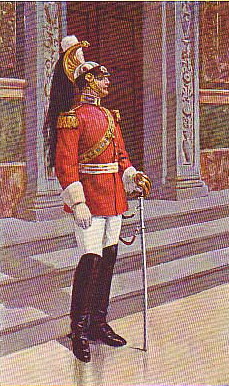
Dress uniform of a Garde Noble della Vaticano

The Noble Guard (Italian: Guardia Nobile) was one of the household guard units serving the Pope. It was formed by Pope Pius VII in 1801 as a regiment of heavy cavalry. Conceived as the Pope’s personal guard, the unit provided a mounted escort for the Pope when he moved about Rome in his carriage and mounted guard outside his apartments in the papal palaces. The guardsmen were also available for special missions within the Papal States at the behest of the pope. One of their first major duties was to escort Pius VII to Paris for the coronation of Napoleon Bonaparte. Exclusively a palace guard, the Noble Guard saw no active military service or combat during the several military campaigns that engaged the Papal States between 1801 and 1870. With the unification of Italy and the abolition of the Papal States in 1870, the Noble Guard restricted its activity to the buildings and grounds of the Vatican. Though nominally still a cavalry unit, the unit had little opportunity to deploy on horseback in the limited confines of the Vatican, although two mounted troopers would accompany the papal carriage when the Pope was driven around the Vatican gardens. In 1904 mounted service was abolished entirely and the last horses were sold off. Originally armed with carbines, pistols and sabers, after 1870 the guardsmen carried only a saber.

The corps was always a volunteer one – its members were not paid for their service, although they received an allowance for their uniforms. Recruits were drawn from noble families in Rome, although in the twentieth century requirements were relaxed in practice to allow nobility from other regions of Italy to join the corps. The commander of the corps was called the Captain. One of the subordinate positions within the corps was that of Hereditary Standard-Bearer, who was responsible for carrying the standard of the Catholic Church.

After 1870, the Noble Guard, now reduced to a force of fewer than 70 men, performed mainly ceremonial duties as an honor guard. Guardsmen most commonly appeared in public when the pope presided over ceremonies in Saint Peter’s Basilica. When the pope was carried in the sedia gestatoria, Noble Guards walked alongside the papal chair. During the hours reserved for papal audiences, guardsmen also stood in the antechamber of the papal apartments and, on formal occasions, on either side of the papal throne. During the Second World War, the Noble Guard shared responsibility with the Swiss Guard for the personal security of Pope Pius XII. For the first time since 1870 pistols were issued to duty personnel. Throughout the war, Noble Guards mounted guard outside the papal apartment night and day and guardsmen followed Pius XII when he took his daily walks in the Vatican Gardens.

The guard was abolished by Pope Paul VI in 1970 as part of the reforms of the Church following Vatican II.