MEATH COUNTY ELECTION.—RETURN OF MR. O’CONNELL. —TRIM, FRIDAY [9th July], Four o’Clock P.M.—Daniel O’ConnelI, Esq., has just been returned for this county, in conjunction with Mr. Grattan. Mr. Corbally retired, in order to give the seat to Mr. O’Connell, in the event of Tory corruption defeating him in Dublin. [O’Connell was also returned for County Cork and chose to sit for Cork]. Both Grattan and O’Connell were Repealers. At the subsequent by-election Matthew Corbally was elected unopposed as a Whig. He had previously been the M.P. briefly after Morgan O’Connell’s retirement in 1840.
The above text was found on p.6, 17th July 1841 in “The Tablet: The International Catholic News Weekly.” Reproduced with kind permission of the Publisher. The Tablet can be found at http://www.thetablet.co.uk .
The text below is taken from the Spectator also on 17th July 1841. Both papers took a strongly anti-Tory stance.
MEATH. Mr. Corbally has retired, to make way for Mr. O’Connell ; who, with Mr. Henry Grattan, was returned without opposition on Friday ; being proposed by Mr. Corbally himself.
The Times on the 20th July reported things rather differently. It was fiercely pro-Tory, and very anti-Whig, anti-Catholic, and very anti-Daniel O’Connell.
DUBLIN, JULY 18, ELECTION INTELLIGENCE
MEATH
It is said that Mr. Corbaly, who was so unceremoniously kicked out of the representation of this county to make room for the great rejected of Dublin, actually had a large party engaged for dinner at Corbalton Hall to celebrate his re-election for Meath, and when the fatal tidings arrived that he was to be thrown overboard, he expressed his indignation against Mr. O’Connell inno very measured terms, personal chastisement being more than hinted at. Mr. Henry Grattan too, fumes and flusters at the insult put on the men of Meath by Mr. O’Connell in first accepting the seat merely as a warming-pan tiIl his election for Cork county was secured then scurvily giving the go-by to the sheep ticklers, and, said Mr. Henry Grattan, inflicting at the same time the additional blow of leaving the county but half represented at the opening of Parliament.
Morgan O’Connell (1804 – 1885) who was Daniel O’Connell’s second son had been M.P. for Meath between 1832 and 1840. Morgan purchased a commission in Simon Bolivar’s Irish Legion even though he was only 15 years old. He survived that, and during his return home in 1821 caught tropical fever, got shipwrecked twice. He was still only seventeen when he returned. On his return his father said ” His South American adventure had made a man of him. Otherwise, it would have been difficult to tame him down to the sobriety of business.”
Morgan fought a duel with Lord Alvanley, on his father’s behalf, on 4 May 1835 at Chalk Farm. Daniel O’Connell had vowed in 1816 never to fight a duel again. He had killed John D’Esterre in a duel in February 1815, which didn’t prevent him almost immediately trying to fight a duel with Sir Robert Peel. But by 1816 he had seen the error of his ways. Morgan was challenged to a duel by Benjamin Disraeli in December 1835 following astonishingly anti-semitic abuse of Disraeli by Dan, but refused.
OUTRAGE AT WATERFORD.—ELEVEN PERSONS SHOT.—On Thursday evening, [July 8] about nine o’clock, a crowd of children assembled in the Manor, and were shouting, “Down with the Tories !” “Wyse and Barron for ever !” with several exclamations of a like nature, when a monster, named Morgan, who resides in Henry-street, opened his door, and deliberately fired a pistol, loaded with balls or slugs, on the young and innocent creatures ; he then reloaded and fired again, then shut his door, and fired a third shot from his window. He succeeded in his deadly purpose. Will it be credited, he wounded eleven defenceless children, three of whom are not expected to recover ? Some boys, indignant at this horrid and brutal outrage, assailed the residence of this wretched and blood-stained man, and broke the windows in front of his house, but they were stopped by a few discreet neighbours. The police conducted the prisoner in perfect safety to the mayor’s office. The following named wounded persons (all being under the age of eighteen) sat at the side bar :—Johanna Heneberry, Alice Foley, Mary Doyle, Alice Keating, Michael Kelly, and Martin Magrath. Some of the other persons wounded were sent to the Leper Hospital, and others are in so dangerous a situation that they cannot be removed. Among the latter are a son of Mr. Thomas Torpey, a little girl named Mountain, and a boy named Quilty. About half past ten the prisoner Morgan was brought forward, when the mayor read the depositions of some of the wounded people, charging the prisoner with having fired two pistol shots. The mayor said he should commit the prisoner, and would not take bail. Since writing the above, we have heard that the child named Mountain has died of her wounds. Morgan is fully committed. – Abridged from the Waterford Chronicle.
WATERFORD (CITY).—SECOND DAY’S POLL, July 8.—The Conservatives started a fourth candidate this morning,—W. Morris Reade, Esq. The following is the close of the poll at five minutes past six o’clock p.m. :—Barron (R), 193; Wyse (R), 192; Christmas (T), 127; Reade (T), 111. Electors have been objected to on both sides as having registered out of house and premises, instead of house or premises; but the same objection having been raised at Dublin the assessor here has determined to be governed by the decision which shall be come to in the metropolis on the subject. —TEN O’CLOCK, P.M.—Four children have been severely wounded by a Conservative and his son, who fired pistol-shots and a blunderbuss laden with slugs on an unarmed mob. The perpetrators of this brutal act are in prison. Another man was stabbed by a man in the arm with a dagger, and two of the police wounded by the same instrument.
The above text was found on p.6, 17th July 1841 in “The Tablet: The International Catholic News Weekly.” Reproduced with kind permission of the Publisher. The Tablet can be found at http://www.thetablet.co.uk .
The text below is taken from the Spectator also on 17th July 1841. Both papers took a strongly anti-Tory stance.
WATERFORD CITY. Mr. [Thomas] Wyse and Mr. [Henry] Barron retired before the close of the poll, on Monday ; when Mr. [William] Christmas and Mr. [William Morris] Reade were declared duly elected. The contest was disgraced by savage riots. In the course of it, one Morgan fired a pistol, in self-defence, say the Tories ; but the persons he shot were boys and girls, eleven in number. One of them died, and Morgan was committed at the Police-office for trial. The Sheriff was thrown down and trampled on ; and four houses were “wrecked”; one of them being “literally torn down by the mob.”
Barron and Wyse having been defeated by the two Conservatives in 1841, were reseated on petition the following year.
Sir Thomas Wyse KCB (1791 – 1862), one of the ultimately successful M.P.’s probably bears more study. He was a Catholic and educated at Stonyhurst, and Trinity College, Dublin. The family were Anglo-Irish having arrived in the C12th during the reign of Henry II. He married Princess Letizia Bonaparte [Napoléon’s niece] in Italy in 1821, when he was 30 and she was 16. The marriage seemed to be fairly rocky. After an especially violent fight in 1824, she fled to a convent and asked for a separation. Eight months later, when Wyse threatened to leave Italy without her, she submitted to him, and travelled to Ireland with him. The arguments continued, and in May 1828 they agreed to a separation. Letizia threw herself into the Serpentine in Hyde Park in a suicide attempt and was rescued by Captain Studholme John Hodgson (1805–1890), who became her lover. They had three children who all used the surname Bonaparte-Wyse.
This is part of a series of posts about the 1841 election rather specifically from an Irish perspective. At the time the letter was written Daniel O’Connell was standing for election as an M.P. in Dublin City. Things changed six days later. “Roche and Barry” are Edmond Burke Roche, and Garrett Standish Barry. Barry was the first Catholic MP elected to represent Cork County after the Catholic Emancipation Act of 1829, and was elected in 1832. Roche was elected in 1837. Edmond Burke Roche also has the distinction of being Prince Harry’s great, great, great grandfather.
TO THE ELECTORS OF THE COUNTY OF CORK.
Dublin, 6th July, 1841.
” Who would be free, themselves must strike the blow ?”
Fellow-Countrymen,
We have arrived at the most important crisis in the affairs of Ireland. The liberty and the religion of the Irish people are at stake. The question is, whether the Orange miscreants, who have so long plundered our country, and persecuted our people, are to trample upon us again—to outrage our venerated clergy, and to inflict the virulent hostility of their blasphemous scurrility upon the most sacred rites of the Catholic religion.
I am convinced that not one liberal Protestant in the county of Cork will refuse to vote for Roche and Barry. I am convinced that not one Catholic will vote against Roche and Barry. In fact, the Catholic who does not vote for Roche and Barry is a traitor to his country, and a renegade to his religion.
Remember, my friends, that the exterminators have openly avowed themselves. And, although, as in this city, they have felt it prudent to qualify the bitterness of their hostility to the Catholics, yet their designs of destruction are sufficiently manifest, even from the equivocal language which they now choose to employ, instead of an open declaration of vengeance.
There is no scheme too vile — no misrepresentation too atrocious — no cunning trick too dirty or too false — for the Orange Tories of your county to make use of, in order to delude or deceive the people to their own destruction.
Amongst other dirty tricks, the Orange faction in your county have asserted that the ministerial plan on the subject of the cornlaws would be injurious to the farmers. I wish you to understand this subject as well as I do. The ministerial plan which Mr. Roche supports, and which I support, is a fixed duty of eight shillings per quarter upon wheat ; and so in proportion upon other grain.
Now, attend to me, I beg of you, my fellow-countrymen. You know me I never deceived you nor any of you : and I tell you distinctly and emphatically, that of all the plans respecting the cornlaws, the ministerial plan of a fixed duty, which both Roche and Barry will support, is the very best for the farmer ! It is so for this reason ; that at present, rents are charged upon the farmers according to the highest prices that corn can bring ; and a speculation takes place respecting rents, in which, as you well know, the landlords have always the best of it.
The fixed duty gives, on the contrary, a fixed and steady rule of price for corn, and therefore a fixed criterion for rent ; thus giving to the farmer the surplus profits when the corn produces a price higher than in ordinary years..
I am bound to add, that after having investigated this subject with all the care and attention due to it from me, whose great object is the good of all the people—the good of the farmers when it varies from that of the aristocracy or landlords, I am thoroughly and conscientiously convinced that the best plan for all the farmers would be the total abolition of the corn-laws.
But that is not the question at present. The present question lies altogether between the plan of a sliding scale of corn duties and the plan of a fixed duty. This latter is the plan which Lord John Russell and his friends—including Messrs. Barry and Roche—will support.
Remember, my dear friends, that I, who, by counselling the people right, extorted emancipation, and put down Protestant ascendancy, in despite of the Orange aristocrats and landlords, who would now deceive and delude you on the subject of the corn-laws—remember, I say, that I, whom you have honoured with the name of the Liberator,—remember, that I tell you that the plan of a fixed duty, which both Roche and Barry support, is infinitely preferable for the farmers, than the sliding and slippery scale with which Leader and the Orange landlords endeavour to gull and deceive you.
As to Leader [Nicholas Leader, one of the Tory candidates.] himself, he is by birth and fortune a gentleman. If he remained quiet, nobody would refuse to admit him to be such. But in politics he is a shabby and despicable fellow. I knew him when he commenced his political career, and he came out not only a Liberal but really as a Radical ; and he is now endeavouring to represent the county of Cork at the head of all the Orange enemies of the people. Say to him, honest men of the county of Cork, “Shame upon thee, Leader! Shame, where is thy blush?”
Whoever votes for Leader, or for any man of his principles, votes for the extermination of Catholicity ; for the Orange Tories—for the haters of Ireland and the Irish—for the revilers of our clergy—for the blasphemers of our religion Those who refuse to vote for Barry and Roche are equally despicable traitors. They are to be loathed and shunned by every honest man.
Those who vote for Barry and Roche vote for the Queen and her ministers ;—for old Ireland and freedom;—for religion and liberty.
Recollect that the faction to which Leader has now attached himself is that which, by the most atrocious treachery, enacted the penal laws against the Catholics ; which set the same price—that is, £5.—upon the head of a wolf and the head of a priest ; which proscribed Catholic education ; which would still employ education for the purposes of trickery and exclusive proselytism.
Leader’s faction is the faction that has proclaimed in the city of Dublin the uprooting of Catholicity ; which seeks the restoration of Protestant ascendancy and Orange domination.
Leader’s faction call your priests ” surpliced ruffians “ and ” anointed vagabonds.”
Leader’s faction call the holy sacrifice of the mass ” mummery.” They call the Catholic religion an “abject superstition” and a “vile idolatry.”
Liberal Protestants of the county of Cork—and you especially, Catholic electors—shall there be found amongst you any man so thoroughly a traitor and a renegade as to give a single vote to Leader, or to the faction to which he belongs ?
Will any of you refuse to vote against the Orange faction, and in favour of my excellent and beloved friend, Edmund Roche, and of his esteemed colleague, Standish Barry ?
Let every man, then, who confides in me, who is ready to take my honest advice—let every liberal Protestant, and let every conscientious Catholic, vote for the religious liberty of Old Ireland.
That is let him record his vote for Roche and Barry.
I am, beloved countrymen, your faithful and devoted servant,
This post is largely to put some context into a series of posts that will follow about the election in Ireland in 1841. The total Irish electorate of almost 50,000 [from a population of 6.5m] and 50% larger than the combined Scottish and Welsh electorate [26,500 and 7,700 respectively]. All were dwarfed by an English electorate of just over 500,000. All in all, the total electorate was 584,200 men.
Sir Robert Peel
The election of 1841 brought Sir Robert Peel to power for the second time, though his first term as Prime Minister had lasted only four months as the head of a minority government. It is regarded as having been one of the most corrupt elections in British parliamentary history, the Westminster Review stating that the “annals of parliamentary warfare contained no page more stained with the foulness of corruption and falsehood than that which relates the history of the general election in the year 1841”. 2016 -2018 are running it close.
Only 3.17% of the total population voted.
At the election, there was a swing of 2.6% to the Conservatives giving them a majority of 76 seats over the combined opposition [367 to 291 – Whig 271, Irish Repeal Party 20]. The Tories campaigned mainly on the issue of Peel’s leadership, whilst the Whigs were largely tinkering with the Corn Laws, proposing replacing the existing sliding scale of import duties on corn with a uniform rate. The Corn Laws made it expensive to import grain from other countries, even when food supplies were short. The laws were supported mainly by landowners, both Tory and Whig, and opposed by urban industrialists and workers.
There was also the issue of electoral reform again, with a substantial view that the Reform Act of 1832 hadn’t gone far enough. The Whigs were largely a landowning aristocratic party, though in favour of reducing the power of the Crown and increasing the power of Parliament. [i.e. Their own power through the House of Lords] They were slowly evolving into the Liberal Party, which was essentially a coalition of Whigs, free trade Tory Peelites, and free trade Radicals. A move not fully complete until 1868.
1841 was curious in so far as even radical [English] support favoured the Tories, it being felt that Peel would be more open to electoral reform. Radical opinion also appeared to favour the business background of Peel and his supporters to the aristocratic and landed background of the Whigs.
Daniel O’Connell
The Whigs also lost votes to the Irish Repeal group who they had an electoral pact with between 1835 and the 1841 election. The Repeal Association was an Irish mass membership political movement set up by Daniel O’Connell in 1830 to campaign for a repeal of the Acts of Union of 1800 between Great Britain and Ireland. The Association’s aim was to revert Ireland to the constitutional position briefly achieved in the 1780s, legislative independence under the British Crown – but this time with full Catholic involvement, but there was still a substantial property qualification. The total Irish electorate was 50,000 men from a population of 6.5m.
The Irish election was partisan, sectarian, and violent. It also had a distinct geographical split with the Tories receiving most support in Ulster, and some eastern counties, as well as pushing through a fraudulent poll in Dublin. There was also substantial anti-Catholic opinion within the Tory party. It is all very multi-layered, and there are some subtle gradations to be navigated. In Ireland it is safe to say being on Daniel O’Connell’s side is probably walking with the [moderate middle class] angels.
My great-grandfather’s first father-in-law [he, G G’pa, married twice] was a George Hopkins. He appears to have been transported to Australia in about 1847. There seem to be a few George Hopkins who show up with criminal records, and probably aren’t all the same person. This may well be the right George – there’s about six years difference between his age here, and the 1841 census – but that census rounded up people’s ages by five years for some bizarre reason. But he’s an entertainingly bad boy. This one was prosecuted at the Old Bailey in 1815, and sent to Newgate prison [1 year, and a whipping]
JOHN BENNET, GEORGE HOPKINS. Theft: grand larceny. 15th February 1815
JOHN BENNET and GEORGE HOPKINS were indicted for feloniously stealing, on the 15th of January, three pints of brandy, value 4 s.[£181.50] a pint of rum, value 3 s.[£136.10] a quart of geneva [gin], value 4 s.[£181.50] two quarts of wine, value 6 s. [£272.20] eight bottles, value 1 s. 4 d. [£60.79] the property of Christopher Smith, esq. Newman Smith , and William Petter Woodhouse , and a basket, value 1 s. [£45.37] the property of John Adnam. [ The total value was 19s.4d., or a modern-day equivalent of £877.40 ]
GEORGE WHEATLEY. I am night constable.
Q. On the evening of Sunday the 15th of Januuary, where were you?
A. I was in Union Street; I saw the prisoner John Bennet in Union Street, with this basket in his hand, and the contents, except this bottle. It was between the hours of seven and eight. I asked him what he had got there, he did not give me a satisfactory account; he asked me what it was to me. I asked him to go into some public-house with me to give me a satisfactory account; I got him to a public-house door, he put the basket down. The prisoner Hopkins then came up, and while we were talking, the prisoner Hopkins took up the basket, and run away; I had got hold of Bennet. Hopkins came by, and got hold of the basket; he ran about twenty-yards; I stopped him with the basket.
THOMAS CHILDS . I am constable of St. Saviours. I was at Union Hall when the prisoners were brought there, on Sunday, the 15th of January, I went to the watchhouse; I asked them where they lived; Bennet told me 223, Kent-street; they both lived together in one room; I found a pint bottle of brandy in a hamper; I found a letter in Hopkins’s box, in that letter was
“send me a bottle of brandy for the old man, for he has nothing to drink but small beer.”
WILLIAM PETTER WOODHOUSE . The names of the firm are Christopher Smith , Newman Smith, and William Petter Woodhouse ; we are wine and spirit merchants , Queen-street, in the City of London. The two prisoners were porters in our house; they were employed in the warehouse and the cellars. There are two pint bottles of brandy, one quart bottle of brandy, a quart of rum, and three of port wine; I can identify the bottle of brandy with the name on it, of which a pipe of wine was sent in our cart; this bottle is a sample of the pipe of wine; it appears to have been emptied and filled with brandy; I have every reason to believe it is all our property; we sent the pipe in the cart; the sample we keep ourselves as a check to the carrier, least there should be any change or alteration in the journey. The prisoners had full employment at our house from seven o’clock in the morning until eight at night.
Q. What is the value of each?
A. About five shillings the quart, about half a crown the pint. I know this bottle to be our property.
The prisoners called four witnesses, who gave them a good character.
BENNET, GUILTY , aged 24.
HOPKINS, GUILTY , aged 22.
Confined one Year , and whipped in Jail .
London Jury, before Mr. Common Serjeant.
Old Bailey Proceedings Online (www.oldbaileyonline.org, version 8.0, 18 July 2018), February 1815, trial of JOHN BENNET GEORGE HOPKINS (t18150215-43).
My great-grandfather’s first father-in-law [he, G G’pa, married twice] was a George Hopkins. He appears to have been transported to Australia in about 1847. There seem to be a few George Hopkins who show up with criminal records, and probably aren’t all the same person. This probably isn’t the right George – he seems to be about eleven years too young. But he’s an entertainingly bad boy. This one was prosecuted at the Old Bailey twice in 1821, the second time when he was already in Newgate prison [3 months, and a whipping] and then this.
George Hopkins. Theft: Grand Larceny. 5th April 1827
GEORGE HOPKINS was indicted for stealing, on the 2nd of April , 50lbs. weight of cheese, value 3l. 10s.,[modern-day value £ 4,052] the goods of Charles Beach .
WILLIAM KLING . On the 2nd of April, at half-past nine o’clock at night, I was in my back premises in Oxford-street, and heard two whistles – I opened our back gates and looked out – I saw the prisoner and another man in conversation, and saw a bag by the prisoner’s side – this was about twenty yards from Mr. Beach’s house – I stood still – the other man then left the prisoner and met a man who was coming down the mews, which my gates open into – that man lifted the bag on the prisoner’s back – I followed them to No. 28, Parry’s-court; they gave three knocks at the door – the prisoner was taken there in about an hour and a half, and the bag and cheese found in his room.
Cross-examined by Mr. BARRY.
Q. You did not see the cheese brought from Beach’s house?
A. No.
CHARLES BEACH. I am an oilman, and deal in cheese , and live in North Audley-street . On the 2nd of April, about half-past nine o’clock, I left the shop for half an hour – the Parmasan cheese was in its usual place – Kling came to me – I then looked and missed the cheese – there are 50lbs. – it cost me 18d. a pound.
Cross-examined.
Q. Where was it?
A. On a tonguetray at my door – mine is a corner house; it was not in a bag – I can swear to the cut of it, and it is eaten by rats in one place.
Prisoner’s Defence. I was coming from my father’s, who is coachman to Mr. Hanbury – a gentleman came and and asked me to carry the parcel, which I did – I did not know what was in it; the man asked if he could leave it at my room till Monday, as he was going into Surrey.
GUILTY . Aged 23. Transported for Seven Years .
Reference Number: T 18270405-213
Verdict: Guilty
Sentence: Transportation
From: Old Bailey Proceedings Online (www.oldbaileyonline.org, version 8.0, 18 July 2018), April 1827, trial of GEORGE HOPKINS (t18270405-213).
This was originally posted on May 7, 2016 as ” Hurrah hurrah, I’ve found a convict………..” However as it is almost 200 years to the day that it happened, I think it is due a re-post.
This one gives me almost unadulterated joy. The only similar one was finding good old JROB mistreating his niece Pauline Roche in such a textbook Victorian villain manner that it would have been rejected by a publisher. If you haven’t seen it yet use the link on her name.
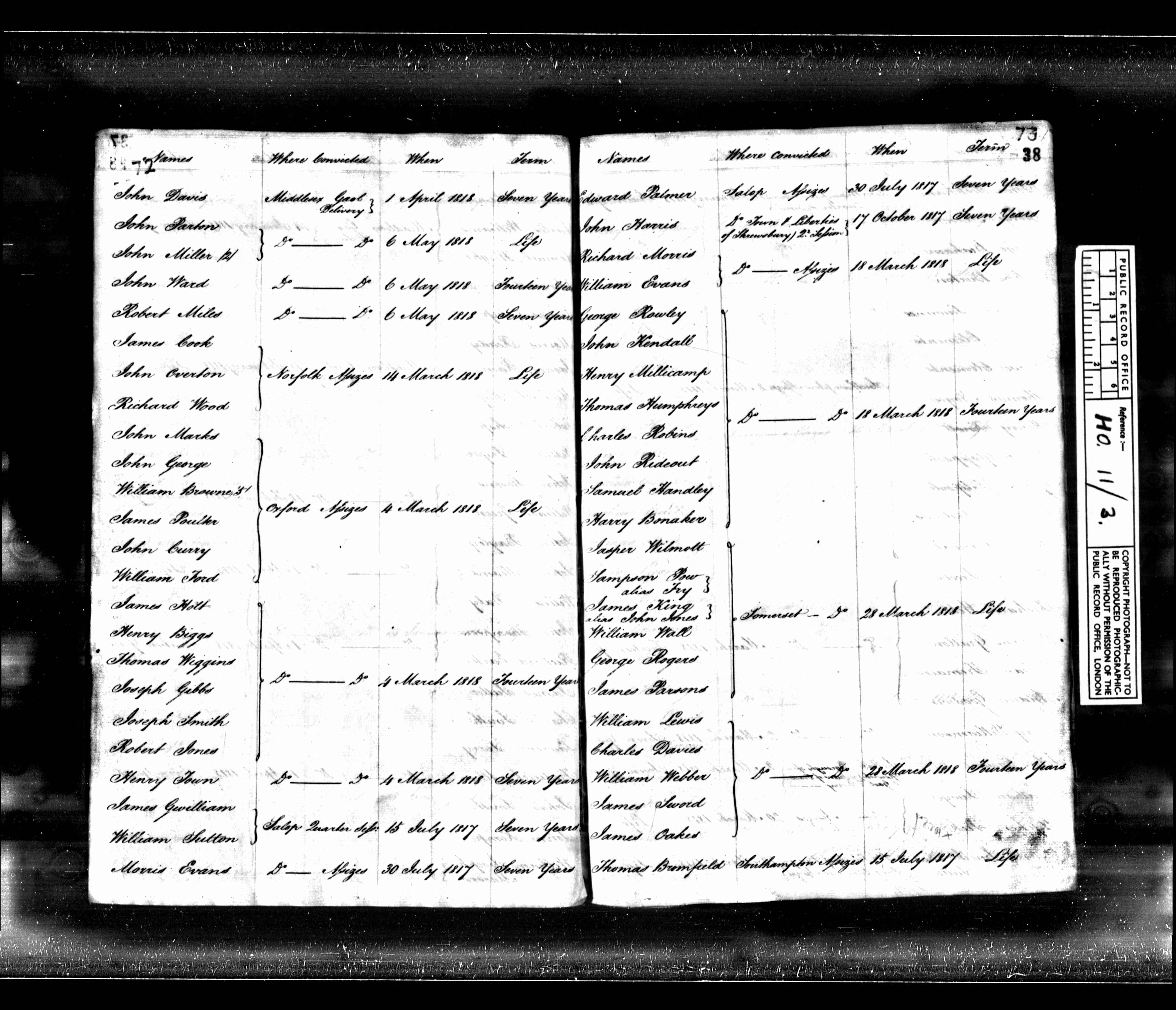
Robert Miles, born about 1798, was tried at the Old Bailey on the 6th of May 1818. He was found guilty of Larceny, and sentenced to seven years transportation. He was sent to New South Wales, on board the General Stuart leaving in July 1818. He was 20 years old, and according to the notes in the court register “an old offender”, so presumably it wasn’t a first offence. He is Esther Penn’s great-grandfather. He seems to have returned as soon as the sentence was up, and married in Tottenham in July 1826, eight years after the sentence.
So basically, he is a Norf London bad boy who got in a bit of bother with some laundry. Not quite the Dandy Highwayman……….or is he??
This is the court transcript from www.oldbaileyonline.org.
ROBERT MILES was indicted for stealing, on the 23d of April , one trunk, value 2s.; 18 shirts, value 5l.; 21 cravats, value 20s.; 20 pair of stockings, value 23s.; 15 handkerchiefs, value 10s.; two night-caps, value 1s.; six shifts, value 2l.; four sheets, value 10s.; eight table-cloths, value 2l.; three pillow-cases, value 3s., and two towels, value 2s. , the goods of George Woodfall . A total of £ 12. 11s. Aproximately £15,140.00 in today’s money.
So maybe bad boy Bobby was on to something. Anyway back to the trial.
SECOND COUNT, the same, only stating them to be the property of William Rance
MARY BERRYMAN. I am laundress to Mr. George Woodfall , who lives at Shepperton. On the 23d of April I sent a box, containing the articles stated in the indictment, to town. I delivered it to Rance, to take to Great Dean’s-yard, Westminster.
WILLIAM RANCE. I am a carrier from Chertsey to London. I received the box from Berryman, and brought it safe to the White Horse, in Friday-street , on Thursday night, the 23d of April. I did not unload the waggon until next morning. I do not know what became of it.
CHARLES STARK . I am servant to Rance. About half-past nine o’clock at night, I got into the waggon at the White Horse, and fell over the box; it laid on the chaff that I wanted for the horses – I left it safe in the waggon.
JOHN TILLEY . I am a watchman of Whitechapel. On the 23d of April, about a quarter past ten o’clock at night, I came up with three men in French-street – each of them had a bundle; I attacked the last man, he dropped his bundle and escaped-the other two turned the corner. I sprang my rattle and pursued, calling Stop thief! I picked up another bundle at the corner of Halifax-street, the prisoner was taken in Halifax-street. He is not the man who escaped.
JOHN COKELEY. I am a watchman of Spitalfields, which joins Whitechapel. I heard the rattle sprung, went to the corner of Halifax-street, and saw the prisoner with a bundle; he laid it down on a step. I pursued, calling Stop thief! A man who stood at a door, stopped him – He did not run above ten yards, and was not out of my sight. I am sure he is the man.
JOHN WILSON . I am a carpenter. I came out, hearing the alarm, and heard some person running on the other side of the way; I crossed over, and collared the prisoner, the watchman came to my assistance. On going along Osborn-street he was rescued from us. I took him again, and am sure he is the man. I put him in the watch-house.
RICHARD PLUNKETT . I am a beadle. The prisoner and property were delivered to me at the watch-house.
Prisoner’s Defence. I was passing and the man caught me.
The second half of the C19th seemed to spawn quite a flourishing industry in genealogy, both as a matter of research, and record, i.e. Burke’s Peerage, Burke’s Landed Gentry etc, as well as privately published family histories. There are quite a number of them, almost always complied and written by men. The quality varies hugely, some are well researched, and provide additional information to respectable sources such as Burke, or John O’Hart. Others range from the camp, and preposterous [Skeffington Gibbon] to meticulously compiled from written Quaker records [Norman Penney].The following is extracted from
“ Some Account of the early history and genealogy with pedigrees from 1330 unbroken to the present time of the families of Hoar and Hoare with all their branches: interspersed throughout with anecdotes and incidents in the lives of the principal persons mentioned.” Complied by Edward Hoare. Esq. Late Captain of the North Cork Rifles, and of Factory Hill, County of Cork.London, Alfred Russell Smith, 36 Soho Square. 1883.
The book itself is incredibly hard work because Edward Hoare provides the information, and anecdotes, under each individual, but links them via a family tree structure that is spread over 94 pages. It means you quite often find three generations of different branches of the family on the same page, and it requires going backwards and forwards to see how people are related.
Edward Hoare’s book falls somewhere in the middle of the range from camp to meticulous. He definitely has an axe to grind, and some scores to settle. He is incredibly keen to prove his noble lineage “I am entitled to quarter over one hundred coats of arms” etc, fairly disapproving of his grandfather, keen to mention two [rather distant] earls in the family, he’s the great, great, great grandson of one, and the great, great, great nephew of another, who is a complete wrong’un. He also absolutely hates his brother, and to quote Tom Leher on Oedipus “he really loved his mother.” Finally, he is remarkably anti-Catholic. An example of which are his comments on his third cousin, John William Deane Hoare: ” In Holy Orders. Curate of Saint Alban’s Church, Rochdale, in Lancashire; afterwards Vicar of Saint Philip’s Church, Sydenham, Kent. Has lately become a Roman Catholic, and a Priest of that Popish and idolatrous Church ! So much for High Church and Ritualism, with perhaps the blood of the “Donoghues ” in addition.”. The Donoghues were John William’s mother’s family, and give every impression of being a fairly respectable family. JW’s father was the [Church of Ireland] Dean of Waterford, and his mother was buried in Waterford Cathedral.
To place him in the story, this Edward Hoare is a second cousin, once removed of Louisa Grace O’Bryen [neé Hoare, a great-aunt x3, who married Rev. Hewitt O’Bryen.] He is also the 1st cousin 2x removed by marriage of Olivia Guinness [daughter of Arthur]. She [Olivia] is Louisa O’Bryen’s aunt. Finally, John William Deane Hoare is Louisa O’Bryen’s nephew.
Over to Captain Hoare:
Edward Hoare [Capt. Hoare’s grandfather] of Factory Hill, county of Cork.: Baptized at Saint Peter’s Church, Cork, 18th May 1751. In the 13th regiment of Light Dragoons; Cornet 16th August 1770; Lieutenant 12th December 1771; and Captain 16th August 1778; was afterwards Captain in the North Cork County Militia, and engaged in all the encounters with the rebels in 1798 in the county of Wexford, where the regiment lost 60 officers and 106 men; was J. P. for the counties of Leitrim and Roscommon, 28th May 1795, also for the county of Cork; was Deputy-Governor for the county of Cork 20th November 1807. He died at Cullen’s Wood, near Dublin, 22nd Sept. 1831, at the house of his son-in-law, Robert Newenham, aged over 80 years, and is buried at the Moravian Burial Ground, near Dublin, where his wife is also buried. Had 19 children, all christened and baptized, none being twins, but who mostly died young. He spent over £20,000 while in the 13th Light Dragoons, and ruined the property.
He married Martha Tyrrell,daughter of Edward Tyrrell,Esq., of Tyrrelstown, near Gort, county of Galway. Died at Dunville, near Dublin, 20th March 1823, aged over 60 years.
His son- Edward Hoare, Ensign in the North Cork County Militia 21st May 1797 ; Lieutenant 12th Dec. 1799; and Captain 23rd August 1803. J. P. for the county of Cork. Born at Cappavama, in the countyof Galway, 27th April 1782. Died of Asiatic Cholera, at Morrison’s Hotel, Dawson St., Dublin, on 21st August. 1834, and was buried the same day at Saint Kevin’s churchyard, Dublin.
Sir Edward Barry
Joined with his father in his debts, cut off the entails, and sold two portions of the estates to Colonel Gribbings and Warren Hastings Jackson, Esq., in the year 1814. Married, by his cousin, the Reverend Edward Henry Hoare of Limerick, who was also trustee of his marriage settlement, on 15th December 1806, at Saint Anne’s Church, Dublin, to Sophia Barry, second and youngest daughter and coheiress of Robert Barry, Esq., third and youngest son of Sir Edward Barry, first Baronet, Physician and Surgeon- General to the Forces in Ireland (who was M.P. for Charleville borough, county of Cork, 12th March 1743).
Gaulstown House
Robert Barry was a Barrister-at-Law and King’s Counsel, of Hume Street and Merrion Street, Dublin, and of Dalkey, county of Dublin. He was also M.P. for the borough of Charleville, in the county of Cork, 24th April 1761 and 12th July 1768. His first wife was Elizabeth Lyons, eldest daughter and coheiress of Henry Lyons, Esq., of River Lyons in the King’s county, M.P. for that county for a long series of years, and J. P. and Deputy Governor, and who [Henry Lyons] married Anna Rochfort, [these two are Capt. Hoare’s great, great grandparents] youngest daughter of George Rochfort, Esq., of Gaulstown, in the county of Westmeath, M.P. for that county (by his wife the Lady Elizabeth Moore, daughter of Henry Moore, third Earl of Drogheda), and sister of Robert Rochfort, first Earl of Belvedere. [Robert Rochfort accused his wife of adultery with his brother Arthur. Arthur was tried for criminal conversation and fined £2,000. Robert kept Mary locked up in Gaulstown House for the remainder of his life. Mary was locked in a room, and apparently, only released for brief periods and not allowed to converse with the staff or even her children. She also had to apply to Robert for permission to walk the grounds. If she was granted permission after declaring the route, a footman was employed to travel the route ahead, whilst ringing a bell and calling out obscenities about her.][Not necessarily a great, great, great uncle one would proudly mention] Robert Barry married secondly Elizabeth Guillelmine La Touche, only daughter of James Digues La Touche, Esq., of Bellevue, county of Wicklow, but by her had no issue.
Sophia Hoare, my dearest mother (by whom and by her mother also, both coheiresses, I am entitled to quarter over one hundred coats of arms, among them the Royal Arms of the House of Plantagenet). died at Factory Hill 5th March 1823, and was buried at Rathcooney churchyard on the 8th of the same month. She was the best of Mothers and of women; to her, and her alone, I owe everything; and during life I have ever cherished her memory with the purest affection, love, and gratitude.
Their sons:
Edward Hoare. Born at Number 92 (former number) the Grand Parade, Cork city, 29th October 1807. Privately baptized by the Reverend Thomas Newenham. his father’s first cousin. Educated at Trinity College, Dublin. In the North Cork County Rifle Regiment of Militia; Lieutenant 19th January 1846; Captain 11th January 1855. Served with the regiment for over five years on embodied service : retired 21th August 1864. Author of a volume of Poems entitled ‘ Solitary Moments(London : Longmans, 1840). [Available in Google Books, and very basic traditional rhyming poetry] Also of several Antiquarian and Numismatic Works. Is a member of a large number of Literary and Antiquarian Societies, and a contributor to several of the periodicals of the day. The collector and compiler of this volume and Genealogy of the family. Unmarried.
William Barry Hoare. Born at Limerick 14th March 1810. Is a Solicitor and Attorney ; now of Moneens, near Bandon, : in the county of Cork; formerly of Monkstown, county of Cork. The history of the life and career of this exquisite and interesting specimen of humanity is in preparation, far advanced towards completion, and will be shortly published, as a guide and caution to posterity. In the mean time parties interested are requested to examine the Prerogative Office for Wills, Dublin; the Deeds Registry Office ; and the Proceedings of the Irish Court of Chancery, “Hoare v. Hoare,” 1854, 1855, and 1856, for the means and artifices used by this pink of propriety ? fraternity ? honour ? and integrity ? ! ! ! [One can only assume from this that Capt. Hoare felt cheated out of an assumed inheritance. Certainly his brother was wealthy, owning 2,815 acres in county Cork in the 1870’s.]
Married, first, at Glanmire Church, county of Cork, on Easter Tuesday, 28th Mar 1837, Mary Anne Pratt, only child of John Pratt. Esq., of Woburn Place, Cork. She died at Monkstown 30th August 1872. Buried at Douglas churchyard. near Cork. She was 54 years of age. Had issue three sons and three daughters.
Married, secondly, on the 7th August, 1877, at Saint Stephen’s Church, Dublin. Man Anne Hawkes, second wife and widow of Zechariah Cornock Hawkes of Moneens, near Bandon, county of Cork, and daughter of John Hawkes Harris of Cork. She was the aunt-in-law of his first wife (Mary Anne Pratt, whose mother was sister of Z. C. Hawkes), and therefore she is now grand-aunt and stepmother to W. B. Hoare’s daughters.
Talk of a deceased wife’s sister’s connection ! What is it compared with this hitherto unheard-of alliance ? There has been no issue by this second marriage. The Lord be praised! If there had been, it would have been a puzzle for genealogists to describe the relationships ! ! !
The slightly curious reference “stepmother to W. B. Hoare’s daughters” is mainly due to the fact when the book was written only two of William Barry Hoare’s children were still living. Two sons and a daughter had died young, and the eldest son, another Edward Hoare (1838-1870), a Captain in the 5th Regiment of Foot, the Northumberland Fusiliers had committed suicide on the passage from India, by leaping from the cabin window of the ship into the sea, on the 4th January 1870. Both the girls, Frances and Sophia, married soldiers, and both Algernon St. Leger Burrowes, Frances’ husband and Herbert St. George Schomberg, Sophia’s husband ended up as Lieutenant Colonels in the Royal Marines.
The telegraph has brought news of the death of Mgr. O’Bryen, Domestic Prelate of his Holiness, who died two days ago at Montreal. The news has been received with the deepest regret, as Mgr. O’Bryen had passed many years in Rome, and had won universal esteem. Though believed to be suffering from apoplexy, he seemed to be in fairly good health. His death was probably caused by a stroke of apoplexy brought on by the fatigue of his travels in Canada and the United States. Until the donation of the Church of San Silvestro in Capite to the English-speaking people, Mgr. O’Bryen had the spiritual care of all the Catholics of English tongue, and the Church of St. Andrea della Valle, parochial for the Piazza di Spagna and its neighbourhood, was that in which he heard confessions. The English sermons on Sundays during the season, which have been a tradition since the days of Pius VII., were delivered in other churches such as the Gesu e Maria, and one of the twin churches, which adorn the Piazza del Popolo. Before coming to Rome, Mgr. O’Bryen had served on the mission in the diocese of Liverpool.
Sant’Andrea delle Fratte
Sunday November 3, 1895
A solemn Requiem for the repose of the soul of Mgr. O’Bryen was celebrated at the church of St. Andrea delle Fratte on Wednesday last. His Grace the Archbishop of Trebizond, Mgr. Stanley, the Rectors of the English and Scots Colleges, were present. Mgr. Kelly, Rector of the Irish College, sang the Mass.
The above text were found on p.17, 2nd November 1895, and p.16, 10th November 1895, respectively, in “The Tablet: The International Catholic News Weekly.” Reproduced with kind permission of the Publisher. The Tablet can be found at http://www.thetablet.co.uk .
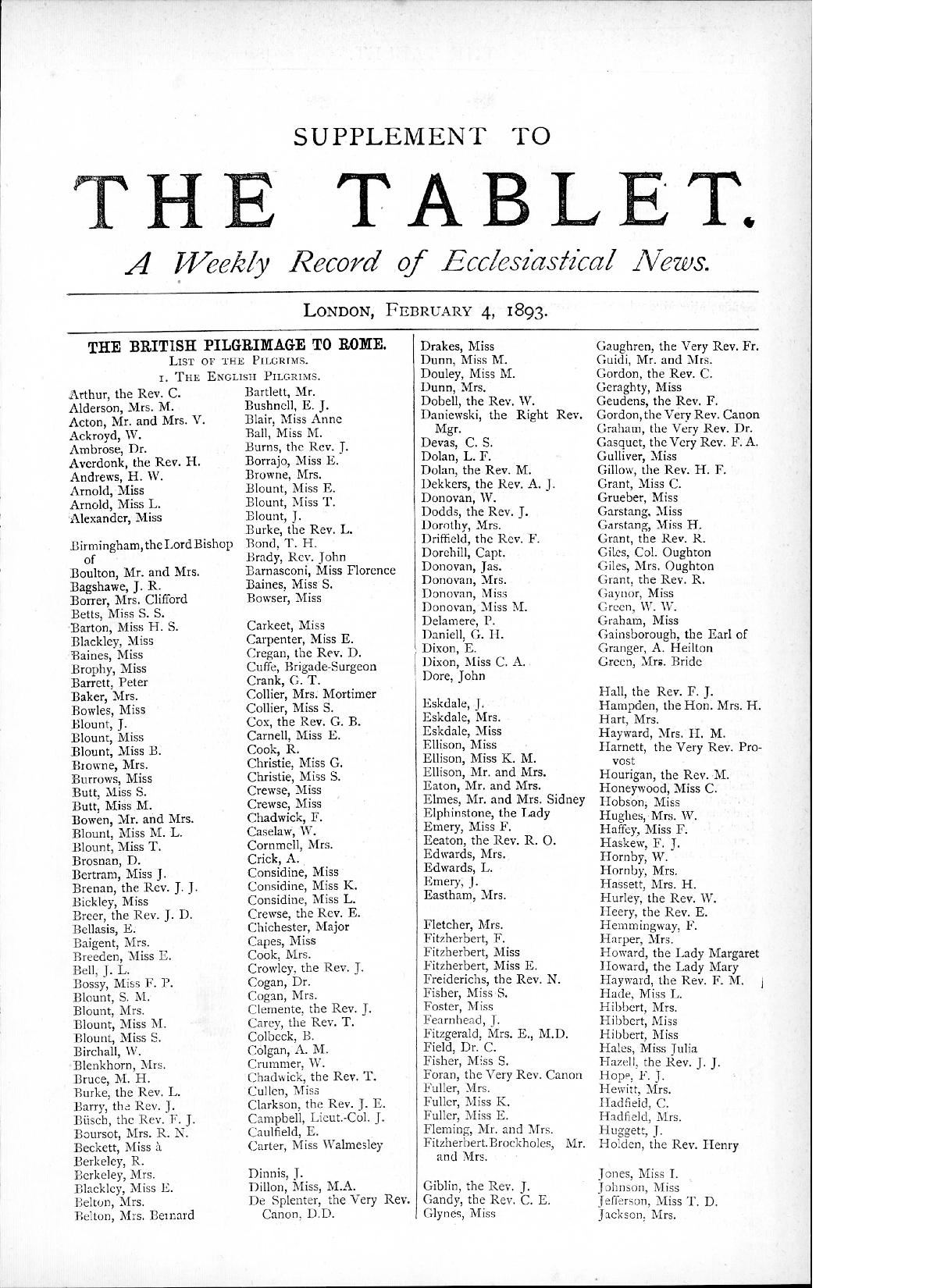
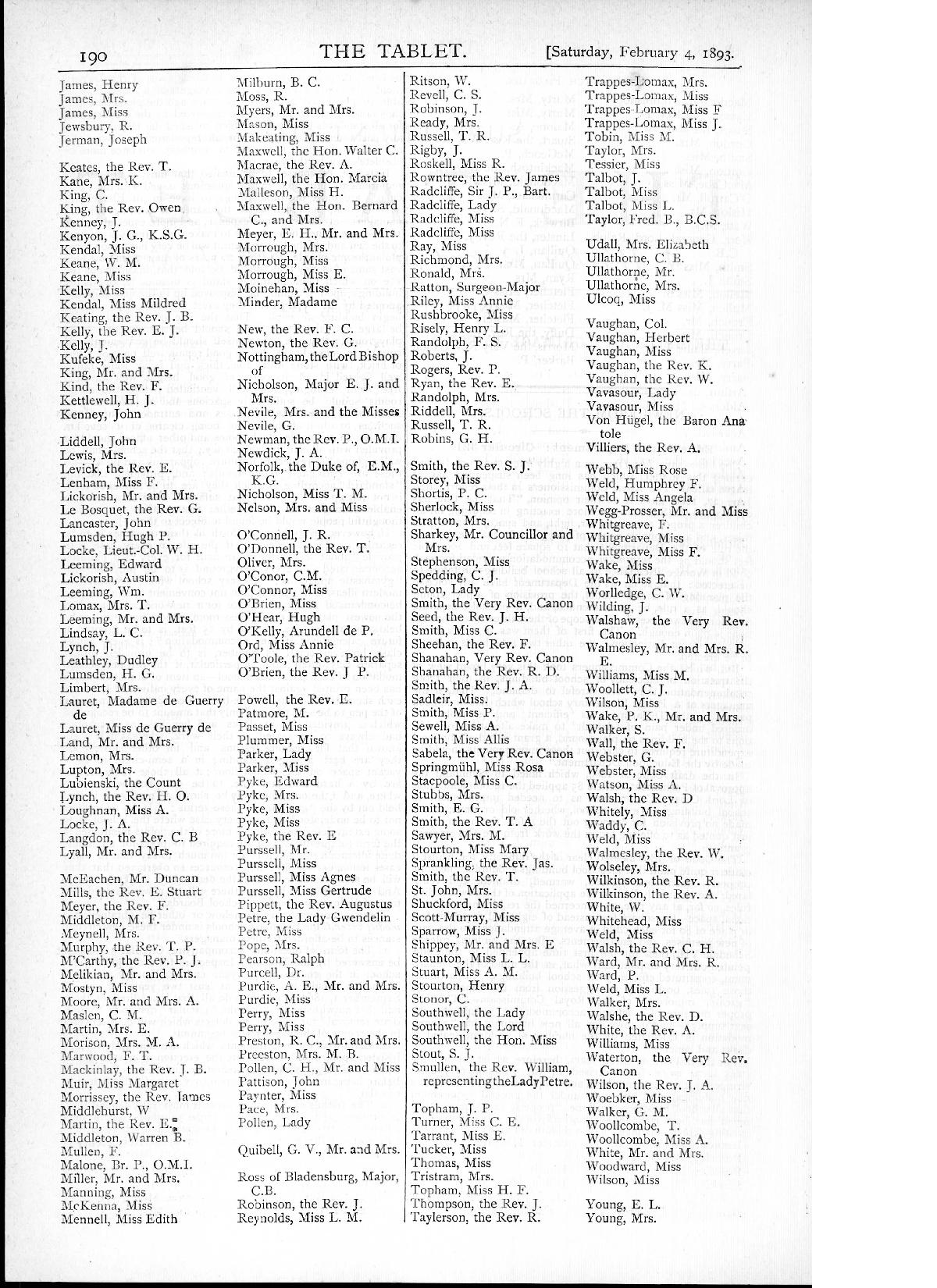
On the 4th of February 1893 the Tablet published a list of approximately 500 English visitors heading to Rome as pilgrims to celebrate the Golden Jubilee of Pope Leo XIII’s consecration as a bishop. Amongst the pilgrims were Alfred Purssell, accompanied by Charlotte, Agnes, and Gertrude Purssell, then in their early twenties. The following text is an article from March describing the pilgrimage
THE RETURN OF THE PILGRIMS.
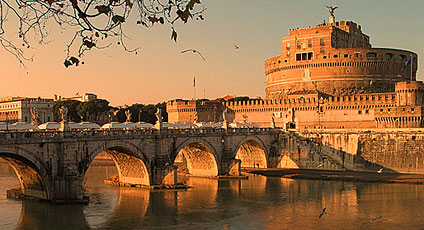
Castel Sant’ Angelo
The great English Pilgrimage of 1893 is over and done with, and is already part and parcel of the indestructible past. Nothing can happen now to mar the perfect success of an enterprise which is safe from all hazard, because treasured away for ever in the memories of all who took part in it. The significance of this public demonstration of British faith and loyalty to the Holy See has been recognized and recorded in Rome for friend and foe, and in all the lands which were represented on that solemn occasion in the Eternal City. It was a time when the courts of the Vatican were thronged with pilgrims from all the earth, eager to do an old man homage ; when Cardinals were busied with splendid and stately ceremonial, acknowledging the courtesies of Kings, and the congratulations of nations, and the gifts of sovereigns—whether Emperors or Republican Chiefs ; but it is doubted whether any single incident during all the Jubilee gave Pope Leo a quicker and livelier sense of gladness than the sudden cheers which broke from 1,300 English and Scotch throats to greet him as he entered the Sala Ducale on Monday week.
Sala Ducale
For those ringing cheers which so astonished the members of the Papal Court, were tuned to the music of sincerity and so touched a chord which went very straight to the heart of the Pontiff. But that little separate incident in its thoroughness and simplicity, was a symbol of the spirit in which the pilgrimage was made. No such band of pilgrims ever left our shores, was so numerous, or so fully representative of the Catholic life of the country. Scarcely a Catholic family of note but was represented directly or indirectly. Following that of the Duke of Norfolk are ranged how many of the old familiar names, some of them of those whose fathers were true through all the trial, and were Catholic from age to age, and some of them of those who will be for ever associated with the coming of the second spring to Catholic England. The history of the Church in this country, whether in recent times or through the days of the penal laws, is inextricably bound up with that of the families represented at the pilgrimage. It is enough to cite in random recollection those of Howard, Clifford, Weld, Feilding, Stourton, Radcliffe, Noel, De Trafford, Townley, Vavasour, Maxwell, Vaughan, Whitgreave, Blount, Cox, Ridell, Hornyhold, Berkeley, Charlton, Southwell, Mostyn, Petre, Stonor, Wegg-Prosser, Dunn, Ward, Wolseley, Herbrt, Walmesley, Weld-Blundell, Ullathorne, Trappes, Lomax, Pollen, Neville, Hibbert, FitzHerbert, Ellison, Chichester, Bellasis, Acton, Arnold, Bagshawe—and other names as well known as these, will occur to the individual reader. But the pilgrims were representative of the future and the present as well as of the past ; as well of those who stand for the new streams of energy and industrial success and modern achievement, as for old family traditions. The accident of circum-stance in other years associated the story of hunted Catholicism with a handful of faithful families, the more vigorous and eager growth of the Church to-day covers a wider field, and depends upon newer homes which circumstances, essentially similar to those which operated of old, are now pressing to the front in the secular struggle of life. It was a happy characteristic of the present pilgrimage that it was a mingling of all classes, of the pro-mise of the future with the survivals of the past. From all parts of Great Britain, and from all sorts and conditions of men were gathered the pilgrims who rightly represented the Catholicism of the land. It was enough that all those widely-sundered hearts were united in their loyalty and love for the Holy See, and one common desire to win from Heaven a blessing upon their native land.
Henry Fitzalan Howard 15th Duke of Norfolk
It is very pleasant to be able to put it on record that the returning pilgrims are loud in their appreciation and praise of the manner in which their wants and comforts were attended to by the Committee of Management, and in their gratitude to every member of it. The Duke of Norfolk, who has accustomed us to the sight of a willing effacement of all personal claims, uses our columns to tender thanks to others, both Englishmen and Italians, for their efforts to make the stay of the pilgrims in Rome pleasant to them.
It hardly needed the friendly importunity of a little crowd of pilgrims to induce us to offer to his Grace the thanks of all the Catholic body for the services and the example he gave. It has been a gracious labour to us to listen to the tale of gratification and pleasure which has come to us from so many pilgrims whose highest hopes have been more than fulfilled. Rome was seen at its best, on a great occasion, by people from all the ends of the earth, but to the British pilgrims it seemed that the Jubilee was in some sort a specially English festival. They were gathered there primarily to do honour and homage to Leo XIII. on the fiftieth anniversary of the day on which he was consecrated a Bishop, but the event, happily synchronized with the creation of an English Cardinal, and the magnificent function at St Peter’s was followed by that in S. Gregorio’s. The words of the Duke of Norfolk happily absolve us from the duty pressed upon us by many of the pilgrims of expressing to Cardinal Vaughan the enthusiastic thankfulness which his kindnesses and attentions have evoked, and we note them only as among the elements which went to secure the unqualified success of the Pilgrimage. Of course there were individual mishaps and disappointments, and, in some cases, privations and hardships to be endured,. but these private mortifications seem to have been suffered in a spirit of cheerfulness and resignation which is eloquent of the spirit which animated the pilgrims. The discomforts of a bad passage across the Channel, of a hurried but far from rapid journey through France and Italy, and difficulties about accommodation in Rome were things naturally to be borne in silence and patience. The fate of the few British pilgrims who in some momentary panic, caused by the cry that forged tickets of admission were being used, were shut out from the great function in St. Peter’s, must have been harder to bear without a murmur.
It was natural to expect that amid the general good humour of the pilgrims some comic incidents should be reported home. Thus much sympathy is expressed for the devout Highland chief who appearing in his national costume in the Corso, was placed under temporary arrest by the Roman police, in what appeared to be the interests of public decorum. The griefs of the Scotchman however, were soon forgotten for the woes of the young lady who, the day after the arrival of the pilgrims, got lost in St. Peter’s, and having forgotten the name of her hotel and speaking only Lancashire, got into an omnibus on the chance that if she saw her abode she might recognize it, and was driven about Rome for several consecutive hours.
Still better authenticated is the fate which befell an Italian who, as the Pope was borne up St. Peter’s, was imprudent enough to shout ” Viva Umberto I.” The creature thought he was insulting only the patient Catholics of the Continent. He was undeceived. A pair of Tipperary arms was round his neck in a moment, for another moment his heels were high in the air, and the next he was stretched flat on the sacred pavement. The crowd was too great to allow him to be put outside the Church, so two devout sons of Tipperary alternately sat and knelt upon him during the remaining hours, of the service. When the Holy Father had again blessed the people and returned to the Vatican, the Italian unharmed but terribly scared, was allowed to escape by his captors who though they caught the word Umberto had been unable to communicate with him.
The reception given by the Duke of Norfolk to the English, Scotch, and Irish pilgrims at the Hotel de Rome will long be a topic of conversation in Rome, and has led the Italian papers to indulge in some very fanciful conjectures as to what it may have cost. Certainly no such crowded reception was ever before held in that spacious hotel. Cardinal Vaughan’s reception at the English College, at which a large number of the Roman aristocracy were present, will also not soon be forgotten. The common bond of religion, for that night at least, was able to obliterate all the barriers of rank and race which men have set between men. Romans and foreigners from the British Isles, idlers and workers, rich and poor, all were there on a footing of Christian equality to do honour and accept the courtesy of the English Cardinal. Our last word before we conclude these recollections of the British pilgrimage is one which we would very willingly linger on. We are able to state that the piety and devotion of the pilgrims from Great Britain, as well as in the heartiness of their congregational singing, have made an excellent and a permanent impression in Rome.
The above text was found on p.5,11th March 1893 in “The Tablet: The International Catholic News Weekly.” Reproduced with kind permission of the Publisher. The Tablet can be found at http://www.thetablet.co.uk .